

 App Store

COIN VALUE GUIDES · DOLLARS
Morgan Silver Dollar Mintage:By Year and Mint, 1878–1921
Find original regular-strike production by date and mint, understand the 1895 exception, and separate mintage from rarity.
 HeriBase TeamPublished
In this article
How many Morgan silver dollars were minted?
Original Morgan dollars were struck in 1878–1904 and again in 1921, across five mints. The table below covers every year and mint for the original regular-strike series, with a separate note for the disputed 1895 Philadelphia production record. Proofs and modern issues from 2021 are outside this table.
The 1893-S has the lowest established regular-issue mintage, 100,000; 1921 Philadelphia has the highest, 44,690,000. Across Philadelphia, Denver and San Francisco, 1921 production reached 86,730,000. These are production counts, not surviving populations or values: melting, stored bags, grade and originality can change availability substantially.
Morgan Silver Dollar Mintage by Year and Mint
Figures below count original regular strikes by coin date and mint. Philadelphia has no mint mark; “P” is only a column label. A dash means no regular Morgan issue for that combination. Proofs, individual die varieties and modern collector issues are excluded.
| Year | Philadelphia (no mark) | New Orleans (O) | San Francisco (S) | Carson City (CC) | Denver (D) |
|---|---|---|---|---|---|
| 1878 | 10,508,800 | — | 9,774,000 | 2,212,000 | — |
| 1879 | 14,806,000 | 2,887,000 | 9,110,000 | 756,000 | — |
| 1880 | 12,600,000 | 5,305,000 | 8,900,000 | 591,000 | — |
| 1881 | 9,163,000 | 5,708,000 | 12,760,000 | 296,000 | — |
| 1882 | 11,100,000 | 6,090,000 | 9,250,000 | 1,133,000 | — |
| 1883 | 12,290,000 | 8,725,000 | 6,250,000 | 1,204,000 | — |
| 1884 | 14,070,000 | 9,730,000 | 3,200,000 | 1,136,000 | — |
| 1885 | 17,787,000 | 9,185,000 | 1,497,000 | 238,000 | — |
| 1886 | 19,963,000 | 10,710,000 | 750,000 | — | — |
| 1887 | 20,290,000 | 11,550,000 | 1,771,000 | — | — |
| 1888 | 19,183,000 | 12,150,000 | 657,000 | — | — |
| 1889 | 21,726,000 | 11,875,000 | 700,000 | 350,000 | — |
| 1890 | 16,802,000 | 10,701,000 | 8,230,373 | 2,309,041 | — |
| 1891 | 8,693,556 | 7,954,529 | 5,296,000 | 1,618,000 | — |
| 1892 | 1,036,000 | 2,744,000 | 1,200,000 | 1,352,000 | — |
| 1893 | 378,000 | 300,000 | 100,000 | 677,000 | — |
| 1894 | 110,000 | 1,723,000 | 1,260,000 | — | — |
| 1895 | See note | 450,000 | 400,000 | — | — |
| 1896 | 9,976,000 | 4,900,000 | 5,000,000 | — | — |
| 1897 | 2,822,000 | 4,004,000 | 5,825,000 | — | — |
| 1898 | 5,884,000 | 4,440,000 | 4,102,000 | — | — |
| 1899 | 330,000 | 12,290,000 | 2,562,000 | — | — |
| 1900 | 8,830,000 | 12,590,000 | 3,540,000 | — | — |
| 1901 | 6,962,000 | 13,320,000 | 2,284,000 | — | — |
| 1902 | 7,994,000 | 8,636,000 | 1,530,000 | — | — |
| 1903 | 4,652,000 | 4,450,000 | 1,241,000 | — | — |
| 1904 | 2,788,000 | 3,720,000 | 2,304,000 | — | — |
| 1921 | 44,690,000 | — | 21,695,000 | — | 20,345,000 |
1895 Philadelphia: Mint records have been cited for 12,000 circulation strikes, but no genuine circulation-strike example is established. The recognized 1895 Philadelphia coins are Proofs, with a recorded mintage of 880. “See note” therefore does not mean an available 12,000-piece regular issue.
1878 Philadelphia: 10,508,800 combines the major regular-strike reverse types. The 7/8-tail-feather varieties are not additional production to add on top. 1880-CC: 591,000 is the whole issue figure used by PCGS and the comparison tables; do not substitute a reverse-type subtotal.
The 1921 row totals 86,730,000 Morgan dollars. It excludes the separate Peace dollar. No original Morgan dollars bear dates from 1905 through 1920.
Read the date and mint as one identity
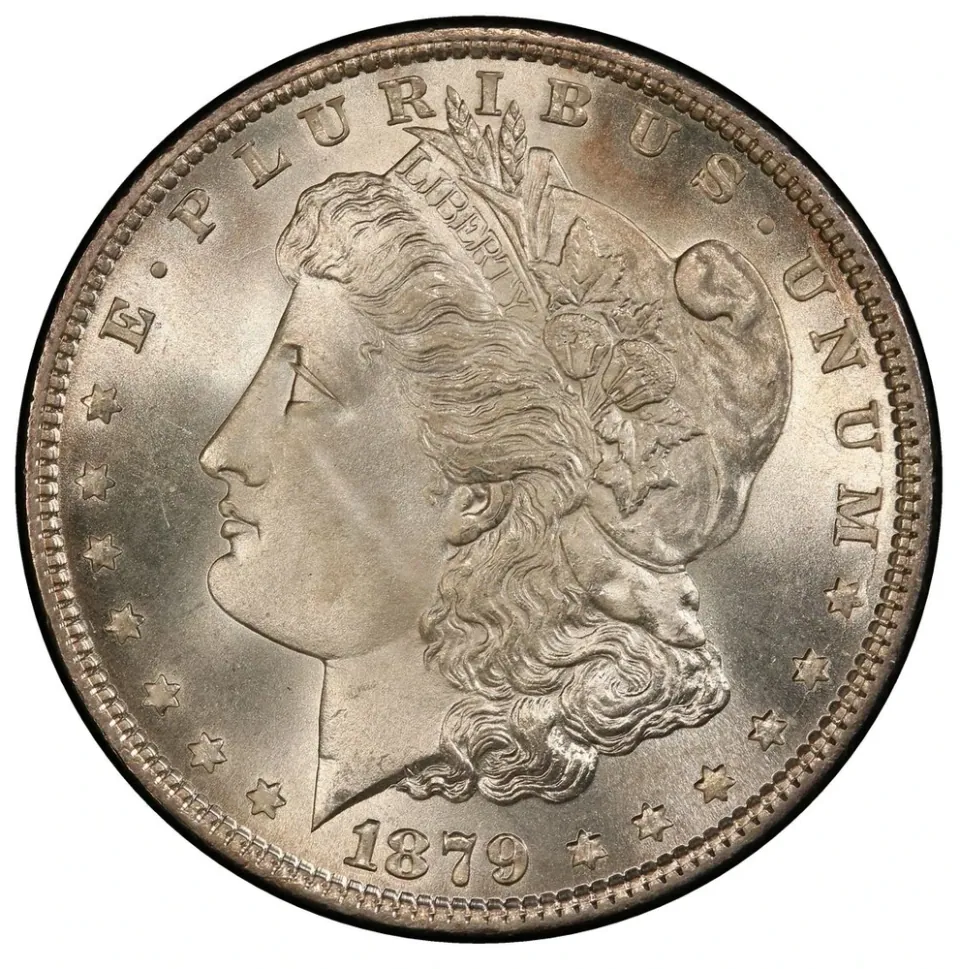
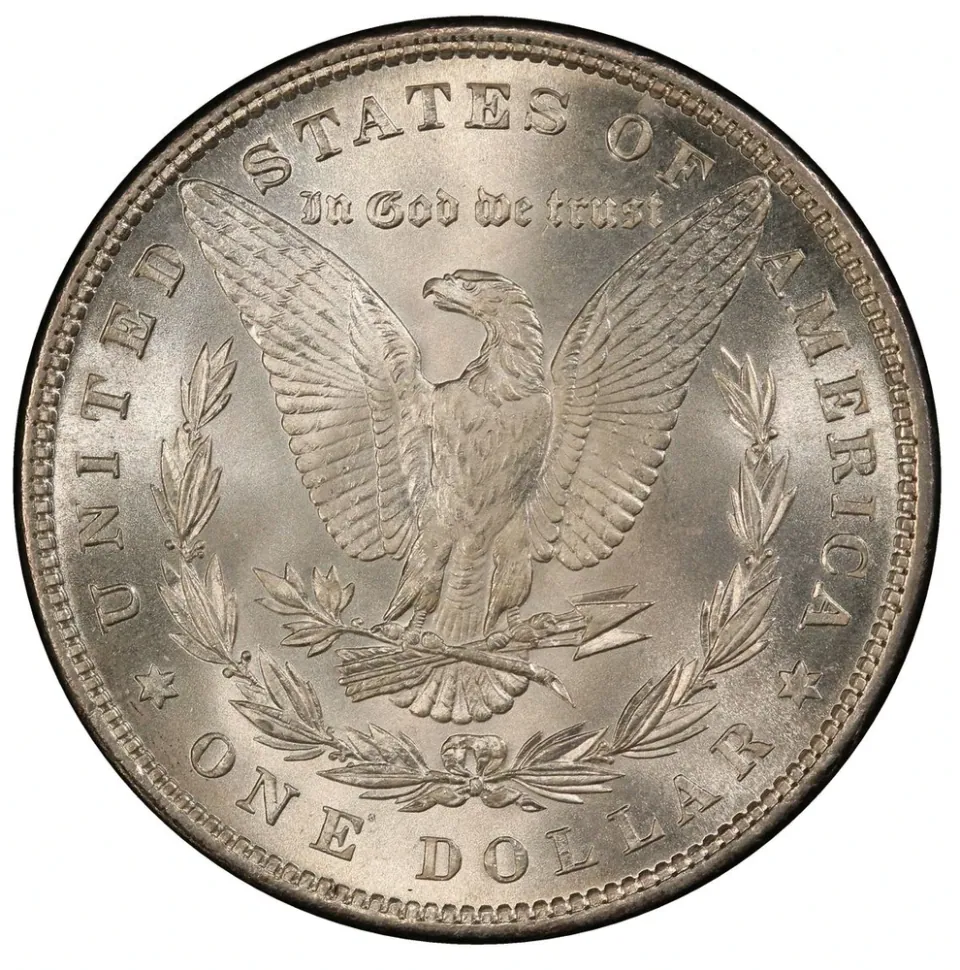
This 1879 Philadelphia example belongs in the 14,806,000 cell. A visually similar 1879-CC belongs in the 756,000 cell. Use the five-mint photographic comparison if the small letters are difficult to identify.
The story behind the production totals
Why the Mint struck more dollars than people needed to spend
The Bland–Allison Act of 1878 required federal silver purchases and coinage. George T. Morgan’s design became the dollar used for this policy. Large production figures consequently reflect legislation and silver purchases as well as everyday demand. Many coins remained in storage rather than wearing out in pockets.
Melting changed the meaning of mintage
The Pittman Act of 1918 authorized extensive silver-dollar melting and replacement. The Mint resumed Morgan production in 1921, then introduced the Peace dollar late that year. Melting did not preserve an issue-by-issue inventory that can simply be subtracted from each cell in this table.
Later releases of stored dollars changed collectors’ access to certain dates. A small mintage can coexist with a substantial supply of uncirculated coins; a large mintage can coexist with scarcity at a particular grade. This is why a production table is useful for identifying an issue, but cannot serve as a price list.
| Feature | Coverage |
|---|---|
| Coin type | Original George T. Morgan silver dollar |
| Coin dates | 1878–1904 and 1921 |
| Metal | 90% silver; nominal weight 26.73 g |
| Units | Number of regular-strike coins; not dollars of bullion value |
| Excluded | Proofs, separate die-variety counts, Peace dollars and modern Morgan issues |
For the first-year total, the 1878 Morgan reverse-type guide explains the tail-feather distinctions without adding their subtotals to the mint total.
For a clear example of why mintage alone cannot predict value, compare 1896 Philadelphia, O and S prices by grade.
The 1886 mint-and-grade comparison illustrates why original output alone cannot predict the New Orleans condition premium.
For grade-specific comparisons alongside production, see the 1880 Morgan value guide, which separates four mints and explains the CC variety question.
How to use the figures without double-counting
1. Match the front date to the reverse mint mark
No mark means Philadelphia; O means New Orleans, S San Francisco, CC Carson City and D Denver. Historic Denver Morgan dollars occur only in 1921. New Orleans starts in 1879; Carson City has a break between 1885 and 1889 and ends in 1893. A date-and-mark combination outside these ranges needs closer examination.
2. Keep varieties inside their parent issue
Reverse types, overdates, VAM die varieties, Prooflike and Deep Mirror Prooflike designations are not independent mint totals. A reference may repeat an issue’s mintage on several variety pages. Adding those entries would count the same production more than once.
3. Separate mintage from a grading-service population
Mintage measures original production. A certification population measures submissions recorded by a grading service, not every surviving coin. Resubmissions and coins graded by other services also complicate the comparison. Neither number tells you how many examples remain in the exact quality you want.
4. Keep modern Morgan dollars in their own table
Modern collector issues began in 2021 with different specifications. The 2021 O and CC privy marks honor former mint facilities; they are not evidence of renewed production in New Orleans or Carson City. Product limits, sales figures and final mintages also describe different things. Do not append a modern product limit to the historic table as if all figures had the same basis.
Which low-mintage issues deserve closer research?
| Issue | Mintage | Question to investigate | Relevant guide | Do not assume |
|---|---|---|---|---|
| 1893-S | 100,000 | Is the date and mint mark genuine? | Key-date identification | A photograph alone authenticates a key date. |
| 1885-CC | 238,000 | How much uncirculated supply survives? | Morgan series guide | Lower mintage always means a higher price. |
| 1889-CC | 350,000 | Which grade and surface category applies? | 1889 value guide | All CC dates trade alike. |
| 1900-O | 12,590,000 | Is it a regular O or attributed O/CC? | 1900 identification guide | An overmintmark adds to the overall mintage. |
| 1921 · Philadelphia | 44,690,000 | Is it Morgan or Peace, and in what condition? | 1921 Morgan/Peace price chart | All 1921 silver dollars share this total. |
Once the issue is clear, compare recent sales at the same grade and surface quality. Use the grading guide to understand the labels and the appraisal guide when attribution or authenticity materially affects value. No price is assigned from mintage alone.
What to remember
Use the date-and-mint table to identify production scale, then investigate survival and condition separately. The 1893-S leads the established regular series at the low end, while Philadelphia’s 1921 output leads at the high end. Neither fact establishes the value of an unidentified coin.
Keep Proofs, die varieties, 1895 Philadelphia’s disputed regular production and modern issues separate. For an actual coin, record the date and mark, preserve its surfaces and follow the corresponding year guide before choosing comparable sales.
Frequently asked questions
Which Morgan dollar has the lowest mintage?
Among established original regular-strike date-and-mint issues, the 1893-S is lowest at 100,000. Proofs are a separate category, and the disputed 1895 Philadelphia regular-production record should not be treated as a confirmed collectible issue.
How many 1921 Morgan dollars were made?
The three mints produced 86,730,000: Philadelphia 44,690,000, Denver 20,345,000 and San Francisco 21,695,000. This total excludes 1921 Peace dollars.
Were Morgan dollars made every year from 1878 to 1921?
No. The original series has dates 1878–1904 and 1921, with none dated 1905–1920. Not every mint participated in every production year.
Does a low Morgan dollar mintage guarantee a high value?
No. Survival, hoard releases, grade, surface quality and authenticity also matter. Mintage is the original number struck, not the number available today or a selling price.
References
Sources
Research checked October 19, 2026. Any price example retains its stated source date and scope.
- Coinflation · Morgan mintage tableAll 95 established regular date-and-mint entries cross-checked; the site’s undated collectible-price ranges are not used.
- Morgan Dollars · historical mintage tablesCross-check of regular-strike counts; 1878 reverse types combined, Proof and modern rows excluded.
- PCGS · 1878 silver dollarsPhiladelphia’s combined regular-strike total and first-year branch-mint counts.
- PCGS CoinFacts · 1880-CC591,000 mintage and reverse-type distinctions.
- PCGS CoinFacts · 1895 Proof880 Proofs and the disputed 12,000 circulation-strike record.
- PCGS · Morgan dollars 1878–1921Silver legislation, melting and the historic series.
- U.S. Mint · Morgan and Peace anniversary coinsModern issues and commemorative privy marks.