

 App Store
COIN VALUE GUIDES · DOLLARS
1882 Silver Dollar Value:No Mint Mark, O, S, CC and O/S
Compare 1882 Morgan dollar values by mint and grade, locate the reverse mint mark, and separate the O/S variety from ordinary coins.
 HeriBase TeamPublished
In this article
How much is an 1882 silver dollar worth?
Common 1882 Philadelphia and San Francisco Morgan dollars are listed at $92 in EF40 in the PCGS retail guide checked October 20, 2026. At MS63 the references are $125 for Philadelphia and $110 for S. These are problem-free, grade-specific estimates; a worn or cleaned coin should not inherit an uncirculated price.
CC and confirmed varieties need a different comparison. The 1882-CC is listed at $265 in EF40 and $650 in MS65. The O/S is a specific overmintmark variety, not every O coin. All regular issues contain 90% silver: identify the reverse mint mark, surface condition and any attributed variety before choosing a value.
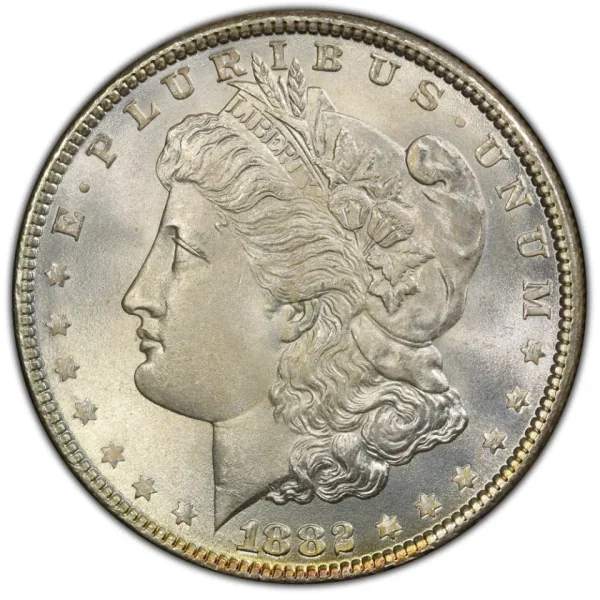
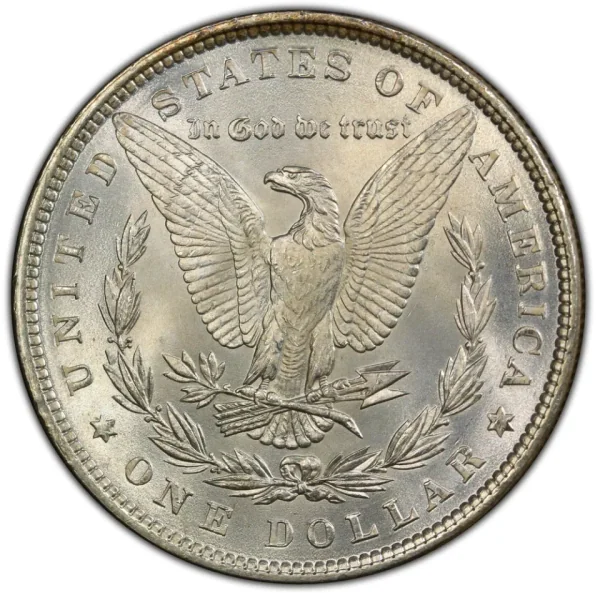
1882 Morgan dollar: obverse and reverse
The story: silver dollars stored instead of spent
| Feature | What to check |
|---|---|
| Design | George T. Morgan; Liberty and eagle |
| Original standard | 26.73 g; 38.1 mm; reeded edge |
| Alloy | 90% silver, 10% copper |
| Mintage | Philadelphia 11,100,000; O 6,090,000; S 9,250,000; CC 1,133,000 |
A nineteenth-century date does not necessarily imply generations of daily use. Many 1882 Philadelphia dollars remained in storage and entered the market through Treasury releases, including those of the 1950s and early 1960s. Long storage preserved luster, but movement in heavy bags could still leave conspicuous marks. That combination explains why an uncirculated dollar may look far from flawless.
The year is also a useful lesson in mint comparison. Original output, surviving condition and collector demand answer different questions. The Morgan mintage table records production; it cannot tell you that every lower-mintage coin must cost more than every higher-mintage one.
The original 26.73 g, 90% silver standard contains approximately 0.77344 troy ounce of pure silver. Multiplying that quantity by a current silver price gives an approximate metal-content calculation, not a dealer offer or the collector value of a scarce grade. Wear, transaction costs and market premiums also matter.
Find the mint mark and check an O/S claim
First read 1882 below Liberty’s portrait. Turn the coin over and look below the wreath, just above DOLLAR. No mark identifies Philadelphia; O identifies New Orleans; S identifies San Francisco; CC identifies Carson City. There was no 1882-D Morgan dollar. The portrait is Liberty, not a president.
Record the date and mint together before comparing prices. Use the Morgan dollar mint-mark guide for the series-wide location. An added letter or altered date requires authentication; weighing a coin alone cannot settle that question.
What does 1882-O/S mean?
O/S describes an O over an underlying S in the die’s mint-mark area. PCGS catalogs strong and weak forms separately. A filled, damaged or shadowed O is not sufficient evidence. Examine a sharply focused close-up and match a recognized attribution before using a variety price.
This guide’s regular-strike table excludes O/S premiums. If a holder identifies the overmintmark, use the full designation, grade and surface description in a specialist comparison. If a seller only says “possible O/S,” treat that as an unresolved identification.
New Orleans strike weakness is not automatically wear
An 1882-O can have soft central detail from the strike. Compare luster and friction as well as the hair and breast feathers. A weakly struck, unworn coin and a circulated coin can look similar in a flat photograph but belong in different grading comparisons.
1882 Morgan dollar value by mint
PCGS retail guide estimates in US dollars, checked October 20, 2026. These are references for genuine, problem-free coins in the stated grade, not auction results or guaranteed offers. Cleaned, damaged and incorrectly graded coins need different comparisons.
EF40 means Extremely Fine, with circulation wear. MS60, MS63 and MS65 are Mint State grades: no circulation wear, but different levels of marks and overall quality. A higher number is not established by brightness alone.
| Mint | EF40 | MS60 | MS63 | MS65 |
|---|---|---|---|---|
| No mark | $92 | $95 | $125 | $400 |
| O | $92 | $95 | $110 | $650 |
| S | $92 | $95 | $110 | $250 |
| CC | $265 | $375 | $450 | $650 |
Read each row independently. A CC premium does not make every CC coin exceptional; a high grade can also make an otherwise common mint issue expensive. The 1883 dollar guide shows an even sharper S-mint condition premium in the following year.
Inspect surfaces before choosing a price
Turn the coin under one soft light. Look for friction on Liberty’s cheek and high hair, then compare the eagle’s breast. Contact marks from storage are compatible with Mint State; loss of luster from wear is a different issue. Cleaning lines and polishing can lower marketability even when details remain sharp.
Use the coin grading scale to understand the terms, and compare recent sales with the same mint, grade and surface status. Prooflike (PL) and Deep Mirror Prooflike (DMPL) are separate surface designations, not synonyms for a manufactured Proof. A coin graded “Details” for problems needs its own comparison.
Keep holders and paperwork intact. If the suspected value justifies it, use the coin appraisal checklist before paying for certification. Do not clean a coin to make its mark easier to see.
The key to valuing an 1882 dollar
Identify the reverse mark before quoting a price. Ordinary P and S coins, CC dollars and attributed O/S varieties are different markets. Match wear, original surfaces and any PL or DMPL designation, then check recent comparable sales. Silver content explains part of the value, but it does not replace a mint-and-grade comparison.
Frequently asked questions
Is an 1882 dollar without a mint mark an error?
No. It is the normal Philadelphia Morgan dollar. No mint mark is an identification feature, not a missing-letter error.
Is every 1882-O dollar an O/S?
No. O/S is a specific overmintmark attribution. The ordinary O issue and the recognized strong or weak O/S forms require separate comparisons.
How much silver is in an 1882 Morgan dollar?
The original standard is 26.73 grams of 90% silver alloy, or approximately 0.77344 troy ounce of pure silver. Metal value changes with silver prices.
Should I clean an 1882 dollar before selling?
No. Cleaning can damage original surfaces and reduce collector value. Photograph both sides and the mint mark under even light instead.
References
Sources
Research checked October 20, 2026. Any price example retains its stated source date and scope.
- PCGS CoinFacts: 1882 PhiladelphiaIssue specifications, grade-specific estimates and collecting history.
- PCGS CoinFacts: 1882OIssue specifications, grade-specific estimates and collecting history.
- PCGS CoinFacts: 1882SIssue specifications, grade-specific estimates and collecting history.
- PCGS CoinFacts: 1882CCIssue specifications, grade-specific estimates and collecting history.
- PCGS: 1882-O/S StrongSeparate overmintmark attribution; not the ordinary O issue.