

 App Store
COIN VALUE GUIDES · DOLLARS
1884 Silver Dollar Value:Mint Marks and the Rare Uncirculated S
Compare 1884 Morgan dollar values by mint and grade, identify CC and S issues, and understand why wear changes the price so sharply.
 HeriBase TeamPublished
In this article
How much is an 1884 silver dollar worth?
An ordinary 1884 Philadelphia or New Orleans Morgan dollar is a common silver issue; the PCGS guide checked October 20, 2026 lists each at $92 in EF40, while MS65 examples are $275 and $185 respectively. These are retail guide estimates for problem-free coins, not a guaranteed selling price.
The mint mark changes the comparison. An 1884-CC is listed at $240 in EF40 and $575 in MS65. The 1884-S is $140 in EF40 but $13,000 at MS60: genuine uncirculated S coins belong to a very different market from worn ones. Confirm the reverse mint mark and wear before using any high price.
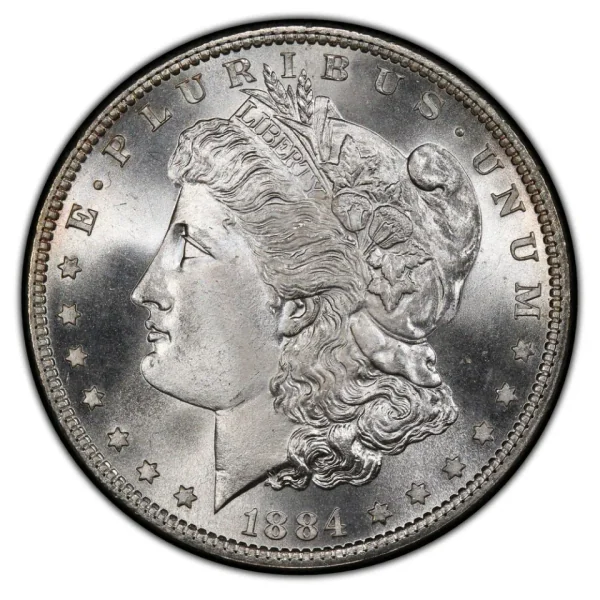
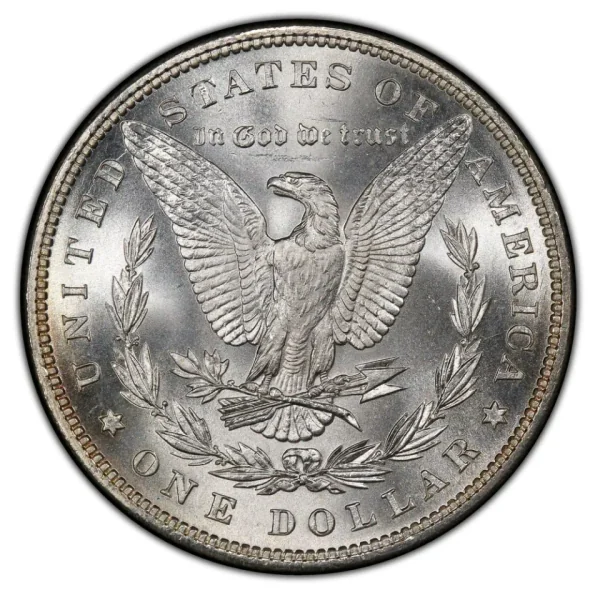
1884 Morgan dollar: real obverse and reverse
Four mints, one date, very different survival
| Feature | What to check |
|---|---|
| Type | Morgan dollar; George T. Morgan design |
| Original standard | 26.73 g; 38.1 mm; reeded edge |
| Composition | 90% silver, 10% copper; approximately 0.77344 troy oz of silver |
| Regular-strike mintage | Philadelphia 14,070,000; O 9,730,000; CC 1,136,000; S 3,200,000 |
The most revealing 1884 story is the contrast between storage and circulation. Many Carson City dollars survived in Treasury holdings and later entered collectors’ hands through government sales. Their CC initials attract demand even though attractive uncirculated examples can still be found. San Francisco struck more dollars that year, yet its truly uncirculated survivors are far harder to obtain.
That contrast explains why mintage is a starting point rather than a price formula. Ask which coins survived, how they survived and what collectors seek today. The Morgan mintage table supplies the wider production context; it is not a count of coins still available.
Find the mint mark before estimating value
Read 1884 below Liberty, then turn the coin over. The mint mark sits below the wreath, above the space between the D and O in DOLLAR. No mark means Philadelphia; O means New Orleans, S means San Francisco and CC means Carson City. There is no 1884-D Morgan dollar.
The head is Liberty, not a president. The reverse eagle, wreath and ONE DOLLAR denomination distinguish this type from later Peace dollars. For the series-wide location guide, see Morgan silver dollar identification.
Check the whole coin before concentrating on a small letter. Compare the date, both faces and the mint-mark area under even light. An added mint mark can imitate a more valuable issue; a correct weight alone does not authenticate it.
Do not turn an AU 1884-S into an MS price
A trace of friction matters greatly on this issue. Treat a seller’s “uncirculated” label as a claim to verify, especially when the price depends on crossing from AU to MS. Independent grading and clear photographs of the surfaces are more useful than an unusually bright appearance.
1884 Morgan dollar value by mint and grade
PCGS retail guide estimates in US dollars, checked October 20, 2026. These are references for genuine, problem-free coins in the stated grade, not auction results or guaranteed offers. Cleaned, damaged and incorrectly graded coins need different comparisons.
| Mint | EF40 | AU50 | MS60 | MS63 | MS65 |
|---|---|---|---|---|---|
| No mark | $92 | $94 | $95 | $100 | $275 |
| O | $92 | $94 | $95 | $110 | $185 |
| CC | $240 | $250 | $310 | $450 | $575 |
| S | $140 | $475 | $13,000 | $50,000 | $280,000 |
Separate wear from bag marks
An uncirculated coin can have contact marks. Conversely, a bright coin can have wear or polished surfaces. Inspect Liberty’s cheek and hair above the ear, then the eagle’s breast, while turning the coin gently under one light. A photograph with glare can conceal both wear and fine cleaning lines.
Use the coin grading guide to understand the labels before choosing a price-table column. AU means some wear remains; MS means no circulation wear. These are grading judgments, not descriptions of how shiny the coin looks.
Match the sale, not just the date
For a useful comparison, match year, mint, grade, surface problems and any PL or DMPL designation. Prooflike describes reflective surfaces on a circulation strike; it does not make the coin a separately manufactured Proof. A cleaned “Details” coin should not inherit the price of an undamaged coin with the same apparent detail.
Preserve the surfaces and check for previous cleaning before seeking offers. Do not polish a dollar to make its portrait or mint mark easier to see.
For the next year, compare the 1885 dollar guide. Its CC and S prices follow different survival patterns, so an 1884 price should not be carried over.
What matters most on an 1884 dollar
Identify the mint, establish wear, then compare prices. P and O provide the ordinary-coin baseline; CC carries collector demand; S becomes exceptionally expensive when genuinely uncirculated. Keep ordinary, Prooflike and damaged coins in their own comparisons, and preserve the surface before appraisal.
Frequently asked questions
Is an 1884 silver dollar with no mint mark an error?
No. It is the normal Philadelphia issue. The mint-mark position is on the reverse below the wreath.
Why is an 1884-S dollar expensive?
Its premium depends strongly on condition. Worn examples exist, but genuine Mint State survivors are rare. An AU coin should not be priced from an MS guide entry.
Are all 1884-CC dollars rare?
No. Many survived in Treasury holdings. Carson City demand still supports a premium, but the CC mark alone does not imply an exceptionally high grade.
How much silver is in an 1884 Morgan dollar?
The original standard is 26.73 grams of 90% silver alloy, or about 0.77344 troy ounce of silver. Metal value changes with silver prices and is separate from collector value.
References
Sources
Research checked October 20, 2026. Any price example retains its stated source date and scope.
- PCGS CoinFacts: 1884 (Philadelphia)Issue specifications, grade-specific guide estimates and historical context.
- PCGS CoinFacts: 1884-OIssue specifications, grade-specific guide estimates and historical context.
- PCGS CoinFacts: 1884-CCIssue specifications, grade-specific guide estimates and historical context.
- PCGS CoinFacts: 1884-SIssue specifications, grade-specific guide estimates and historical context.