

 App Store
COIN VALUE GUIDES · DOLLARS
1885 Silver Dollar Value:No Mint Mark, O, S and CC
Identify an 1885 Morgan dollar, compare four mint marks and dated values, and learn why the low-mintage CC is often found uncirculated.
 HeriBase TeamPublished
In this article
How much is an 1885 silver dollar worth?
For ordinary 1885 Philadelphia and O Morgan dollars, the PCGS guide checked October 20, 2026 lists $92 at EF40 and $110 at MS63. The 1885-S is also $92 at EF40 but rises to $650 at MS63. Prices depend on the mint and condition, not the date alone.
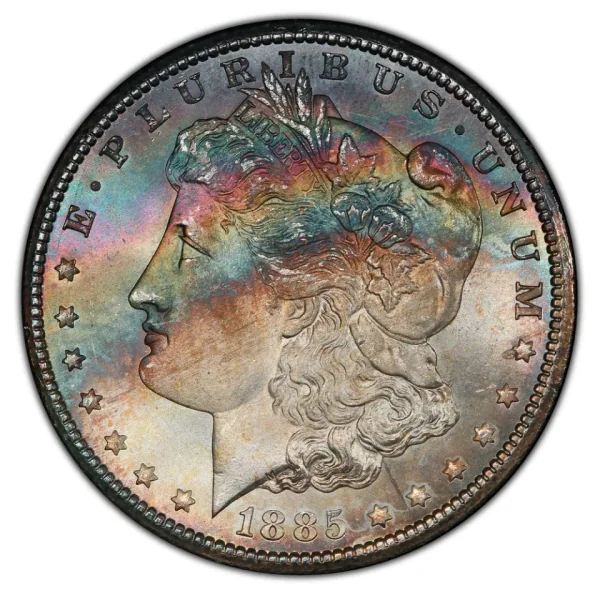
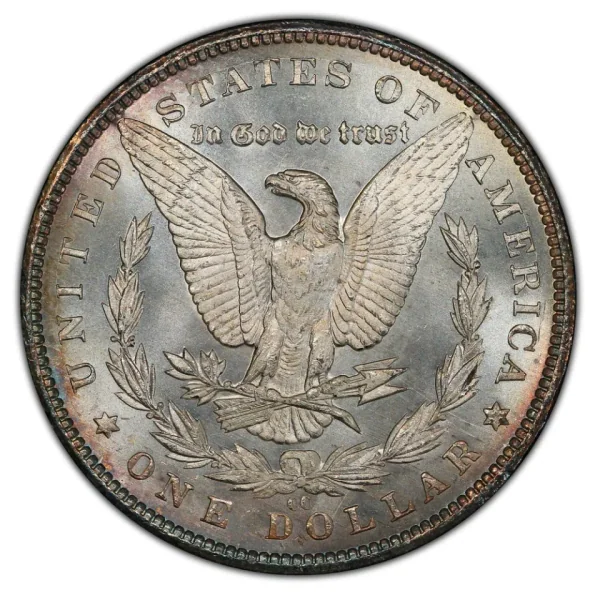
The 1885-CC is the premium mint-mark issue: the same guide lists $785 at EF40, $1,050 at MS63 and $1,450 at MS65. Its small original mintage does not mean every survivor is heavily worn or uniquely rare. Read the mark below the reverse wreath and compare the correct grade and surface designation.
An 1885-CC Morgan dollar in detail
The story: a scarce mintage preserved in storage
| Feature | What to check |
|---|---|
| Design | Liberty portrait and eagle reverse by George T. Morgan |
| Physical standard | 26.73 g; 38.1 mm; reeded edge |
| Alloy | 90% silver, 10% copper |
| Regular-strike mintage | Philadelphia 17,786,837; O 9,185,000; S 1,497,000; CC 228,000 |
Carson City’s 1885 coinage ended before a multi-year interruption in dollar production there. Its 228,000 dollars make a small original issue, yet many remained out of everyday commerce. Later Treasury and GSA dispersals brought stored coins to collectors. This is why a low-mintage date can be encountered in attractive Mint State condition while worn examples are less familiar.
An original government holder can be part of a coin’s collecting context. Keep it and any associated paperwork rather than removing the coin merely for a photograph. The holder is useful history; the coin’s grade, marks and surface quality still need separate assessment.
Compare this history with the 1884 Morgan dollar and the 1889-CC issue. A shared CC mint mark does not give different years the same rarity.
Identify your 1885 mint and version
Read 1885 below Liberty, then turn the coin over. The mint mark sits below the wreath, above the space between the D and O in DOLLAR. No mark means Philadelphia; O means New Orleans, S means San Francisco and CC means Carson City. There is no 1885-D Morgan dollar.
The head is Liberty, not a president. The reverse eagle, wreath and ONE DOLLAR denomination distinguish this type from later Peace dollars. For the series-wide location guide, see Morgan silver dollar identification.
Check the whole coin before concentrating on a small letter. Compare the date, both faces and the mint-mark area under even light. An added mint mark can imitate a more valuable issue; a correct weight alone does not authenticate it.
Proof, Prooflike and toned are different descriptions
Mirrors, rainbow color and a shiny portrait answer different questions. A Proof is a production method; PL or DMPL is a surface designation for eligible circulation strikes; toning describes color. None should be inferred from a listing’s flattering lighting alone. Use the certification description and matching photographs when comparing a special designation.
1885 silver dollar value chart
PCGS retail guide estimates in US dollars, checked October 20, 2026. These are references for genuine, problem-free coins in the stated grade, not auction results or guaranteed offers. Cleaned, damaged and incorrectly graded coins need different comparisons.
| Mint | EF40 | AU50 | MS60 | MS63 | MS65 |
|---|---|---|---|---|---|
| No mark | $92 | $94 | $95 | $110 | $240 |
| O | $92 | $94 | $95 | $110 | $185 |
| S | $92 | $150 | $350 | $650 | $2,000 |
| CC | $785 | $800 | $835 | $1,050 | $1,450 |
The S row shows a growing premium as grade increases; the CC row begins higher even with circulation wear. These are different collecting problems. Decide whether you have an ordinary circulated dollar, a high-grade coin or a special surface designation before choosing comparable sales.
Separate wear from bag marks
An uncirculated coin can have contact marks. Conversely, a bright coin can have wear or polished surfaces. Inspect Liberty’s cheek and hair above the ear, then the eagle’s breast, while turning the coin gently under one light. A photograph with glare can conceal both wear and fine cleaning lines.
Use the coin grading guide to understand the labels before choosing a price-table column. AU means some wear remains; MS means no circulation wear. These are grading judgments, not descriptions of how shiny the coin looks.
Match the sale, not just the date
For a useful comparison, match year, mint, grade, surface problems and any PL or DMPL designation. Prooflike describes reflective surfaces on a circulation strike; it does not make the coin a separately manufactured Proof. A cleaned “Details” coin should not inherit the price of an undamaged coin with the same apparent detail.
Preserve the surfaces and check for previous cleaning before seeking offers. Do not polish a dollar to make its portrait or mint mark easier to see.
A useful way to value an 1885 dollar
Start with the reverse mint mark. P and O are common issues; S gains a larger premium in better Mint State grades; CC combines a low mintage with many preserved survivors. Match grade and surface condition, retain original holders, and compare recent sales before treating a guide value as an offer.
Frequently asked questions
Is an 1885 dollar without a mint mark valuable?
It is the normal Philadelphia issue. It contains silver and may have collector value, but the missing mint mark is not an error. Grade and surface quality determine the comparison.
Why are 1885-CC dollars often uncirculated?
Many were stored rather than spent and later reached collectors through Treasury and GSA dispersals. Original mintage and surviving condition are different measures.
Is an 1885-S dollar worth more than an 1885-O?
The difference depends on grade. In the October 20, 2026 PCGS guide, both are $92 at EF40; at MS63 the S is $650 and the O is $110.
Does a GSA holder guarantee a high grade?
No. It records a packaging and distribution context, not a modern numerical grade. Contact marks, luster, wear and surface problems must still be assessed.
References
Sources
Research checked October 20, 2026. Any price example retains its stated source date and scope.
- PCGS CoinFacts: 1885 (Philadelphia)Issue specifications, grade-specific guide estimates and historical context.
- PCGS CoinFacts: 1885-OIssue specifications, grade-specific guide estimates and historical context.
- PCGS CoinFacts: 1885-SIssue specifications, grade-specific guide estimates and historical context.
- PCGS CoinFacts: 1885-CCIssue specifications, grade-specific guide estimates and historical context.