

 App Store

COIN VALUE GUIDES · DOLLARS
1887 Silver Dollar Value:P, O, S and Overdate Checks
Identify an 1887 Morgan dollar, compare dated P, O and S prices, and understand overdates, storage history and condition premiums.
 HeriBase TeamPublished
In this article
How much is an 1887 silver dollar worth?
The PCGS guide checked October 20, 2026 lists ordinary 1887 P, O and S Morgan dollars at $92 in EF40. At MS63, the differences widen: Philadelphia is $110, O is $250 and S is $500. These retail estimates apply to problem-free coins in the stated grade, not every coin bearing the date.
Mint and preservation matter more than age alone. At MS65 the same guide lists $185 for P, $2,500 for O and $2,000 for S. Recognized 1887/6 overdates and special surface designations require separate prices. There is no regular 1887-CC or 1887-D Morgan dollar.
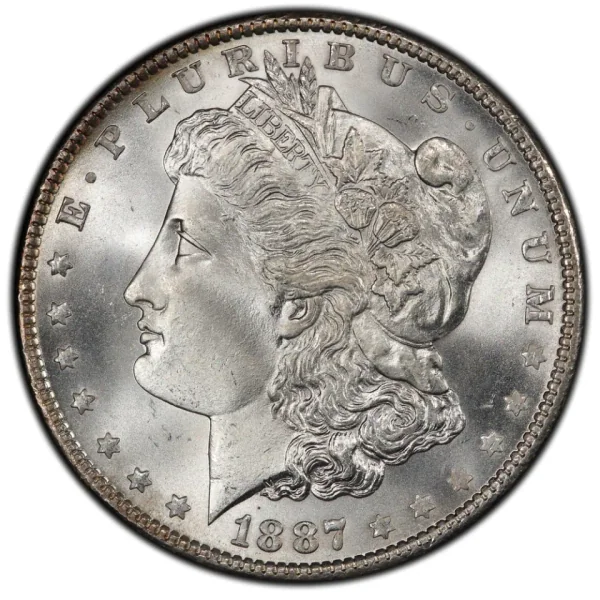
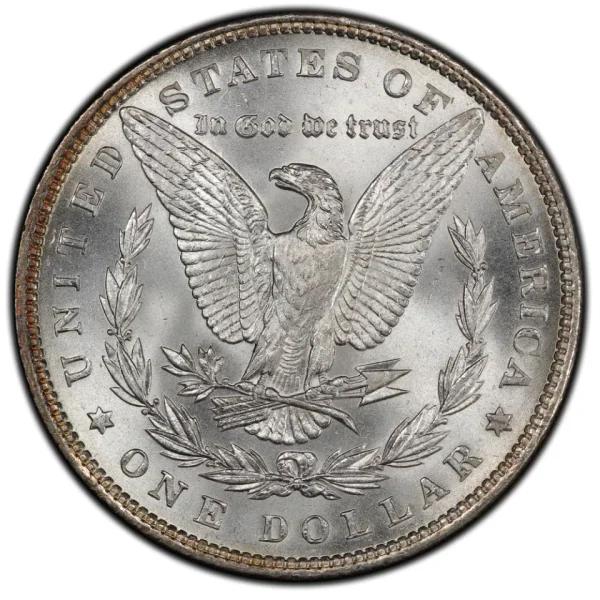
A real 1887 Philadelphia dollar
The story: record production and surviving bags
| Feature | What to check |
|---|---|
| Designer | George T. Morgan |
| Original standard | 26.73 g; 38.1 mm; reeded edge |
| Composition | 90% silver, 10% copper |
| Mintage | Philadelphia 20,290,000; O 11,550,000; S 1,771,000 |
Philadelphia’s 1887 output set a Morgan dollar production record that lasted until 1921. Large numbers survived in bags, with later Treasury releases adding to the supply available to collectors. This is why an attractive 1887 Philadelphia coin can be easier to find than its age suggests.
San Francisco tells a different storage story. The Redfield hoard included thousands of 1887-S dollars, broadening access to an issue that still commands more than common Philadelphia coins in many Mint State grades. A hoard can change availability without making all dates equally common.
Use the year-and-mint production table for the broader pattern. In this particular year, the O and S rows also show why a lower original mintage is not a reliable ranking of prices at every grade.
The original 26.73 g, 90% silver standard contains approximately 0.77344 troy ounce of pure silver. Multiplying that quantity by a current silver price gives an approximate metal-content calculation, not a dealer offer or the collector value of a scarce grade. Wear, transaction costs and market premiums also matter.
Which 1887 issue do you have?
First read 1887 below Liberty’s portrait. Turn the coin over and look below the wreath, just above DOLLAR. No mark identifies Philadelphia; O identifies New Orleans; S identifies San Francisco. There was no 1887-CC issue. There was no 1887-D Morgan dollar. The portrait is Liberty, not a president.
Record the date and mint together before comparing prices. Use the Morgan dollar mint-mark guide for the series-wide location. An added letter or altered date requires authentication; weighing a coin alone cannot settle that question.
Overdates need a specific attribution
PCGS lists 1887/6 Philadelphia and 1887/6-O overdates separately from the normal date. An overdate concerns remnants of an earlier numeral in the die, not a scratch crossing the final 7. Photograph the entire date sharply and compare the correct mint’s diagnostic reference.
Keep ordinary 1887, 1887/6 and repunched-date varieties distinct in searches and sales comparisons. If a label gives a VAM number, carry that number into the comparison rather than dropping it and using a generic “error dollar” price.
Why is an 1887-O often weak in the center?
Many examples have weakly defined central detail and substantial contact marks. Luster, strike and wear must be judged separately. Do not promote a coin to a high grade because the peripheral lettering is sharp, or demote it solely because the eagle’s breast was weakly struck.
1887 silver dollar value chart
PCGS retail guide estimates in US dollars, checked October 20, 2026. These are references for genuine, problem-free coins in the stated grade, not auction results or guaranteed offers. Cleaned, damaged and incorrectly graded coins need different comparisons.
EF40 means Extremely Fine, with circulation wear. MS60, MS63 and MS65 are Mint State grades: no circulation wear, but different levels of marks and overall quality. A higher number is not established by brightness alone.
| Mint | EF40 | MS60 | MS63 | MS65 |
|---|---|---|---|---|
| No mark | $92 | $95 | $110 | $185 |
| O | $92 | $130 | $250 | $2,500 |
| S | $92 | $170 | $500 | $2,000 |
The O issue overtakes S at MS65 in this guide even though O had a much larger original mintage. The price is responding to the availability of high-quality survivors. This is a condition comparison, not a prediction that any ungraded O coin will achieve that grade.
Inspect surfaces before choosing a price
Turn the coin under one soft light. Look for friction on Liberty’s cheek and high hair, then compare the eagle’s breast. Contact marks from storage are compatible with Mint State; loss of luster from wear is a different issue. Cleaning lines and polishing can lower marketability even when details remain sharp.
Use the coin grading scale to understand the terms, and compare recent sales with the same mint, grade and surface status. Prooflike (PL) and Deep Mirror Prooflike (DMPL) are separate surface designations, not synonyms for a manufactured Proof. A coin graded “Details” for problems needs its own comparison.
Keep holders and paperwork intact. If the suspected value justifies it, use the coin appraisal checklist before paying for certification. Do not clean a coin to make its mark easier to see.
For another common Philadelphia date with different branch-mint behavior, compare 1886 Morgan dollar values.
What matters on an 1887 dollar
P, O and S can look similar but diverge sharply in better grades. Read the reverse mint mark, evaluate wear and strike independently, and verify any overdate claim. Ordinary Philadelphia dollars are widely available; high-grade O or S coins and attributed varieties need more exact evidence and matching sales.
Frequently asked questions
Was an 1887-CC Morgan dollar made?
No. Carson City did not strike Morgan dollars dated 1887. A coin bearing that date and CC needs careful examination.
Is an 1887 no-mint-mark dollar rare?
The normal Philadelphia issue is common. Exceptional grade, special surfaces or an attributed variety can change the comparison, but the missing mark itself is normal.
What is an 1887/6 silver dollar?
It is an attributed overdate with evidence of an underlying 6 in the date. Philadelphia and O overdates are cataloged separately and should not use ordinary-date prices.
Why can an 1887-O cost more than an 1887-S?
The answer depends on grade. High-quality survivors are distributed differently; the October 20, 2026 PCGS MS65 references are $2,500 for O and $2,000 for S.
References
Sources
Research checked October 20, 2026. Any price example retains its stated source date and scope.
- PCGS CoinFacts: 1887 PhiladelphiaIssue specifications, grade-specific estimates and collecting history.
- PCGS CoinFacts: 1887OIssue specifications, grade-specific estimates and collecting history.
- PCGS CoinFacts: 1887SIssue specifications, grade-specific estimates and collecting history.
- PCGS: 1887/6 PhiladelphiaOverdate identification and separate issue record.
- PCGS: 1887/6-ONew Orleans overdate record.