

 App Store

COIN VALUE GUIDES · DOLLARS
1878 Morgan Silver Dollar Value:Mint Marks and Tail-Feather Varieties
Compare first-year Morgan reverses, Philadelphia versus S and CC issues, and grade-specific price references.
 HeriBase TeamPublished
In this article
How much is an 1878 Morgan silver dollar worth?
An 1878 Morgan dollar must be priced by mint, reverse type and condition. For Philadelphia’s seven-tail-feather Reverse of 1878, the PCGS retail guide checked October 19, 2026 lists $92 in Very Fine 20, $225 in Mint State 63 and $700 in Mint State 65. The eight-tail-feather type is listed at $115, $525 and $2,300 in those same grades. These estimates apply to problem-free coins, not every raw or cleaned example.
No mint mark means Philadelphia; S means San Francisco and CC means Carson City. All standard issues contain 90% silver and weigh a nominal 26.73 g. Philadelphia’s 8-tail-feather, 7-tail-feather and 7/8-tail-feather reverses are different comparisons. Identify that detail before applying a price, and do not treat a 7/8 overpunched die as a coin struck twice.
Start with the date and complete reverse
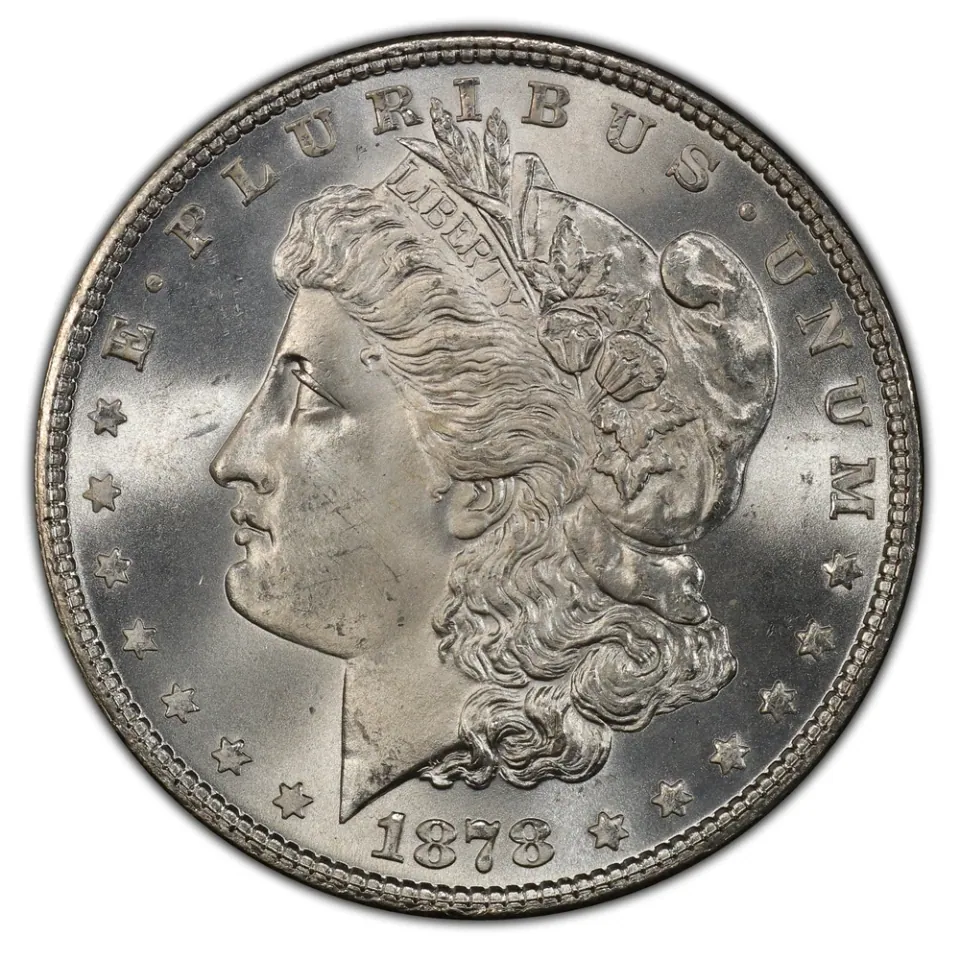
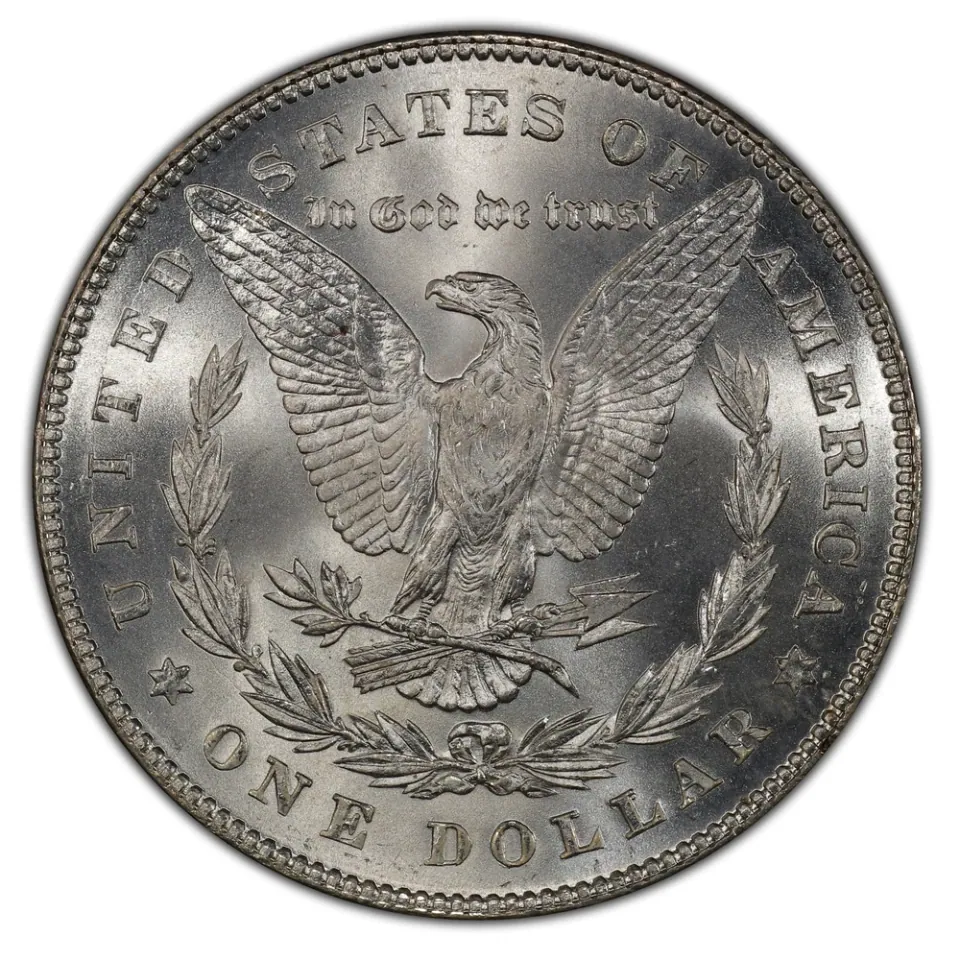
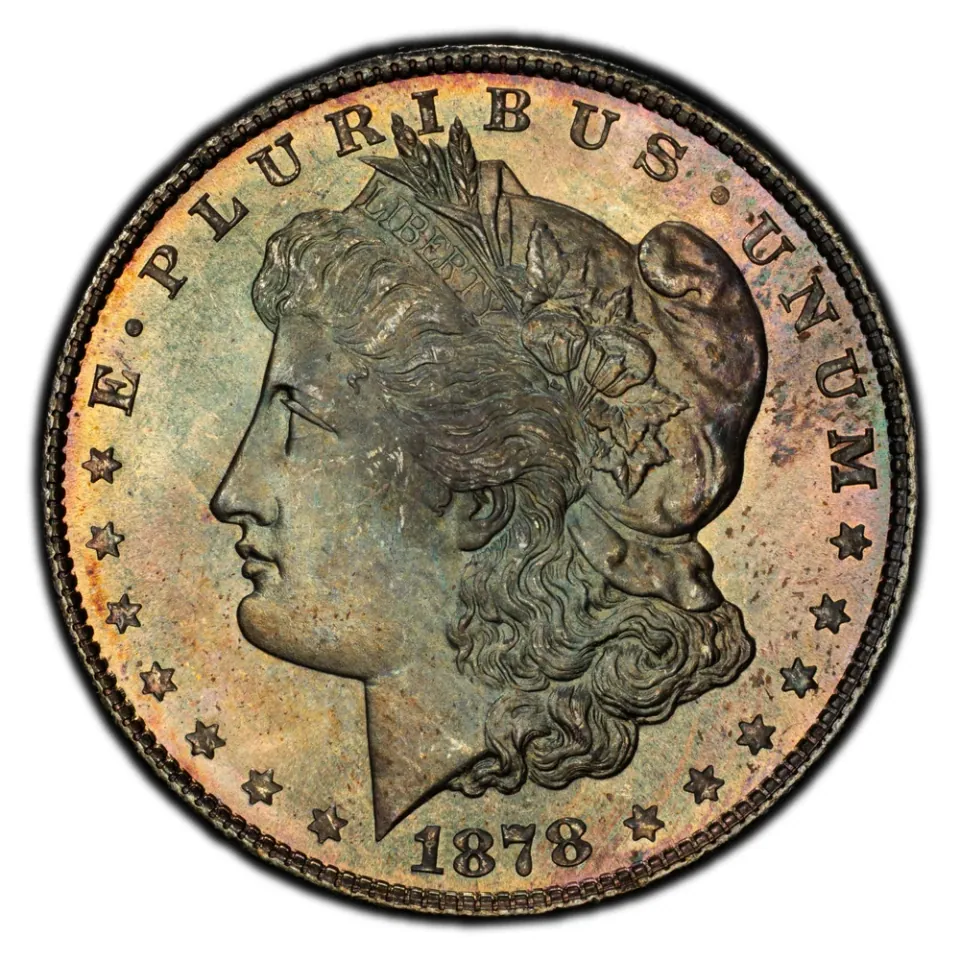
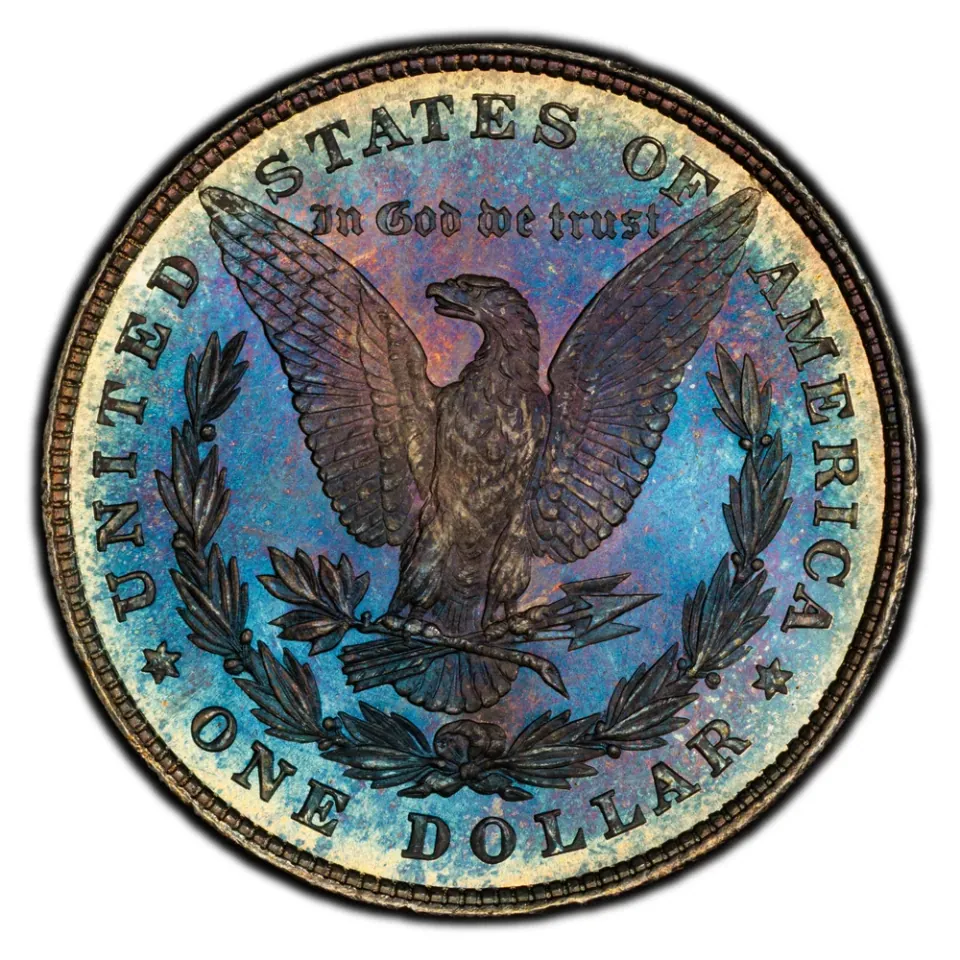
The first year of the Morgan dollar
The Bland–Allison Act of 1878 required government silver purchases and renewed silver-dollar coinage. George T. Morgan’s portrait of Liberty and heraldic eagle became the design associated with that policy. The first year also brought changes to the eagle’s tail and other reverse details, leaving several collectible types under one date.
The 1878 date is not enough to identify every American silver dollar: Trade dollars also exist with that date. Confirm the Morgan portrait and reverse before using this guide. The Morgan series overview covers other dates and mint locations; this page concentrates on first-year reverse distinctions.
| Mint mark | Mint | Recorded regular-strike mintage | Scope |
|---|---|---|---|
| None | Philadelphia | 10,508,800 | All major regular reverse types combined |
| S | San Francisco | 9,774,000 | Separate issue from Philadelphia |
| CC | Carson City | 2,212,000 | Separate issue; authenticate the mint mark |
The 749,500 figure often shown for eight tail feathers is a subtotal within Philadelphia’s total, not extra production to add to 10,508,800. Variety-page mintages may describe a broader parent issue. Use the year-by-mint mintage table to avoid counting the same coins twice.
Seven, eight or seven over eight tail feathers?
| Type | What to check | What the name means |
|---|---|---|
| 8 tail feathers | Eight distinct tail feathers beneath the eagle | Early reverse design |
| 7 tail feathers · Reverse of 1878 | Seven feathers; flatter breast and parallel upper arrow feather | A reverse style, not a separate mint |
| 7 tail feathers · Reverse of 1879 | Rounded breast and slanted upper arrow feather | A design-style name used on coins still dated 1878 |
| 7/8 tail feathers | Remnants of earlier feathers below the revised tail | Overpunched die detail; strength varies |
Count from a sharp close-up and compare the whole diagnostic. Wear, toning and shadows can hide feather edges. “Strong” and “weak” 7/8 descriptions refer to the surviving detail from the earlier design; a vague extra line is insufficient for attribution.
Find the mint mark on the reverse below the wreath and above the denomination. An 1878-O or 1878-D is not a normal Morgan issue: New Orleans began Morgan production in 1879, and Denver’s original Morgan issue is 1921. An unexpected combination requires authentication rather than an invented rare-coin price.
Do not assign Philadelphia reverse-type prices to S or CC coins solely because the tail seems similar. Record the mint first, then the cataloged variety. If the coin already has a holder, verify its certification and precise attribution, including any Prooflike designation.
1878 Morgan value chart: compare like with like
| Issue | VF20 | XF40 | MS63 | MS65 |
|---|---|---|---|---|
| 1878 · 7 TF, Reverse of 1878 | $92 | $92 | $225 | $700 |
| 1878 · 8 TF | $115 | $160 | $525 | $2,300 |
VF means Very Fine, XF Extremely Fine, and MS Mint State. This chart deliberately compares two identifiable Philadelphia types at matching grades. It is not a complete S, CC, 7/8, Proof or Prooflike price list. Use the exact issue’s reference for those coins rather than treating an omitted row as the same value.
These figures are retail guide estimates observed on October 19, 2026. They are neither completed sales nor offers to purchase your coin. A dealer’s buying price, auction proceeds after fees and a retail guide can differ even when the coin is correctly identified.
Why the same date can have very different prices
At Mint State 65 the two displayed types have markedly different guide figures. That makes reverse attribution important, but it does not turn every eight-tail-feather coin into a $2,300 coin. An example with circulation wear, harsh cleaning or damage belongs in a different comparison.
Large marks on Liberty’s cheek and in the fields can affect an uncirculated coin’s grade. Reflective fields should not be assumed to establish a Proof or a certified Prooflike designation. Toning can obscure detail in a photograph; changing the lighting is safer than rubbing or dipping a coin to see it better.
All standard 1878 Morgan issues contain approximately 0.7734 troy ounce of silver. Multiply that quantity by a dated silver spot price for a metal-content reference, then assess collector demand separately. A silver-content calculation does not authenticate a coin or determine its numismatic premium.
For condition terminology, use the grading scale. For a suspected added mint mark or altered surface, obtain an assessment with clear photographs before paying a key-date or variety premium.
The most useful first-year checks
Read 1878, identify the mint, then identify the reverse type. The October 19, 2026 PCGS guide lists the Philadelphia 7-TF Reverse of 1878 at $225 in MS63, compared with $525 for 8 TF. Condition and attribution both matter.
Keep S, CC, 7/8 and special surface designations in their own comparisons. Do not double-count mintage subtotals or use a high-grade price for an ungraded worn coin.
Frequently asked questions
Where is the mint mark on an 1878 Morgan dollar?
Look on the reverse below the wreath and above the denomination. No mark means Philadelphia, S means San Francisco and CC means Carson City. O and D are not normal 1878 Morgan mint marks.
Are all 1878 Morgan dollars worth the same amount?
No. Mint, reverse type, condition and surface quality affect value. For example, the PCGS guide checked October 19, 2026 lists the Philadelphia 7-TF Reverse of 1878 at $225 in MS63 and the 8-TF type at $525 in MS63.
Does Reverse of 1879 mean the coin is dated 1879?
No. It names a reverse design style found on some coins dated 1878. Identify the rounded eagle breast and slanted upper arrow feather rather than changing the coin’s date.
Is a 7/8-tail-feather Morgan a double-struck coin?
No. The name describes remnants of an earlier tail-feather design in an overpunched die. It does not mean the finished coin received two strikes.
References
Sources
Research checked October 19, 2026. Any price example retains its stated source date and scope.
- PCGS · 1878 eight tail feathersFirst-year type, specifications and retail guide.
- PCGS · seven tail feathers, Reverse of 1878Reverse attribution and matching-grade retail guide.
- PCGS · Reverse of 1879Breast and arrow-feather design distinctions.
- PCGS · 7/8 tail feathersOverpunched reverse attribution.
- PCGS · 1878-SSan Francisco issue and mintage.
- PCGS · 1878-CCCarson City issue and mintage.