

 App Store

COIN VALUE GUIDES · HALF DOLLARS
Franklin Half Dollar Value:Year Guides, Silver and Full Bell Lines
Identify 1948–1963 Franklin halves, calculate silver content, find the mint mark and use year-specific prices without confusing Full Bell Lines with a grade.
 HeriBase TeamPublished
In this article
Quick answer
Franklin half dollars were issued from 1948 through 1963. Each standard coin is 90% silver and contains approximately 0.3617 troy ounce of fine silver. Value depends on date, mint, wear, original surfaces and manufacture; an ordinary circulated example and a certified Full Bell Lines coin are different comparisons.
As a common-date reference, the PCGS guide consulted October 26, 2026 lists 1963 Philadelphia non-FBL regular strikes at $37 in Fine 12, $44 in Mint State 63 and $55 in Mint State 65. These are retail estimates for those grades. They are not a price range for the entire series or a guaranteed cash offer.
Coin photos
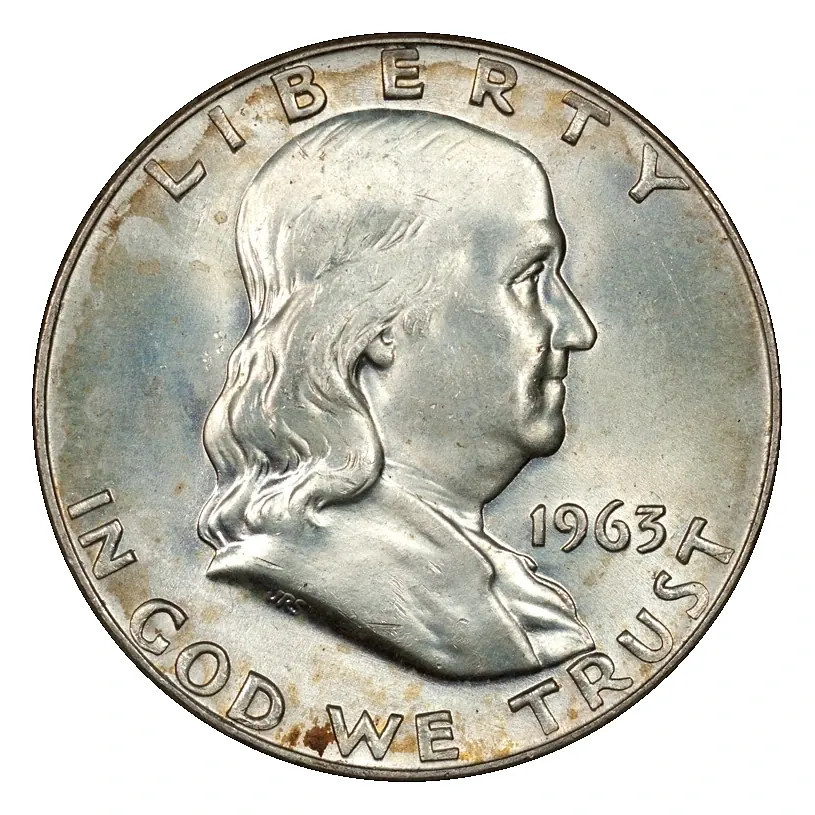
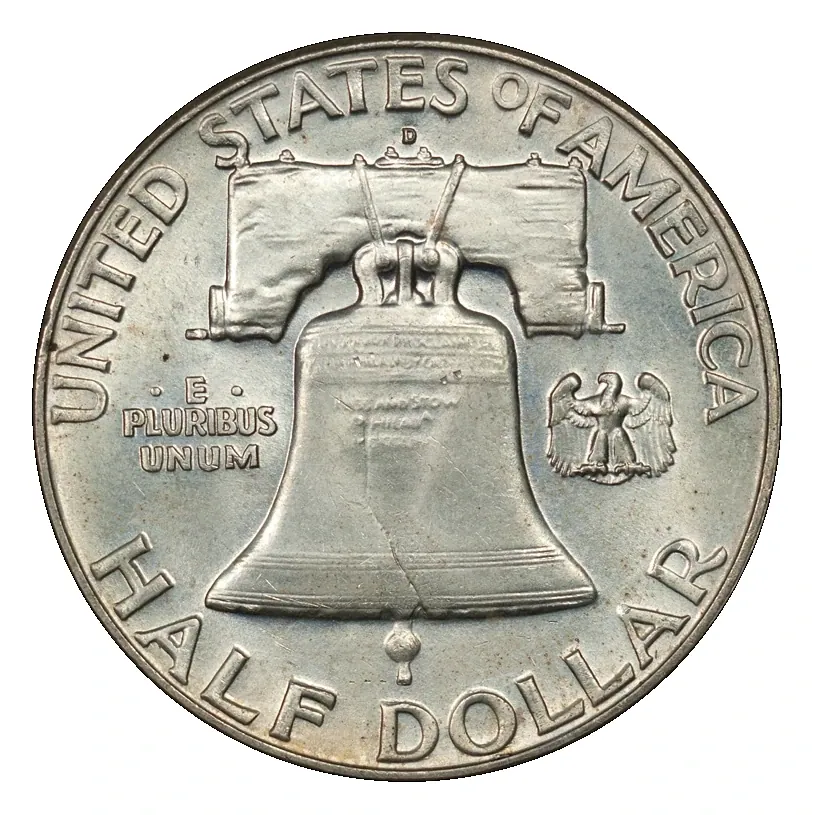
Basics & coin story
John R. Sinnock’s Benjamin Franklin portrait replaced the Walking Liberty half in 1948. The Liberty Bell dominates the reverse, accompanied by a small eagle. The bell’s familiar crack is part of the design; Full Bell Lines concerns its horizontal detail, not whether the crack is visible.
The series ended in 1963 when the Kennedy tribute was prepared for 1964. A 1963 half therefore depicts Franklin, while the 1964 half-dollar guide covers a different portrait. Philadelphia struck Proofs from 1950 through 1963; none were issued for 1948 or 1949. Regular strikes and Proofs should remain separate even when both lack a mint letter.
For a manageable collection, decide whether you want one coin per year, every date-and-mint combination, or designated strikes. Those goals require different budgets. The half-dollar identification overview helps sort mixed designs before you begin.
| Feature | What to check |
|---|---|
| Series / denomination | 1948–1963 / 50 cents |
| Designer | John R. Sinnock |
| Normal alloy | 90% silver, 10% copper |
| Nominal mass / diameter | 12.50 g / approximately 30.6 mm |
| Fine silver | Approximately 0.3617 troy ounce |
| Mint mark | Reverse above the Liberty Bell; no mark, D or S where issued |
| Proof production | Philadelphia, 1950–1963 |
| Strike designation | Full Bell Lines (FBL), separate from the numerical grade |
Identification
Read the date and reverse mint mark together
Look above the bell for D or S. No letter is normal for Philadelphia, including its Proofs. Not every year exists from each mint. Use an issue listing before assuming that an empty album position represents a missing coin.
Full Bell Lines is a strike designation
PCGS uses FBL on eligible Mint State coins with full separation of the lower bell lines. NGC’s published standard examines all the horizontal lines. The services’ criteria are not identical, so compare the actual service and designation. A photograph showing part of a line does not establish a professional attribution.
FBL does not mean that the bell’s vertical crack disappears, and it is not a synonym for MS65. The number evaluates preservation; the designation adds a detail requirement. Proofs use their own grading and cameo comparisons rather than the ordinary-strike FBL table.
Use the year page after identifying the issue
| Year | Guide | Issue distinctions |
|---|---|---|
| 1951 | 1951 Franklin values | No mark, D, S, Proof and bell lines |
| 1952 | 1952 Franklin values | Mints, condition and Full Bell Lines |
| 1954 | 1954 Franklin values | P/D/S regular strikes and no-mark Proofs |
| 1962 | 1962 Franklin values | No mark and D; separate Proofs |
| 1963 | 1963 Franklin values | Final year; no mark, D and Proofs |
The links cover dates already documented in detail. For other dates, use the same issue-and-grade method with the relevant primary guide. Do not borrow the nearest year’s price.
Condition & value
Amounts are USD. The cited guide was consulted October 26, 2026; its displayed update date is stated below. Values apply only to the specified issue, grade and designation, and are not guaranteed purchase offers.
| Issue | Grade / condition | Value or reference | Basis | Important condition |
|---|---|---|---|---|
| 1963 Philadelphia, non-FBL | F12 | $37 | PCGS retail guide | One ordinary date and mint |
| 1963 Philadelphia, non-FBL | MS63 / MS65 | $44 / $55 | PCGS retail guide | Original surfaces; numerical grade verified |
| 1963 Philadelphia, FBL | MS65 | $375 | PCGS retail guide | Separate designation and market |
| Contained silver | 0.3617 troy oz | 0.3617 × silver price per troy oz | Metal-content calculation | Not the complete collector value |
| Other dates, mints or Proofs | Exact issue | Use matching evidence | Issue-specific | Do not transfer the 1963 references |
The PCGS table retrieved for this guide states an October 25 update. The MS65 non-FBL and FBL entries illustrate how the designation can change the comparison within one date. Neither figure establishes the grade of an ungraded coin. The photographed 1963-D example illustrates the design and mint location; the Philadelphia figures do not value it.
For a circulated coin, calculate the contained-silver reference separately from any collector premium. Worn common dates may trade close to their metal component, but spreads and market conditions matter. Scarcer dates and stronger strikes can require more specialized evidence.
Inspect the cheek, hair and bell for friction, then the fields for marks or cleaning. Preserve the coin and use the grading scale before selecting comparable completed sales. Match the exact mint and designation and record the sale date and fees.
Summary
Sort Franklin halves by year, reverse mint mark, manufacture and condition. Silver content supplies a transparent metal reference; FBL and Proof prices require their own attribution. Use the linked year guides for specific coins and preserve original surfaces before seeking an offer.
FAQ
Are all Franklin half dollars silver?
Standard Franklin half dollars are 90% silver, with approximately 0.3617 troy ounce of fine silver at their nominal 12.50-gram mass.
Where is the mint mark on a Franklin half dollar?
Look on the reverse above the Liberty Bell. D identifies Denver and S San Francisco where issued; no mark normally identifies Philadelphia.
Does Full Bell Lines mean MS65?
No. FBL is an additional strike-detail designation, while MS65 is a numerical condition grade. Match the grading service and its criteria.
Are 1963 half dollars Kennedy coins?
No. A normal 1963 half dollar is a Franklin. The Kennedy portrait began in 1964.
References
References and further reading
- PCGS: Franklin series history and Proof years
- PCGS: Franklin price table, ordinary and FBL rows
- PCGS: Full Bell Lines criteria
- NGC: its Full Bell Lines standard
References consulted October 26, 2026. Price tables retain the update dates stated in the text; guide estimates, face values and completed transactions are different forms of evidence.