

 App Store

COIN VALUE GUIDES · HALF DOLLARS
1951 Half Dollar Value:Franklin Silver, D, S, Proofs and Bell Lines
Identify a 1951 Franklin half dollar, locate its reverse mint mark and compare ordinary Philadelphia grades separately from Full Bell Lines, Proofs and named die varieties.
 HeriBase TeamPublished
In this article
Quick answer
A standard 1951 Franklin half dollar contains 90% silver and approximately 0.3617 troy ounce of fine silver. Philadelphia regular strikes have no mint mark; Denver has D and San Francisco S. Philadelphia also produced a separate no-mark collector Proof, so the letter alone cannot establish finish.
The PCGS guide checked October 23, 2026 lists ordinary Philadelphia regular strikes at $37 in Very Fine 20, $44 in Mint State 63 and $70 in Mint State 65. These are non-FBL references for problem-free coins. Full Bell Lines (FBL), other mints, Proofs and named varieties require their own comparisons.
Coin photos
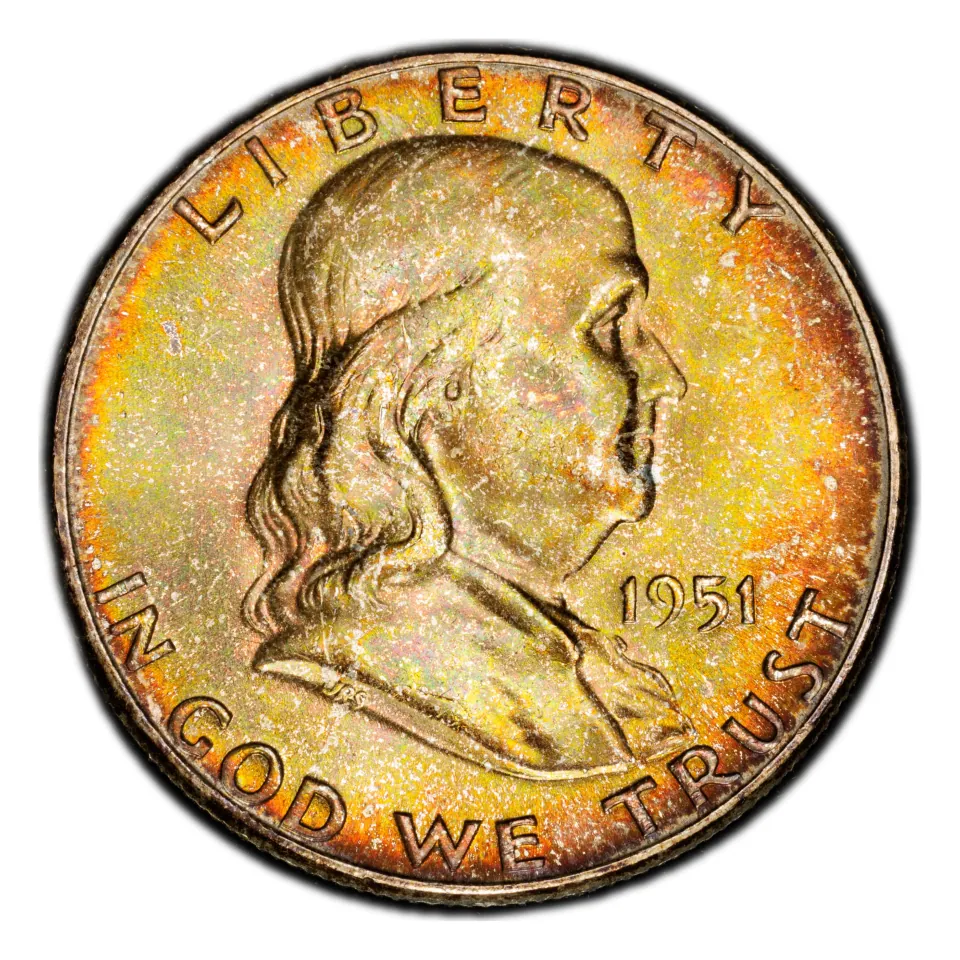
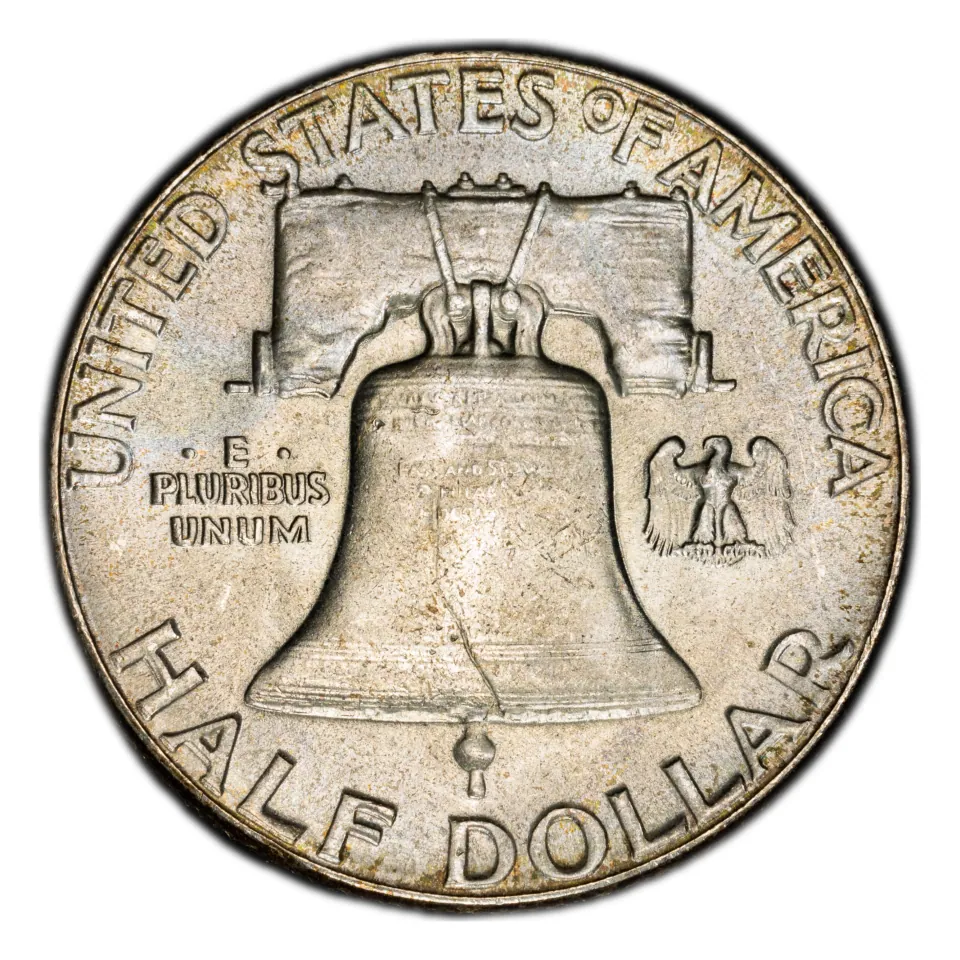
Basics & coin story
The Franklin half-dollar series began in 1948 and continued through 1963. The 1951 date belongs to its early years, well before the Kennedy portrait appeared in 1964. Franklin’s profile and the Liberty Bell distinguish the design even when the date is partly obscured. The small eagle to the right of the bell is an intentional device, not a mint mark.
PCGS records 16,802,102 Philadelphia regular strikes for 1951. That catalog figure describes original output, not surviving coins or the number with complete bell lines. A date set, a mint set and a strike-designation collection therefore ask different questions of the same year.
The bell creates one of the series’ best-known collecting distinctions. Some uncirculated coins show incomplete lower horizontal lines because of strike characteristics. FBL is assessed separately from a numerical grade, so an ordinary Mint State coin and an FBL example should not share an assumed price. The 1952 Franklin guide provides the following year’s separate comparison.
| Feature | What to check |
|---|---|
| Type / denomination | Franklin half dollar / 50 cents |
| Design | Franklin portrait; Liberty Bell and small eagle |
| Composition | 90% silver, 10% copper |
| Nominal weight / diameter | 12.50 g / approximately 30.6 mm |
| Fine silver | Approximately 0.3617 troy ounce |
| Edge | Reeded |
| Regular issues | Philadelphia: no mark; Denver: D; San Francisco: S |
| Mint-mark location | Reverse above the Liberty Bell |
| Proof issue | Philadelphia, no mark; separate collector issue |
Identification
Read the mint mark above the Bell
Turn the coin over and inspect above the bell. D and S identify separate regular-strike entries. No letter is normal for Philadelphia. Do not treat the small eagle to the right as a mint identifier, and do not apply the obverse mint-mark location used on later Kennedy halves.
Proof and Full Bell Lines are different categories
A Proof is specially manufactured for collectors. FBL is a strike-detail designation used for qualifying regular strikes, not a synonym for Proof or for a perfect coin. A reflective surface and a few visible lines are insufficient to establish either category. Compare the grading service’s criteria, full photographs and any reliable certification information.
A “Bugs Bunny” claim needs the exact attribution
PCGS catalogs a 1951 FS-401 variety carrying the Bugs Bunny nickname. A nickname is not enough: the feature must match the relevant die-clash diagnostics rather than a scratch or damage near Franklin’s mouth. Keep this comparison separate from the ordinary price rows, and do not borrow a variety label from another Franklin date.
Condition & value
Amounts are in U.S. dollars. PCGS retail-guide examples were checked October 23, 2026 and apply only to the stated issue, grade and designation. They are not guaranteed purchase offers; current market conditions and selling costs can change the amount received.
| Issue | Grade / condition | Value or reference | Basis | Important condition |
|---|---|---|---|---|
| 1951 Philadelphia ordinary regular | VF20 | $37 | PCGS retail guide | No FBL or variety premium assumed |
| 1951 Philadelphia ordinary regular | MS63 | $44 | PCGS retail guide | Problem-free uncirculated example |
| 1951 Philadelphia ordinary regular | MS65 | $70 | PCGS retail guide | Ordinary non-FBL entry |
| Contained silver | Approximately 0.3617 troy oz | 0.3617 × silver spot per oz | Metal-content reference | Not a guaranteed purchase offer |
| D / S / Proof / FBL / FS-401 | Exact issue and designation | Use separate evidence | Different comparisons | No ordinary Philadelphia price transferred |
The silver reference is approximately 0.3617 times the silver price per troy ounce. It changes with the metal market and does not capture every collector premium or selling cost. An offer for a circulated coin may differ from a retail guide because of buying spreads and the condition actually observed.
Inspect Franklin’s cheek and hair, the Bell and the fields for wear, marks and altered surfaces. The Bell’s normal crack is part of the design; it is not a defect that automatically lowers a coin to a damaged category. Conversely, strong detail cannot erase hairlines or a cleaning problem. Use the grading guide and cleaning-signs guide before choosing comparison coins.
For an FBL or attributed-variety purchase, verify the certification record and inspect the actual coin rather than relying on a seller’s abbreviated title. A matching designation, mint and grade matters more than a broad claim that the date is rare. The 1962 Franklin guide illustrates a later year with its own mint and value distinctions.
Summary
Identify no mark, D or S on the reverse, then separate ordinary strikes, FBL coins, Proofs and any named variety. Silver is normal for 1951. Keep the material calculation separate from collector pricing, preserve the surfaces and use an exact issue-and-grade comparison.
FAQ
Is a 1951 half dollar silver?
Yes. A standard Franklin half dollar is 90% silver and contains approximately 0.3617 troy ounce of fine silver at its nominal weight.
Where is the mint mark on a 1951 Franklin half dollar?
On the reverse above the Liberty Bell. D identifies Denver, S San Francisco, and no mark Philadelphia.
Does FBL mean a 1951 half dollar is a Proof?
No. Full Bell Lines is a strike-detail designation for regular strikes. Proof is a separate manufacturing category.
Is every mark near Franklin’s mouth a Bugs Bunny variety?
No. A 1951 FS-401 attribution requires matching die-clash diagnostics. Damage, scratches or an indistinct photograph do not establish the variety.
References
References and further reading
- PCGS CoinFacts: exact issue, specifications and available guide evidence
- U.S. Mint: Franklin half-dollar chronology
- PCGS: 1951 Bugs Bunny FS-401 with FBL
- PCGS: grading and Full Bell Lines standards
Sources and quoted guide evidence checked October 23, 2026. Guide estimates, historical sales, face value and metal-content calculations are identified separately.