

 App Store
Blog
PAPER MONEY · COLLECTING GUIDES
How to Identify Old Paper Money and Check Its Value
Start with HeriBase identification, ask a human expert when a result is unclear, and arrange physical examination if the question cannot be resolved remotely.
In this guide
Quick answer
To identify old paper money, match both sides of the note to a reliable catalog using its issuing authority, denomination, series or date, signatures, and complete serial number. Confirm the exact issue and variety before estimating its value.
Next, record folds, tears, stains, repairs and other condition issues. Compare recent completed sales of the same issue and variety in similar condition, checking the currency and whether fees are included. Use those records to build a supported value range; age, face value and a seller’s asking price alone do not establish collector value.
If important details remain uncertain, ask a banknote expert to review clear photographs. When photographs cannot resolve questions about authenticity, alterations or condition, arrange physical examination through a professional banknote authentication and grading institution.
The method is: identify the exact note → assess its condition → compare relevant sold examples → resolve any remaining uncertainty. Keep the photographs, catalog match and sale records together so the conclusion can be checked. The annotated note below shows where to find the key identifying details.
Where to look on a banknote
Follow the numbered markers on this 1923 U.S. $1 silver certificate. The same fields may appear in different positions on other issues.
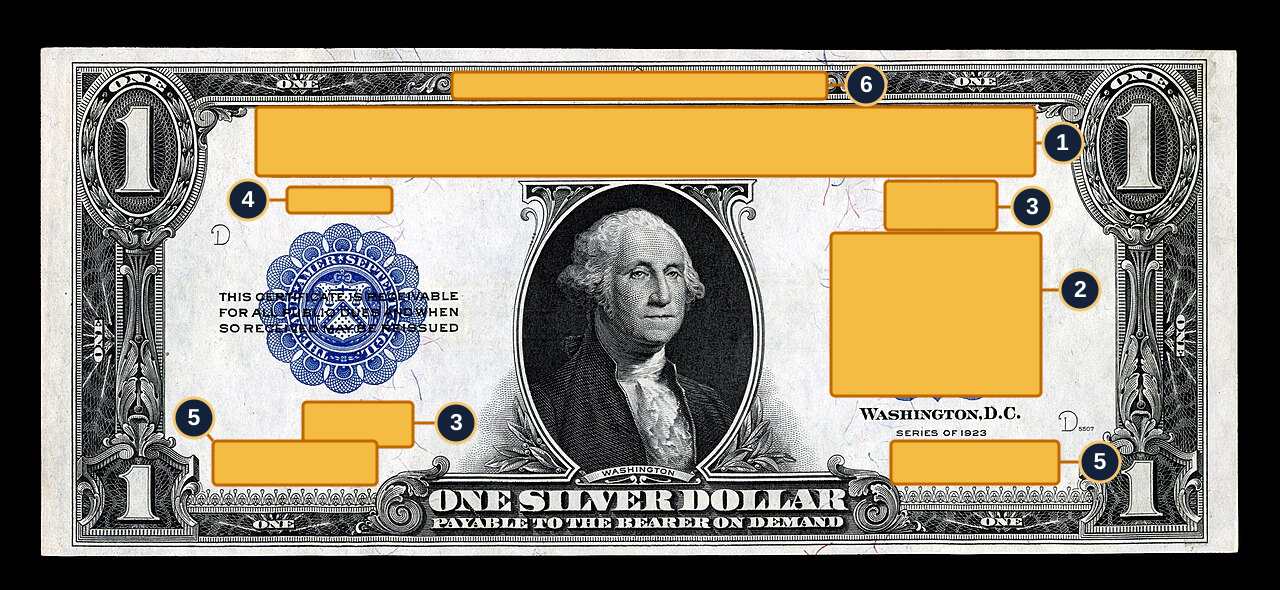
- 1Issuing authority
Look across the upper front for the Treasury wording and “United States of America.” This example is a U.S. Treasury silver certificate.
- 2Denomination
The large blue “1 DOLLAR” gives the face value. The denomination also appears at the corners and along the bottom.
- 3Serial number
“A12D” appears at upper right and lower left on this museum example. Copy every letter and digit; serial formats vary by issue.
- 4Series / date
“SERIES OF 1923” appears above the blue seal, and again below “WASHINGTON, D.C.” Record the printed series exactly.
- 5Signatures
Find the Register of the Treasury at lower left and the Treasurer of the United States at lower right. Match the pair when checking a variety.
- 6Note type
“SILVER CERTIFICATE” runs along the top border. Include the type in your search, rather than searching only for “old one dollar.”
1. Identify your banknote with HeriBase
- 01 · HeriBase identificationPhotograph the note and review the identification and reference value.Start here →
- 02 · Human expert appraisalDisagree or still have questions? Submit the result and detail photos for review.Ask an expert →
- 03 · Physical examinationIf remote review remains inconclusive, arrange an in-hand assessment with a specialist institution.When to submit →
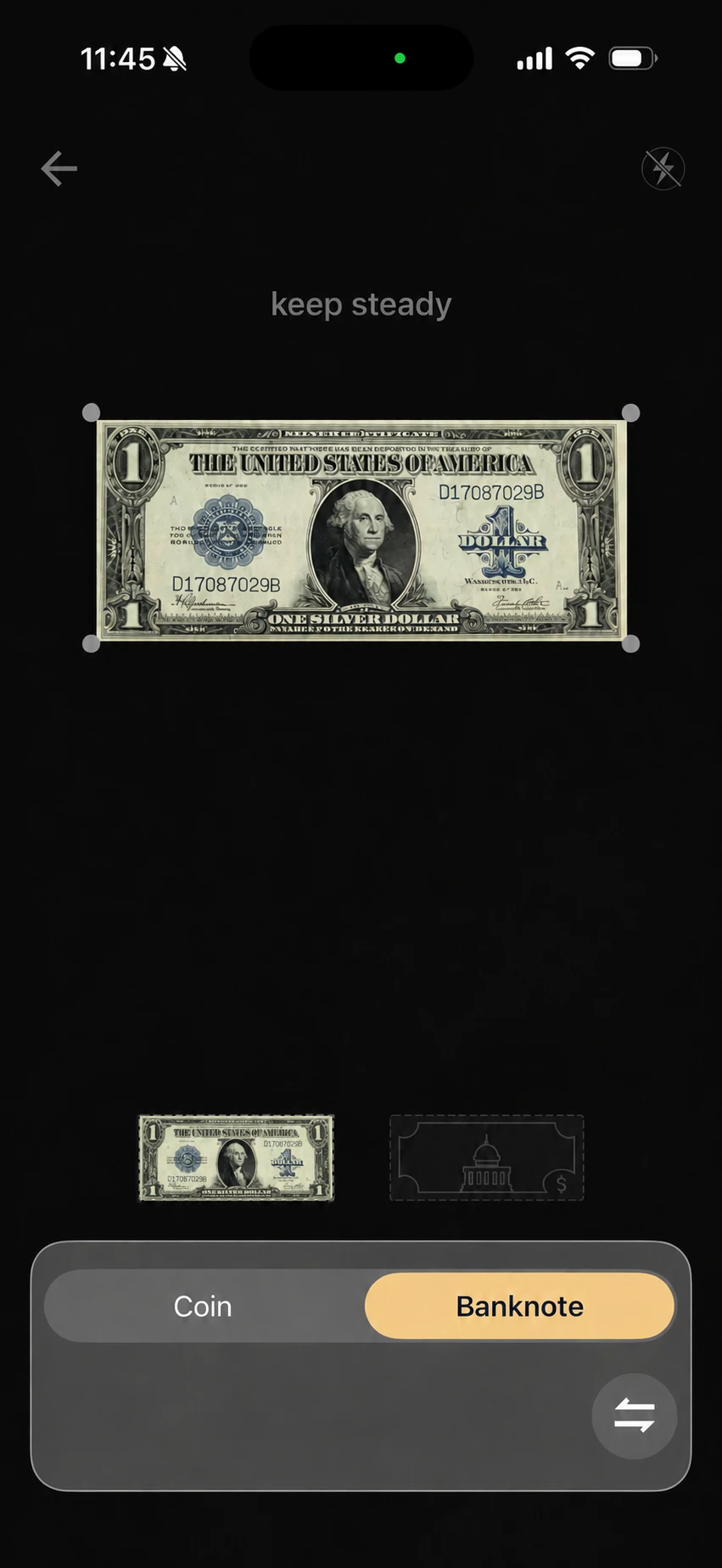
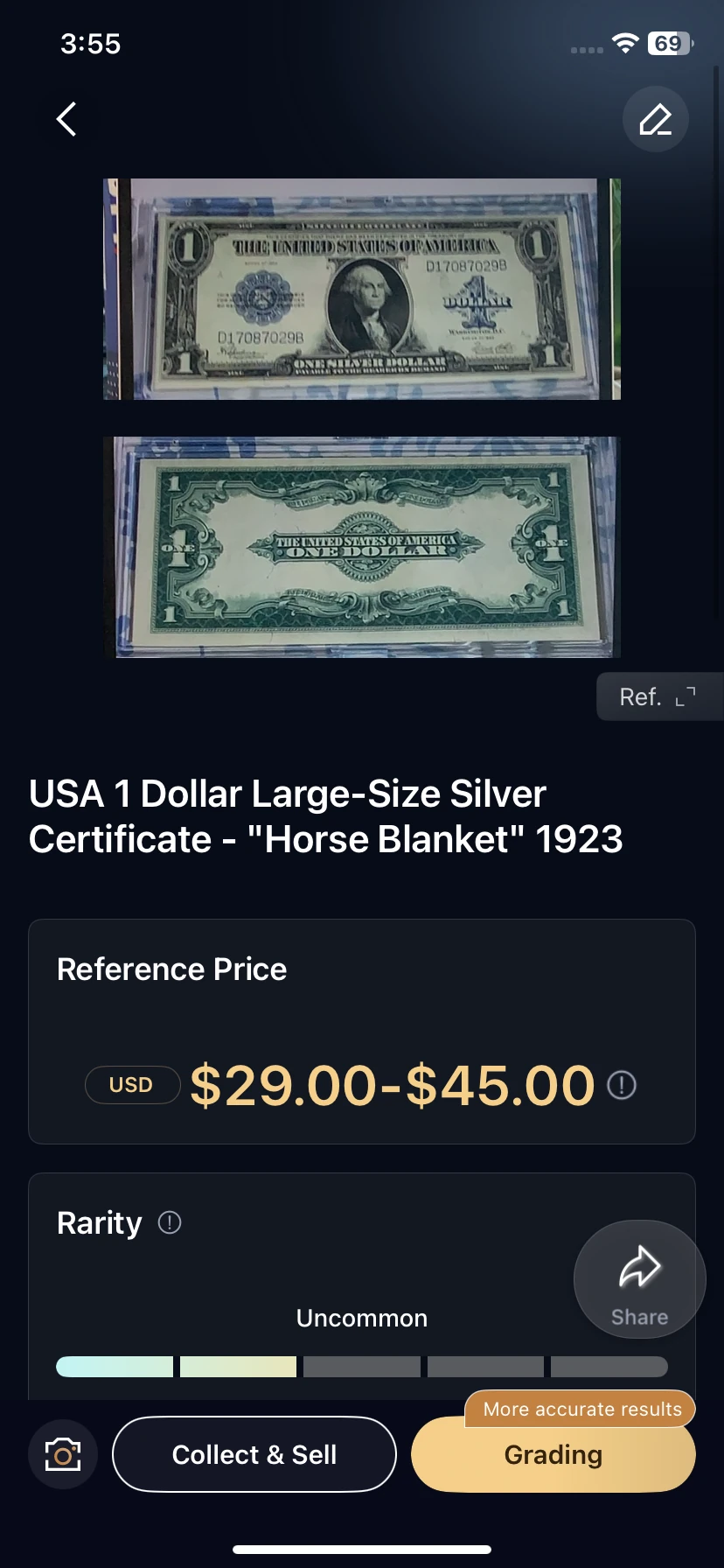
In HeriBase, select Banknote in the identification view and capture the note clearly. Review the proposed identity and the available details against the physical note. The existing guide screenshots below show the capture screen, a result, and the accompanying detail fields.
Image context: these are existing HeriBase guide assets, not a newly conducted accuracy test. The app version and capture date have not been established for this article.
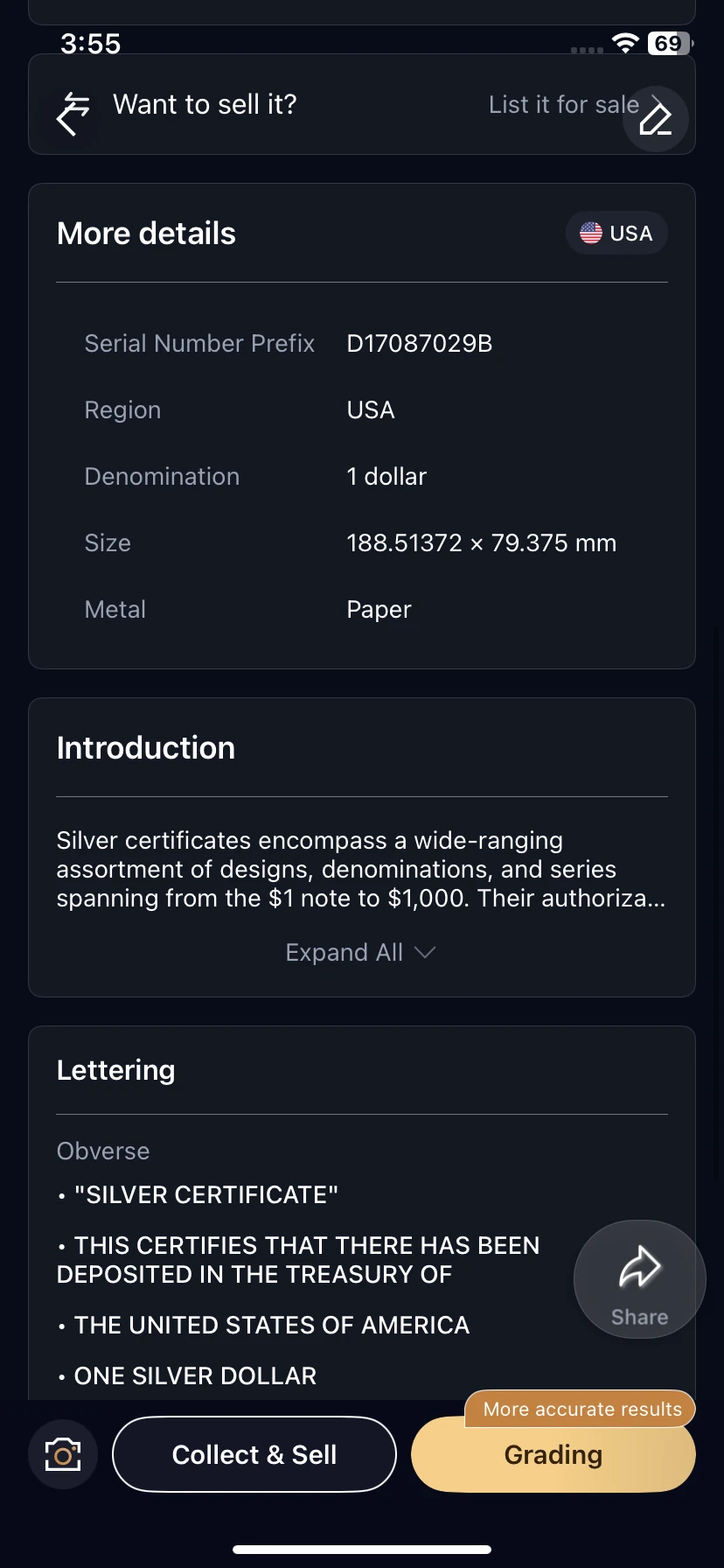
What this example shows—and what still needs checking
The result screen labels the example as a 1923 U.S. $1 large-size silver certificate. It also displays a USD $29–$45 reference range. That is a historical interface example, not a current valuation or verified sale result for the pictured note.
Before using that identification in a collection record, check the series inscription, signature pair, complete serial, and catalog variety. Confirm condition separately. The screenshots do not establish a professional grade, authenticity, or a current market price.
The existing details screen uses generic field labels: “Serial Number Prefix” shows a complete serial, while “Metal: Paper” describes the material. Read the displayed information against the physical note. Catalog dimensions are not a measurement of the photographed object.
If a result appears close but a key detail conflicts, keep both the original photographs and the uncertain field. If you disagree with the result or still have doubts, request a human expert appraisal in HeriBase. Send the result together with clear photographs and explain the specific mismatch. If remote review cannot settle it, move to physical examination. For the wider app workflow, see the HeriBase user guide.
2. Request a human expert appraisal if you have doubts
If you disagree with the automated identification, cannot match the serial or signature details, or need help understanding the reference value, request a human expert appraisal in HeriBase. Explain the point you want reviewed rather than sending only a general question such as “Is this valuable?”
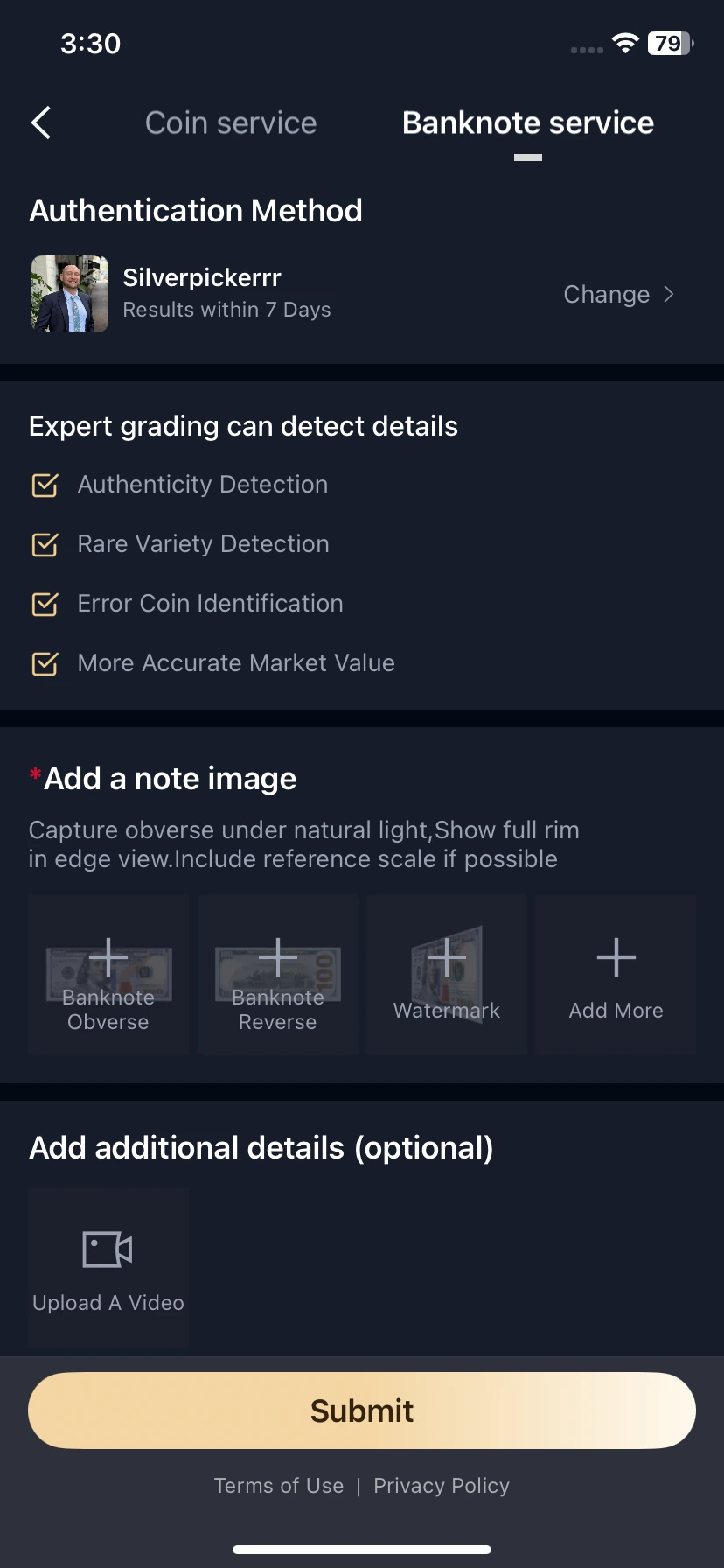
Open the app’s Expert / Expert Appraisal Service and select the banknote service. The existing submission screen provides slots for front, back, watermark and additional images. Labels may vary by version; see the HeriBase expert appraisal guide.
- Attach the original identification result and full front/back photographs.
- Add close-ups of the disputed serial, date, signature, overprint or condition issue.
- Include a watermark image where it is relevant to the issue; provide any other views the expert requests.
- State what you believe is incorrect or uncertain, and include any supporting catalog record.
Check the selected expert’s scope, fee and estimated response time before submitting. Expert appraisal is a separate service from a Premium subscription. If the expert needs clearer images, supply those first; if the question requires physical inspection, proceed to the next step.
3. Arrange physical examination if remote review cannot resolve it
When HeriBase identification and a human expert’s remote review still leave an important question unanswered, contact a professional banknote authentication and grading institution about submitting the actual note. This is the next step when the expert needs to inspect the paper, a suspected alteration, a repair, or another feature that photographs cannot establish.
Choose an institution that accepts the relevant note type and serves your location. For example, PMG’s official submission guide explains its direct-submission requirements, authorized-dealer route, forms, and preparation process. Follow the institution’s current instructions for eligibility, packaging, insured transport, fees and return arrangements.
Keep a copy of the photos, HeriBase result and human expert review, and state the unresolved question in your submission. Check the total cost before proceeding. Arrange submission directly with the chosen institution or its authorized channel; this guide does not describe a HeriBase mail-in service.
Use the next step only when needed. If the identification and expert explanation resolve your question, save the record and continue with value research. Physical submission is for questions that remain unresolved or require an in-hand assessment.
4. Take the photographs needed for a useful review
Begin with two clear photographs: the complete front and complete back. Place the note on a plain, contrasting surface, keep the camera parallel to it, and use even light. Leave a little space around all four edges. A cropped corner or glare across a signature can hide the detail you need.
Keep the original files. Take separate close-ups of the date, signatures, serial numbers, and any damage; do not substitute those close-ups for the full views. If a protective holder creates glare, change the lighting first. Do not remove a note from a sealed grading holder just to photograph it.
- Front and back: same note, readable lettering, no filters or perspective effects.
- Details: serial characters, signature pair, seals, overprints, and small printer text.
- Condition: corners, folds, holes, stains, repairs, and missing pieces.
- Transmitted light: a separate image if the identified issue should have a watermark or embedded feature.
Store the images under one item ID, such as “Note-001.” This makes it harder to accidentally compare the front of one note with the back of another.
5. Read the identifiers in a consistent order
Use this checklist before searching for a price. Transcribe what you can actually read and mark uncertain characters with a question mark. It is more useful to retain an uncertainty than to silently turn it into a confident catalog match.
| Field | What to record | What to verify |
|---|---|---|
| Issuing authority | The full bank, treasury, or government name. | Do not identify the issuer from the portrait alone. |
| Denomination | Both the number and currency unit. | A large number does not imply high collector value. |
| Series / date | Every printed date, including any suffix. | Which date identifies the issue? |
| Signatures | Names and titles, or clear close-ups. | Does the catalog distinguish this combination? |
| Serial number | All letters, digits, leading zeros, and symbols. | Read every repeated serial on the physical note. |
| Design and format | Both sides, seal color, overprints, dimensions. | Does the complete design match the proposed issue? |
| Catalog reference | Catalog name, number, and variety suffix. | A similar picture may represent a different variety. |
Series year and printing date are not interchangeable
For U.S. Federal Reserve notes, the series year relates to an approved design or a signature change. It should not automatically be read as the year that your individual note was printed. Other issuing systems need their own references. See the U.S. Currency Education Program’s identifier guide.
Read the issuer and signatures together
Search the exact issuing name in quotation marks, then add the denomination and date. When a proposed match appears, compare the small details as well as the main illustration. If the catalog splits an issue by signature pair, do not stop at the broad issue name. Photograph signatures you cannot confidently transcribe.
6. Check serial numbers and replacement notes
Keep the complete serial in your record. A leading zero, prefix, suffix, or symbol can be lost during manual entry or image recognition. Read the note again after an app supplies a result, especially where ink is faded or a fold crosses a character.
Patterns that look interesting are a reason to investigate, not a ready-made price. For a suspected low serial or repeating pattern, search for completed sales described in the same way, then check whether the issue and condition are comparable. Avoid assigning a premium from an unsold listing with a dramatic headline.
On U.S. Federal Reserve notes, a star suffix identifies a production replacement. That does not establish scarcity or a particular market premium for every star note. Replacement conventions elsewhere should be checked against the relevant issuer and catalog. Source: U.S. banknote identifiers.
Two different kinds of star: a printed replacement star belongs to the note. PMG’s Star designation on a grading label refers to exceptional eye appeal. Do not treat the label symbol as evidence that the note is a replacement issue. PMG grading scale and designations.
7. Match watermarks and security features to the issue
First establish which design you are checking. Then use that issuer’s guidance for the corresponding denomination and issue. A modern note’s checklist is not automatically appropriate for a much older design.
For example, the official U.S. $1 guide describes raised printing and the note’s paper and fibers. It should not be replaced with a checklist copied from a different denomination. See the official $1 note guide.
Where your reference specifies a watermark or thread, compare its subject, position, and appearance under the stated viewing conditions. Record what you can see and what remains uncertain. A normal front photograph may not reveal an embedded feature at all.
When to pause for a closer examination
- The front and back appear to belong to different catalog designs.
- Lettering, a serial, or a signature looks altered or cannot be reconciled with the reference.
- A feature expected for the exact issue does not match.
- The proposed identification depends on details that the available photographs cannot show.
These are prompts for further examination, not a diagnosis of counterfeiting. Wear, repairs, glare, and an incorrect initial identification can also cause a mismatch. Start with a HeriBase human expert review if you are unsure; if the relevant detail cannot be assessed remotely, arrange physical examination through a professional institution. For suspected circulating counterfeits, follow the relevant local authority’s instructions; the Bank of England’s guidance, for example, directs suspected counterfeits to the police.
8. Describe condition before assigning a grade
Write down visible observations before using a grade label: a central fold, rounded corners, a small edge tear, writing, staining, or an apparent repair. A bright photograph and a flat-looking note are not enough to establish an uncirculated grade.
PMG uses a 1–70 grading scale and considers factors including wear, folds, margins, and paper quality. Its published descriptions are useful for learning the terminology, but matching a few visible features in a photograph is not a substitute for professional examination. Read PMG’s grading scale.
Originality matters too. PMG’s Exceptional Paper Quality (EPQ) designation concerns original paper that has not been processed to appear higher grade. Cleaning or flattening a note to improve a photograph can compromise the very characteristics you are trying to assess. PMG’s explanation of EPQ.
Before handling: do not wash, iron, press, tape, or erase the note. Leave a fragile or repaired example as found and ask a specialist about safe handling. Record existing damage rather than trying to improve its appearance.
9. Estimate value from comparable sales
Once the identification is stable, build a small comparison set. Start with the catalog reference, variety, and a realistic condition description. Broaden the search only when you cannot find close matches, and record what differs.
The PMG World Paper Money Price Guide organizes world notes using Pick numbers. A Pick number is a catalog reference identifying a banknote type or variety, not the serial number of an individual note, its grade, or its value. It also cautions that its figures are general guides rather than valuations of a particular note. Use a catalog or app estimate as a research starting point, then examine actual sale records.
For completed-sale research, use the Heritage Auctions currency archive listed in References. Search by issuer or country, denomination, series and catalog number, then narrow by grade and check the individual lot. Use the recorded sold price, not a later offer-to-owner amount; confirm the currency and buyer’s premium basis before comparing records.
- Match the issue. Check issuer, denomination, series, signature variety, and any replacement status.
- Match the condition. Do not compare a worn raw note directly with a high-grade certified example without explaining the difference.
- Check the transaction. Record the auction or marketplace, sale date, and whether the lot actually sold.
- Normalize the price basis. Note the currency and whether buyer’s premium is included. A hammer price and an invoice total are different amounts.
- Report a range and its limits. Explain which records support it. If there are too few close matches, say so instead of presenting false precision.
| Price | What it tells you |
|---|---|
| Asking price | What a seller hopes to receive; it does not establish a completed transaction. |
| Realized price | A reported sale result; verify the lot, date, condition, and fee basis. |
| Reference estimate | A guide or app’s starting figure; its applicability depends on the exact note and assumptions. |
A collector’s purchase price also differs from what a seller receives after fees. Keep any proposed sale estimate separate from face value, redemption value, insurance value, and the number displayed in an identification app.
10. Save the evidence with the identification
A reusable record makes future research easier. It also helps a buyer or specialist understand how you reached the identification. Copy this checklist into your collection notes:
- Item ID; full front and back photographs; detail photographs.
- Issuer, denomination, series/date, signatures, and complete serial.
- Catalog reference and variety; source used to confirm them.
- Visible condition issues; certification number if applicable.
- HeriBase result and the app version/date of your own capture.
- Comparable sold lots, dates, currency, fee basis, and differences.
- Open questions: uncertain characters, variety, grade, or authenticity.
For an inherited group, record one note at a time before sorting by country or denomination. Keep any old envelopes, receipts, and collector labels with the associated item; treat the descriptions on them as leads to verify.
Summary: identify the note, then check its value
A useful identification connects the issuing authority, denomination, series or date, signature pair and complete serial number to the exact issue and variety. A useful value estimate then compares that note with completed sales of similar examples in similar condition. Keep the photographs and supporting records together, and leave uncertain details open until they can be checked.
Start with HeriBase banknote identification to obtain an initial result and reference value. If you disagree with the result or still have questions, request a human expert appraisal with clear photos and the specific point you want reviewed. If remote review cannot resolve it, arrange physical examination through a professional institution.
You do not need to complete all three steps for every note. Use the next step when a question remains unresolved, then save the confirmed details and the evidence behind your valuation. An app reference value, an asking price and a completed sale are different pieces of information.
Frequently asked questions
Can a serial number alone tell me what a note is worth?
No. Identify the issue and variety first, then assess condition and compare relevant sales. A serial pattern is one part of the record, not a complete valuation.
Does “old” automatically mean rare?
No. Age alone does not establish scarcity or collector demand. Find the exact catalog match and supporting market evidence before assigning a premium.
Can HeriBase authenticate a banknote from a photograph?
An automated photo identification alone cannot establish that a banknote is genuine. Use the HeriBase result as an initial identification, then request a human expert appraisal if you doubt the result or need its authenticity reviewed. If photographs cannot resolve the question, arrange physical examination by a professional banknote authentication institution. Identification, an opinion on authenticity, and a certified grade are different outcomes.
Should I clean a note before photographing or selling it?
Leave it as found. Record its condition without washing, ironing, pressing, erasing, or repairing it. If it is fragile, ask a specialist how to handle it.
What if I cannot find any comparable sales?
Keep the valuation open. Recheck the catalog variety, look for specialist auction archives, and ask a knowledgeable dealer or auction specialist. An unrelated note’s selling price is not a reliable substitute.
Sources and further reading
References · 10 sources
The issuer and grading references below support the relevant sections. The capture workflow and screenshot commentary are based on the existing HeriBase user guide. This guide does not include a new controlled app test or a verified appraisal.
- U.S. Currency Education Program — Banknote identifiers
- U.S. Currency Education Program — $1 note features
- PMG — How to submit notes for physical grading
- PMG — Grading scale and designations
- PMG — Exceptional Paper Quality
- PMG — World Paper Money Price Guide
- Heritage Auctions — Currency auction archives and past sale prices. Search completed currency lots and compare the issue, grade, sale date and price basis. Public results show sold prices without signing in; account features require sign-in.
- Bank of England — Counterfeit banknotes
The expert-appraisal screenshot is an existing HeriBase guide image. Its shared interface includes the coin-specific label “Error Coin Identification”; that label is not evidence of a banknote error-authentication result. The displayed expert and response time are historical interface examples; check the current service in the app.
Image credit
Front of a Series 1923 $1 silver certificate (Fr. 237). Photo: Godot13 / Smithsonian Institution, National Numismatic Collection, via Wikimedia Commons. Photo and annotated diagram: CC BY-SA 3.0. HeriBase added numbered overlays and selected the front view; the note itself is unchanged. This is a different specimen from the app screenshots in this article.
