

 App Store

Fancy Serial Number Checker
Check numerical patterns on banknotes from the US, China, Japan and beyond.
Check your bill’s serial number
Try:
YOUR RESULT
★ Star suffix detected. This marks a replacement note; it does not establish rarity. This tool does not look up print runs.
Real banknote examples
See how these patterns look on actual notes.
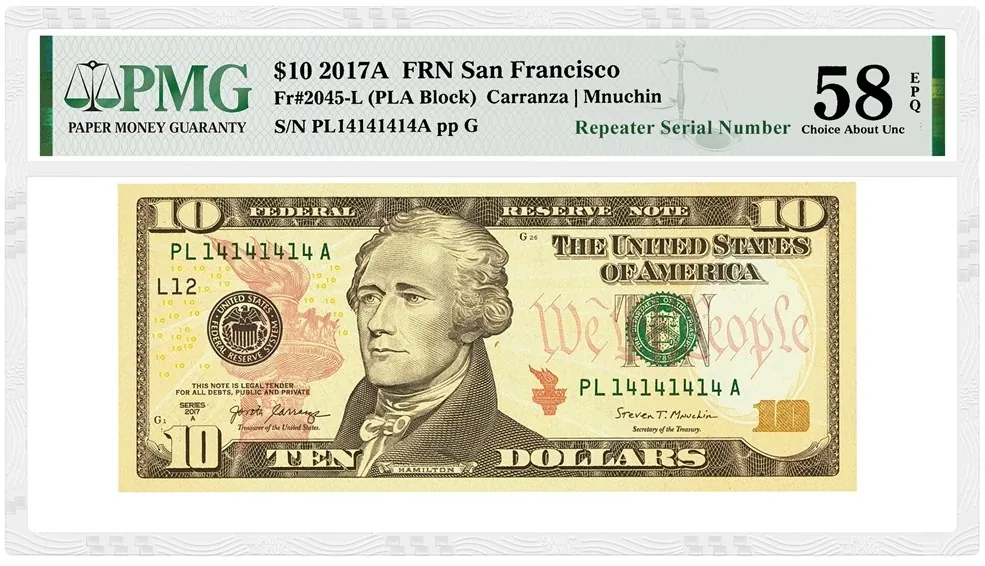
141414142017A $10 Federal Reserve note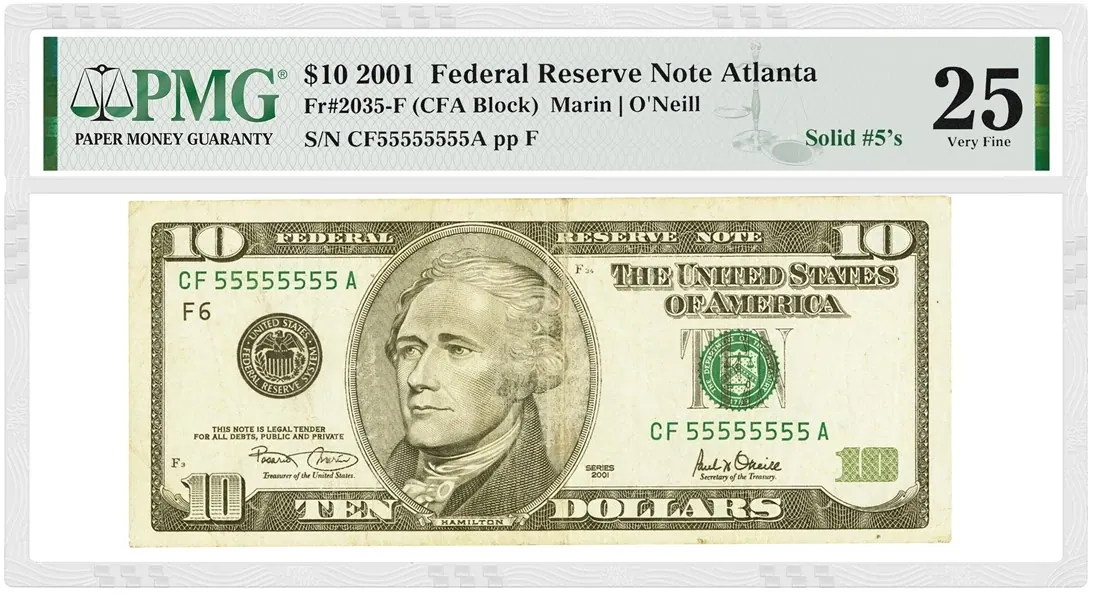
555555552001 $10 Federal Reserve note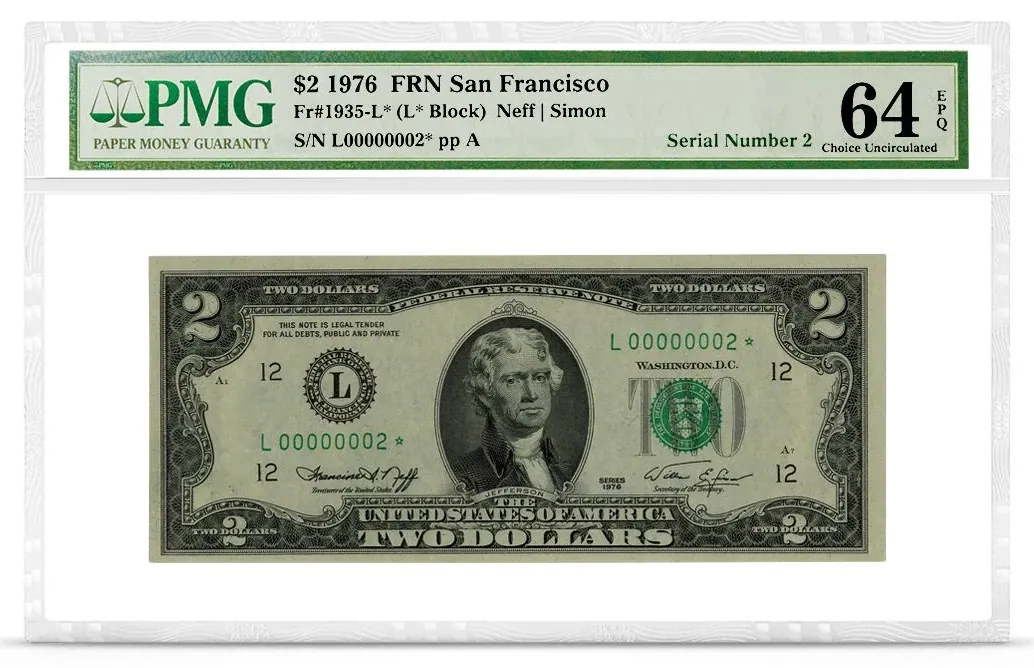
000000021976 $2 replacement noteSerial number types you can check
The examples below illustrate each rule. These numerical categories can overlap; a match is not a rarity rating, appraisal or grading-service designation.
Radar
12344321The full selected numeric sequence reads the same forwards and backwards.
Repeater
12341234A block of two or more digits repeats across the complete sequence.
Solid
88888888The same digit fills every position.
Ladder
12345678Every digit steps up or down by one, without wrapping.
Low number
00000008Serials 1–10 are shown separately; 11–999 use our broader screening threshold.
Binary & two-digit
01011010Only 0 and 1, or exactly two distinct digits. The result distinguishes the two.
Repeated tail
12345888Three or more identical digits at the end. A partial suffix pattern, not a full solid.
High number
99999876The final 1,000 combinations in the selected digit length. Real issuing limits may differ.
Date pattern
19901023A valid date in YYYYMMDD, MMDDYYYY or DDMMYYYY format; years 1800–2099.
Trinary serial number
12312312Exactly three different digits appear across the numeric sequence.
Near-solid serial number
77777778All but one digit are the same. A near solid is distinct from a full solid.
Rotator serial number
16900691The sequence stays the same after a 180-degree rotation using 0, 1, 6, 8 and 9. Printed digit shapes still need visual review.
Million serial number
12000000An eight-digit sequence ending in at least six zeros. This rule does not establish a premium.
Star suffix detection
AB12345678*A star suffix on a supported US format indicates a replacement note. Issuance and print-run records are not queried.
Understanding fancy serial numbers on dollar bills
A banknote serial number checker looks for patterns in the printed number. A fancy serial number is a collector term for an unusual arrangement, such as a radar, repeater or solid. This tool checks the selected digits; it does not examine an uploaded note or authenticate its printing.
Radar vs. repeater serial numbers
A radar reads identically in both directions, such as 12344321. A repeater repeats a complete block, such as 12341234. A number can meet multiple rules. Solids are listed separately so 88888888 is not presented as several different full-sequence patterns.
Birthday serial numbers and date formats
A birthday serial number may have personal meaning when its eight digits form a date. The date checker validates YYYYMMDD, MMDDYYYY and DDMMYYYY from 1800 to 2099, including leap years. It cannot determine whose birthday it represents or whether a buyer will pay more.
Star note lookup vs. a pattern check
A printed star identifies a US replacement note. Detecting it is separate from a star note lookup that searches production records. This checker detects the suffix only. Research the denomination, series and print run separately; see our star note value guide.
Can a serial number tell you a bill’s value?
A serial alone cannot give a reliable dollar bill value. The issue, denomination, condition and comparable completed sales matter. Low-number and high-number thresholds here are screening rules, not proof of scarcity. Read the fancy serial number guide for examples and value research.
Frequently asked questions
Can this tell me what my bill is worth?
No. This checker detects numerical patterns. Value research needs the actual note’s condition, denomination, series and comparable completed sales. A pattern alone cannot establish a premium.
Where do I find the serial number?
Enter your numeric sequence with leading zeros, or paste a supported full serial including its prefix. The checker uses the format to suggest a possible country. Pure numeric sequences are often shared across currencies and cannot determine the issuing country. Do not enter a plate number or issue year.
Which international formats can I check?
US, Japanese, common Chinese and euro serial formats are screened automatically. Other formats accept a manually selected 4–12 digit sequence. Country suggestions are based on format only; matching a format does not prove the issuing country. These are pattern checks, not complete country-specific serial validation. Euro results include the numeric checksum position; the checksum itself is not verified. Other currencies with embedded dates or prefix digits require you to select the numeric sequence manually.
Format references: Bank of Japan, European Central Bank. Actual issue ranges and collector terminology vary by country.
Does a star mean my note is rare?
A star identifies a replacement note. To research scarcity, check its specific series, denomination and production run. This checker only detects the star suffix.
Why does my result show more than one pattern?
Patterns can overlap. For example, 12121212 is a repeater and uses just two digits. Matching more patterns does not automatically mean a higher value.
How are the patterns defined?
We check numerical rules for the detected format and explain each match. This does not search an issuing registry or verify a prefix, print run, checksum, authenticity or country of origin. We do not certify grading-service designations. Solids are shown separately from radars and repeaters; ladders do not wrap between 9 and 0. Date patterns support three explicit eight-digit calendar formats. Rotators use a numeric rotation map and require visual typeface review; partial ladders are outside this version’s scope. Automatic format recognition is limited to the formats described; they do not cover all historical series.
Further reading: PMG’s fancy serial number overview and US Currency banknote identifiers.