

 App Store

PAPER MONEY · SERIAL NUMBER GUIDES
Are Fancy Serial Numbers on Dollar Bills Valuable?
A guide to special serial number types, what makes them scarce, and how to decide whether a U.S. banknote deserves a closer look.
HeriBase Team · Published
In this article
Quick answer
Some fancy serial numbers on dollar bills command a premium, but a special pattern alone cannot tell you what a note is worth. Read the full serial, including leading zeros, letters and any star. Check the numeric portion for an exact pattern, identify the denomination and series, assess condition, and compare completed sales of closely matched notes.
Very low numbers, solids and complete ladders merit a closer look; radars, repeaters and binary patterns also attract collectors. Definitions matter: a near-match is not a complete pattern, “binary” can mean different things, and a birthday serial may appeal mainly to someone connected to that date. A mathematically scarce pattern does not establish how many notes survive or how much buyers will pay.
Use several relevant sold records where available, matching the pattern, issue and condition. Keep single-note prices separate from set prices, and record the sale date and buyer’s premium. If the evidence is weak, leave the premium unconfirmed; seek expert review when identity, authenticity or a potentially substantial value remains uncertain.
1. Read the complete serial number first
This guide focuses on the eight-digit numeric portion of serial numbers on modern U.S. Federal Reserve notes, including denominations above $1. Older U.S. currency and notes from other countries can use different numbering systems.
Find the serial printed twice on the front, rather than the much smaller plate or position numbers. Copy every digit, including leading zeros, and record the surrounding letters or replacement star separately. The digits determine most patterns discussed here; the full serial and issue details establish which note you have.
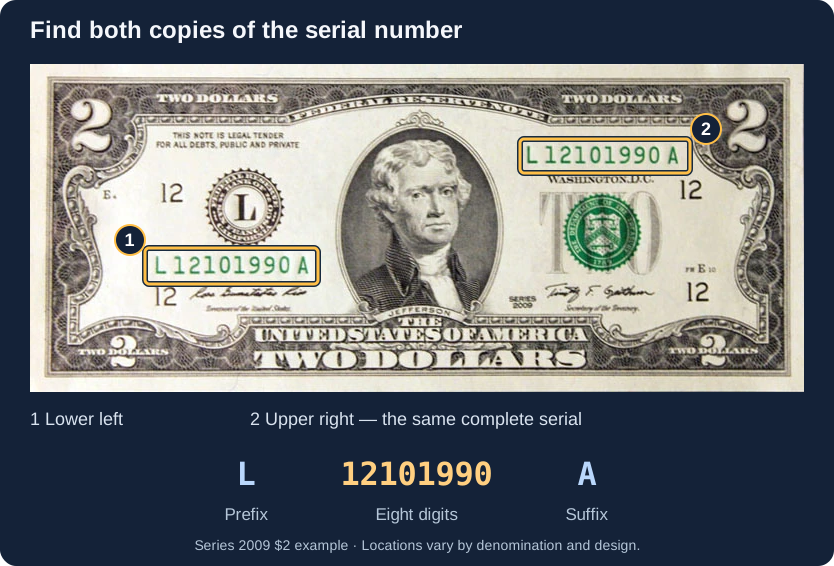
On this $2 note, both marked locations show L12101990A. Record all eight digits and the surrounding letters. Replacement notes carry a star instead of the final letter; other denominations and designs may place the serial differently.
Record the denomination, printed series year, Federal Reserve district and any series suffix, such as “A.” A series year relates to the approved design or changes such as signatures; it is not necessarily the year that individual note was printed. Do not interpret a date-shaped serial as the printing date.
For a broader identification checklist, see How to Identify Old Paper Money and Check Its Value.
2. Which serial numbers are considered fancy?
A fancy serial number has an arrangement collectors recognize or a numerical position they seek. Use a precise description: grading-service designations and informal seller labels are not always interchangeable.
| Type | Example | What to look for |
|---|---|---|
| Low | 00000008 | A small numerical value, with the leading zeros preserved. |
| High | 99999998 | A number very close to the upper end of the eight-digit range. Verify the issue’s numbering history. |
| Solid | 88888888 | All eight digits match. |
| Ladder | 12345678 | Every digit follows in consecutive order; 87654321 descends. |
| Radar | 12344321 | The number reads identically in reverse. |
| Repeater | 12121212 | A digit group repeats across the whole number. Another example is 12341234. |
| Binary | 01011010 | This example uses only 0 and 1. Check which definition a seller or grading service applies. |
| Birthday / date | 01011990 | A valid date in a stated format: January 1, 1990 in MMDDYYYY. |
Read the patterns on real U.S. banknotes
Compare the printed serials with the explanations below. Each photograph preserves the complete note and its grading holder. Select an image to inspect it at full size.
Low number: 00000002
Series 1976 · $2 · San Francisco
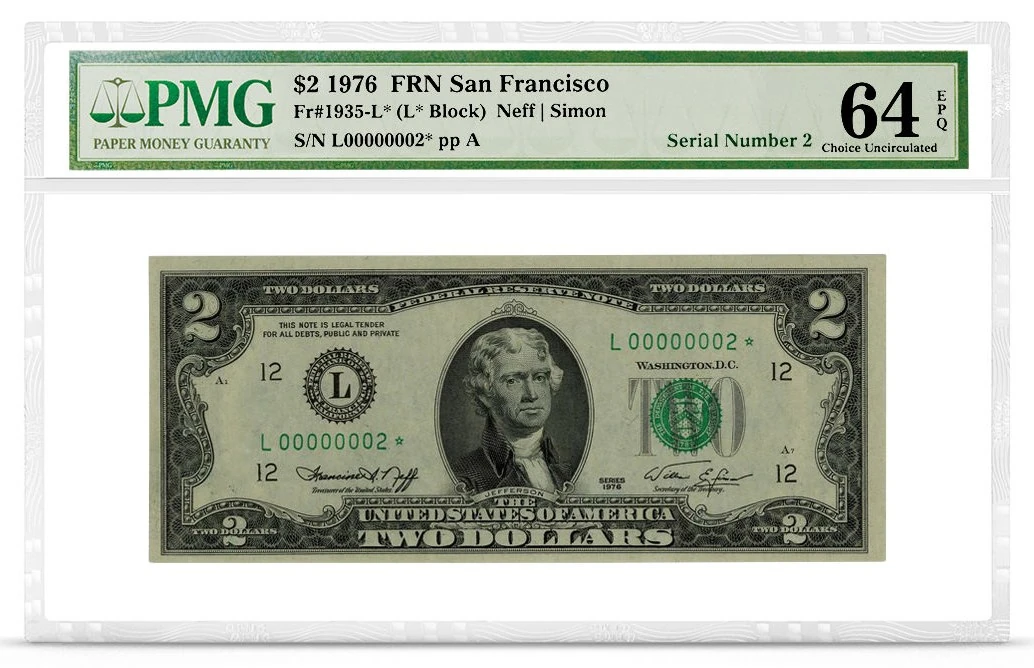
L00000002★
Read the leading zeros: the numeric value is 2. The star identifies a replacement note; it is separate from the low-number pattern.
Solid: 55555555
Series 2001 · $10 · Atlanta
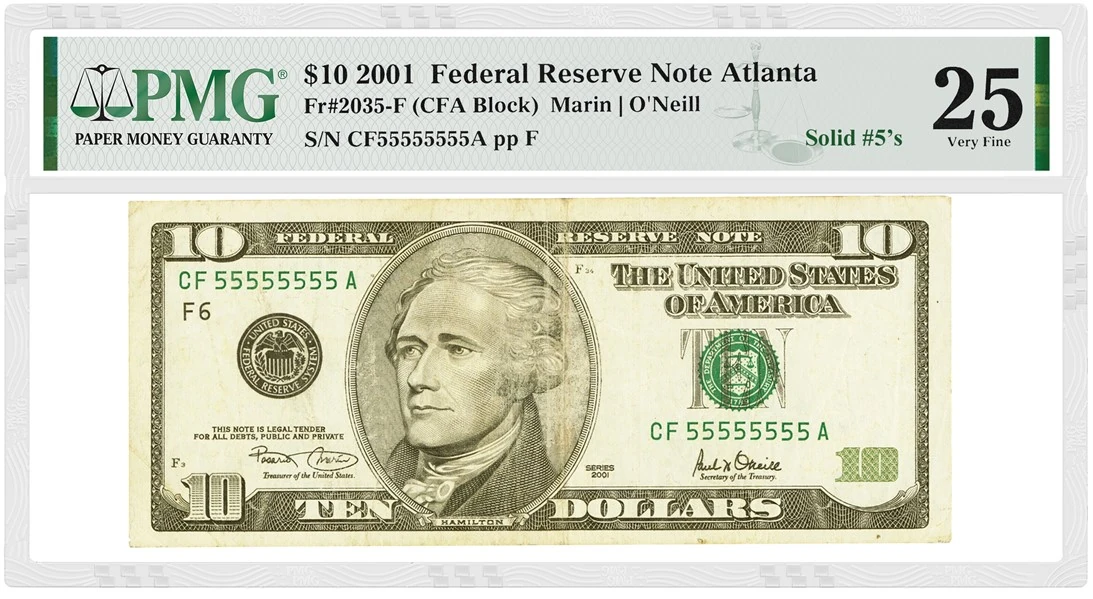
CF55555555A
All eight numeric positions contain 5. The prefix CF and suffix A identify the note but are not part of this solid-digit pattern.
Repeater: 14141414
Series 2017A · $10 · San Francisco
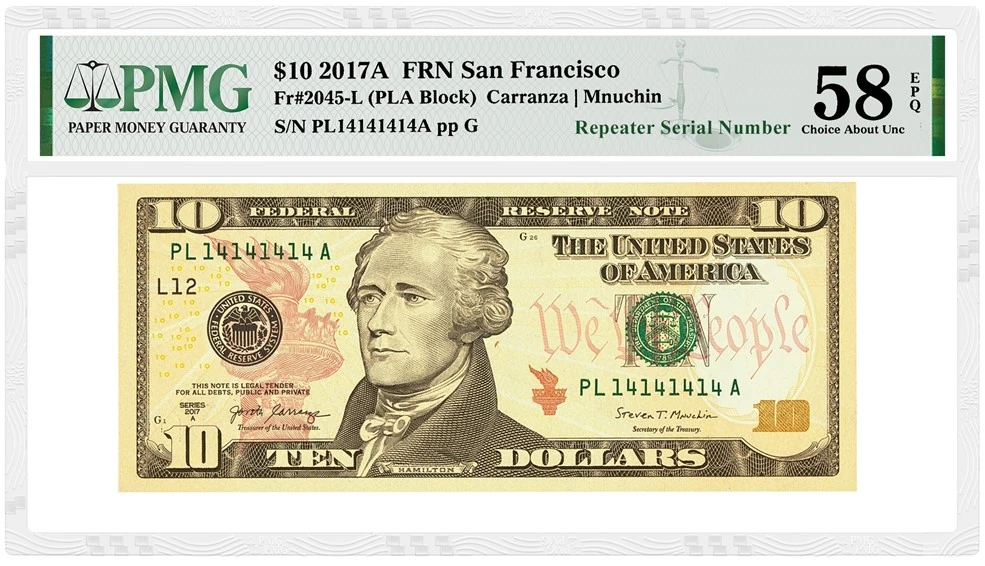
PL14141414A
Split the digits into 14 · 14 · 14 · 14. The same two-digit group repeats four times across the serial.
High and solid: 99999999
Series 1999 · $10 · Boston
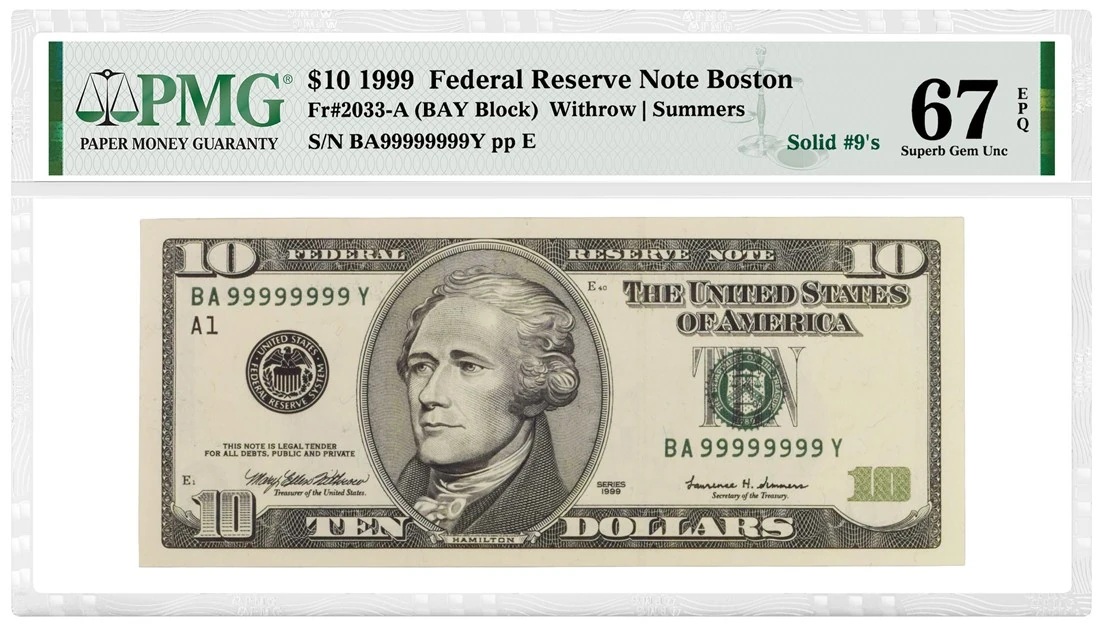
BA99999999Y
This note combines the highest eight-digit number with a solid-9 pattern. It is one of the documented twelve-note set discussed in the sale-record section, not a typical circulation find.
Low and high numbers need context
A listing calling a number “low” should tell you how low. PMG’s published fancy-number guide specifically recognizes serials 1 through 10; sellers may use a broader threshold. Do not treat every number with a leading zero as equally desirable.
High numbers need an extra production check. A numbering block is a group sharing identifying letters; do not assume every block reaches 99999999. PMG documents special BEP premium sets containing solid-9 notes and explains why high-range numbers are not a routine modern circulation issue. An exceptionally high serial should prompt research into its series and original distribution, not an immediate claim of rarity or a printing error.
The numeric serial is 2. Preserve the leading zeros and record replacement status separately.
A documented solid-9 issue. Establish the issue and distribution before calling a high number a circulation rarity.
Binary has competing definitions
PMG’s published definition uses only 0 and 1 and lists exclusions, so merely matching those digits does not guarantee its designation. In marketplace descriptions, “binary” may instead mean any two distinct digits. Describe 27272727 as a two-digit repeater and state the digits used, rather than assuming it qualifies under the stricter definition.
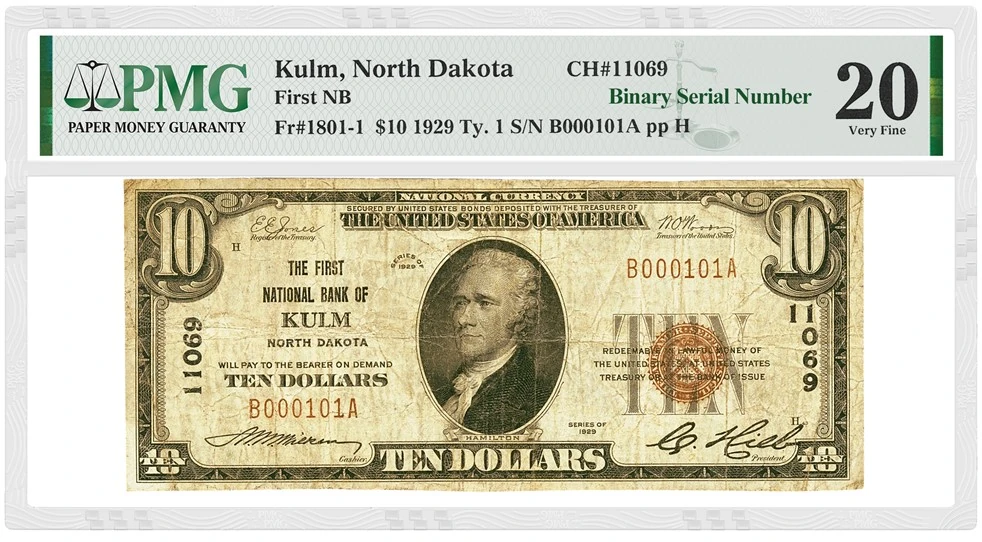
PMG identifies this Series 1929 $10 National Bank Note from Kulm, North Dakota as binary. Its numeric portion uses only 0 and 1. This older issue has six numeric digits; it is not an example for the eight-digit counting table below.
A birthday number needs a buyer who wants that date
A clear date can make a meaningful gift or personal collectible. State the format: 04051990 means April 5 in MMDDYYYY but May 4 in DDMMYYYY. An impossible date, such as 02311990 in MMDDYYYY, does not become valid because a listing calls it a birthday note.
The date’s personal importance does not establish a general market premium. A number associated with a famous event also needs evidence of buyer demand, not just a compelling story.
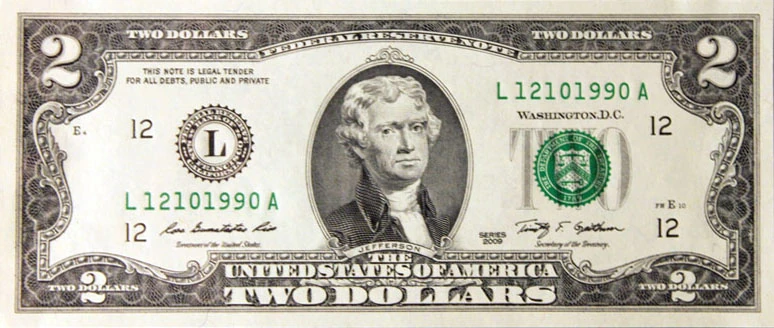
This collector-shared Series 2009 $2 note reads 12 / 10 / 1990 in MMDDYYYY: December 10, 1990. In DDMMYYYY it reads October 12. State the intended format; the photograph illustrates the date pattern, not a verified sale or a professional authentication.
3. How to tell whether your number really qualifies
Test the exact number before searching for a price. A pattern should work without dropping an inconvenient digit, rearranging the sequence or ignoring a leading zero.
- Copy and cross-check. Compare your transcription with both printed serials and a sharp photograph.
- Write the rule. For
12344321, reverse all eight digits and compare. For12341234, split the number into two four-digit halves. - Look for the exception.
12344322fails the radar test;12345679fails a consecutive ladder test. A near match should not be priced as the complete pattern. - Separate overlapping labels.
01011010is both a radar and a 0/1 pattern. Two labels describe one note; they do not justify adding two price estimates. - Check the issue and the printing. A copied photograph or an altered digit can imitate a desirable serial. A pattern match cannot authenticate paper, ink or the note itself.
Read the full serial on the note, then separate the eight digits: 14 · 14 · 14 · 14. This passes the repeater test. Reversing the digits gives 41414141, so it is not a radar. Keep the letters in the identification record.
A fancy serial number checker can be useful for testing digit rules. Its result should explain the rule and any exclusions. A novelty score or “rarity percentage” is not a sale price, an authentication result or a count of surviving notes.
4. Which patterns are relatively rare?
On pattern counts alone, solids are much less common than radars or four-digit repeaters. However, counts of possible numbers are not the odds of finding a note in change.
One digit occupies every numeric position. The pattern is one of the ten theoretical solid strings counted below. This is the same photographed specimen shown in the type examples, reused here to compare the rules.
The first four digits, 1414, repeat as the last four. The same note also repeats the shorter group 14; overlapping labels do not create extra notes. This is the same photographed specimen shown in the type examples, reused here to compare the rules.
The calculations below use an artificial set containing every eight-digit string from 00000000 to 99999999: 100 million possibilities. They include strings that may not be issued. They are calculations of patterns, not printing statistics or grading-service eligibility.
| Rule | Matching strings | Calculation |
|---|---|---|
| All digits identical | 10 | Choose one digit: 10 choices. This includes all zeros. |
| Only 0 and 1 allowed | 256 | Two choices at each position: 28. This includes all-zero and all-one strings. |
| Reads the same in reverse | 10,000 | Choose the first four digits; the last four are fixed: 104. |
| First four digits repeated | 10,000 | Choose the first half and duplicate it: 104. |
These groups overlap, so their totals must not be added together. A birthday count also depends on the date format and year range chosen. “Low” and “high” need an explicit cutoff before a count is meaningful.
Real availability depends on which numbers were printed, which notes survived, which were saved and their condition today. The same eight-digit pattern can occur in different blocks and series. A scarce pattern can still have limited demand, while a particular issue or an exceptionally well-preserved example may attract stronger competition.
5. What determines how much a fancy-serial bill is worth?
There is no dependable price list based only on the eight digits. Estimate the whole note by matching its pattern, issue and condition to actual sales.
- Pattern and exact number. A complete pattern and a near match are different comparisons. A single-digit low number should not be valued from sales of loosely described “low” five-digit numbers.
- Condition. Folds, tears, stains, writing, repairs, paper originality, margins and centering matter. PCGS’s grading standards distinguish wear and impairments; a note that looks crisp in a photograph should not automatically be called uncirculated.
- Denomination. A $100 bill has a higher face value than a $1 bill, but that does not prove a larger collectible premium. Record both the total sale price and the amount above face value.
- Series and issue. The series, signatures, district, block and replacement status help identify a suitable comparison. Age alone is not a price multiplier, and a scarce issue can be valuable independently of its serial pattern.
- Buyer demand. A specific date, favorite digit or matching set can appeal strongly to one buyer and weakly to another. A memorable auction result may not be repeatable.
If you cannot find comparable completed sales, describe the premium as unestablished. Do not fill the gap with a seller’s asking price or a calculator’s unsupported estimate.
6. How to research real sale prices
Start with auction archives and marketplace sold records. Search for the denomination, pattern and relevant issue details—for example, “$1 1977 radar PMG 67”—then inspect the actual lot rather than relying on a search snippet.
- Confirm that it sold. An active listing, estimate, reserve or unsold lot is not a completed transaction. If a best-offer amount is hidden, do not substitute the crossed-out asking price.
- Match the note. Compare the pattern’s strength, denomination, series, grade and any condition comments. Separate single-note sales from groups or complete sets.
- Record the price basis. Note the sale date, currency and whether the reported amount includes buyer’s premium. Shipping, tax and the seller’s fees are separate considerations.
- Use several relevant records when available. Retain the photographs or lot identifiers. Explain why a comparison is weaker if its condition or issue differs.
A real result—and why it is not a price for your bill
PMG reported that a set of twelve Series 1999 $10 Federal Reserve notes, each with a solid-9 serial and representing all twelve districts, realized US$149,000 including buyer’s premium at World Banknote Auctions on February 24, 2023, lot 1146.
One of the twelve notes in the reported 2023 sale.
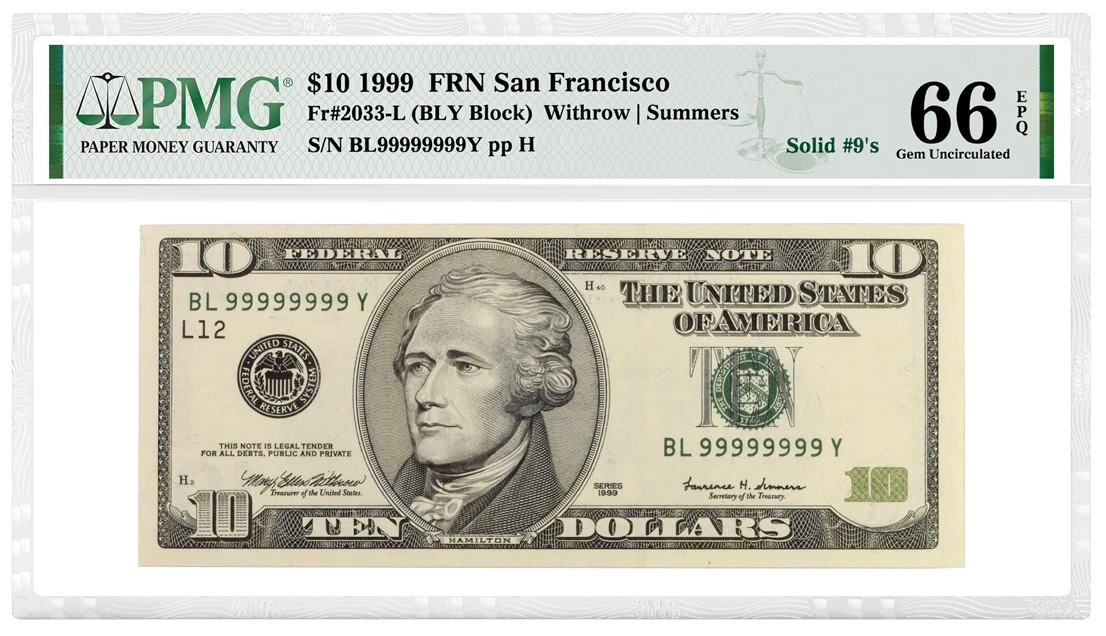
Another member of the same set. The US$149,000 result is for all twelve notes, not these two or either note individually.
That was a complete, certified set. It is evidence for that particular sale, not a valuation for one ordinary $10 bill, a near-solid number or a birthday note. Dividing the total by twelve would not establish a reliable individual-note price.
For a more focused comparison exercise, Heritage’s April 8, 2025 lot 82267 identifies a Series 1977 $1 radar, 99000099, graded PMG 67 EPQ. Its denomination, pattern and grade make it a useful record to inspect. Where the realized price requires sign-in, retrieve the result before using it in an estimate. EPQ means Exceptional Paper Quality; compare both the numeric grade and the condition designation when selecting similar records.
A practical research record is: full serial → denomination and series → pattern → condition → comparable lot and date → price basis → reasons it differs from your note.
7. What can a dollar bill serial number lookup tell you?
A dollar bill serial number lookup can help organize numbering or issue information when the reference covers that denomination and series. It cannot establish a specific note’s market value from the digits alone. The condition and authenticity of the physical bill are missing from a text entry.
Also distinguish a printed banknote serial from a grading-holder certification number. PMG’s certification lookup uses the holder’s certification number and grade to retrieve its record. It is not a universal database of every dollar bill in circulation. Compare the returned information with the actual note and holder.
8. Identify the note with HeriBase, then resolve specific doubts
Use HeriBase to photograph and identify the banknote, then compare the suggested issue information with the denomination, printed series and issuer details visible on your note. Photograph both sides clearly, with all edges visible, and take a separate close-up of the full serial. Leave the note as found: do not wash, iron, press or repair it to improve the photograph.
Read the digits yourself and apply the pattern checks in this guide. HeriBase’s identification result helps establish the note’s context; it should not be treated as proof of a fancy-number designation, authenticity, professional grade or guaranteed selling price. This article is a knowledge guide, not an online serial-number checker.
If you disagree with the result, cannot confirm the issue, or have evidence suggesting a substantial premium, request a human expert appraisal in HeriBase. Send the original identification, front and back photographs, a serial close-up and any relevant sale records. Ask a specific question, such as whether the serial meets a recognized definition or whether the comparison is appropriate for the note’s condition.
Check the expert’s scope, fees and requested photographs before submitting; the HeriBase user guide explains the appraisal workflow. If photographs cannot resolve suspected alterations, authenticity or condition, arrange physical examination through a suitable professional banknote authentication or grading service. The likely collectible premium should justify the total cost of review, shipping and any certification.
Summary
Treat an unusual serial as a reason to investigate, not as a price tag. Keep a record of the complete serial, denomination, series and condition. Confirm the exact pattern and its definition, then compare genuinely similar completed sales. Neither an attractive date nor a small mathematical pattern count proves a market premium.
The US$149,000 result in this guide was for a certified set of twelve solid-9 notes. It is not a price for one note, and dividing it by twelve does not produce a reliable valuation. Preserve the note as found, and keep the photographs and comparison records with any estimate.
HeriBase can help identify the banknote and establish its issue context. Request human expert review if you dispute the result, cannot resolve a detail or have evidence of significant value; arrange physical examination when photographs cannot settle authenticity or condition. If comparable sales do not support a premium, keep the value open rather than assigning an unsupported price.
FAQ
Is a star note automatically a fancy serial number?
No. A printed star identifies a replacement note; it does not by itself create a fancy digit pattern. Evaluate replacement status and the numeric pattern separately. Neither alone guarantees a premium.
Are consecutive serial numbers the same as a ladder?
No. Two bills numbered 12345670 and 12345671 are consecutive to each other. A ladder describes the digit sequence within one serial, such as 12345678.
Does every birthday serial number sell for extra money?
No. A valid date may have personal meaning without a demonstrated resale premium. State the date format and look for completed sales relevant to that kind of note, rather than assuming any eight-digit date is valuable.
Can an ordinary-looking serial still be on a valuable bill?
Yes. A note can be collectible because of its issue, scarcity or condition even when the serial lacks a special pattern. Identify the whole banknote before dismissing it.
Should I pay for grading as soon as I find a pattern?
Not automatically. First confirm the pattern and look for comparable sales. Consider grading when independent examination is useful and the likely premium can justify the fees and shipping; certification does not guarantee a profitable sale.
References
Sources and further reading
- PMG: Fancy Serial Numbers on Currency — recognized patterns and the stricter binary definition.
- U.S. Currency Education Program: Banknote Identifiers and Symbols — serials, replacement stars, district indicators and series years.
- PMG: Solid-9 notes in the 1995 BEP premium set — context for high serials and special distributions; the cited pre-sale estimate is not used as a realized price.
- PCGS Banknote Grading Standards — condition and impairments.
- PMG: February 2023 auction results, including the twelve-note solid-9 set — reported result including buyer’s premium.
- Heritage Auctions: Series 1977 $1 radar 99000099, lot 82267 — an example of an individual-note comparison record; price access may require sign-in.
- PMG Verify Certification — lookup of a grading-holder record.
- PMG: Solid Serial Numbers — photographed Series 2001 $10 solid-5 note.
- PMG: Repeater Serial Numbers — photographed Series 2017A $10 repeater.
- PMG: Binary Serial Numbers — the six-digit Kulm example
- CoinTalk: collector 50011005, post 8 — Series 2009 $2 birthday photograph
Banknote photographs: PMG / Certified Collectibles Group; birthday photograph: CoinTalk contributor 50011005. Original note details are preserved. Image credits
References checked October 10, 2026. Pattern counts are explicit calculations in this guide, not production or population data. Historical auction results describe specific lots and are not current offers for another note.