

 App Store

PAPER MONEY · ERROR GUIDES
Dollar Bill Errors: Types, Identification and Value
A practical guide to unusual printing, cutting and serial numbers—and the evidence needed before calling a bill valuable.
HeriBase Team · Published
In this article
Quick answer
A dollar bill error is a mistake made during official production—not simply a bill that looks unusual. Genuine errors can attract a premium, but the type, authenticity, condition and demand determine whether a particular note is worth more than face value.
Photograph both sides with every edge visible. Identify the denomination and series, compare the design with a normal note of the same issue, and describe exactly what is misplaced, missing or repeated. Check whether the appearance fits a printing or cutting error rather than ordinary variation, wear or alteration.
Once the error is reasonably established, research completed sales of closely comparable notes. Do not price a slightly uneven border from a spectacular auction record. If the cause or authenticity remains uncertain, preserve the note as found and seek expert review before assigning a premium.
1. What counts as a dollar bill error?
The key question is when the abnormality happened. A production error originates while a banknote is being made. Damage or modification after that process does not become a production error merely because the result looks dramatic.
U.S. currency passes through several printing and finishing operations. The Bureau of Engraving and Printing describes separate stages for designs, numbering, inspection and cutting; the equipment and details vary by denomination and issue. That sequence matters: an irregular border, a missing design and misplaced serial numbers can have different causes.
Use “misprint” as an initial description, not a final diagnosis. Record an observation such as “the right serial overlaps the border” before deciding which error name applies. For the basic identification record, see How to Identify Old Paper Money and Check Its Value.
Three things to keep separate
- Production error: an abnormality created during manufacture.
- Issue or design variety: a documented difference in the normal issue, such as a series or signature combination.
- Fancy serial number: a collectible arrangement of digits, which can appear on an otherwise normally printed note.
A star or an attractive serial pattern alone does not establish a printing error. Our fancy serial number guide explains that separate collecting category.
2. Common error types: what should you look for?
Start with the affected feature, then compare the rest of the note. The table is a recognition aid, not an authentication test. PCGS and PMG publish illustrated designations; their terminology and acceptance criteria should be checked for the exact case.
| Type | Visible clue | Next check |
|---|---|---|
| Misalignment / shifted overprint | A design layer or the seals and serials sit out of position. | Compare both faces; an uneven margin alone is insufficient. |
| Cutting error | The sheet was cut in the wrong position. | Inspect all edges and both designs; exclude later trimming. |
| Missing print / insufficient ink | A printing is absent, or parts appear unusually faint. | Determine what should be present and whether ink remains. |
| Gutter fold / printed foldover | A fold affected the design during production. | Distinguish interrupted or displaced printing from an ordinary crease. |
| Offset transfer / doubled print | An extra transferred image or another impression appears. | Record orientation and location; exclude added printing. |
| Inverted back / inverted overprint | A face or overprint is reversed relative to the other elements. | Keep a consistent orientation when photographing both sides. |
| Obstructed printing | Material blocked ink; occasionally the obstruction remains attached. | Leave the surface and any attached material untouched. |
| Mismatched serials | The two serials on one note disagree. | Transcribe every character directly from both printed locations. |
| Double denomination | The face and back represent different denominations. | Physical examination is especially important to exclude alteration. |
A gutter fold can leave a narrow unprinted gap where folded paper kept ink off the surface. In a printed foldover, a folded part receives printing in an unexpected position. An offset can add a reversed transfer of the opposite design; a doubled print is an additional impression. These distinctions explain why “a crease” or “extra ink” is not a complete attribution.
Read the error on the banknote
These four documented examples show the affected banknotes. Compare the visible printing and paper edges with the explanation below. A similar-looking photograph is a lead to investigate, not proof that your note has the same error.
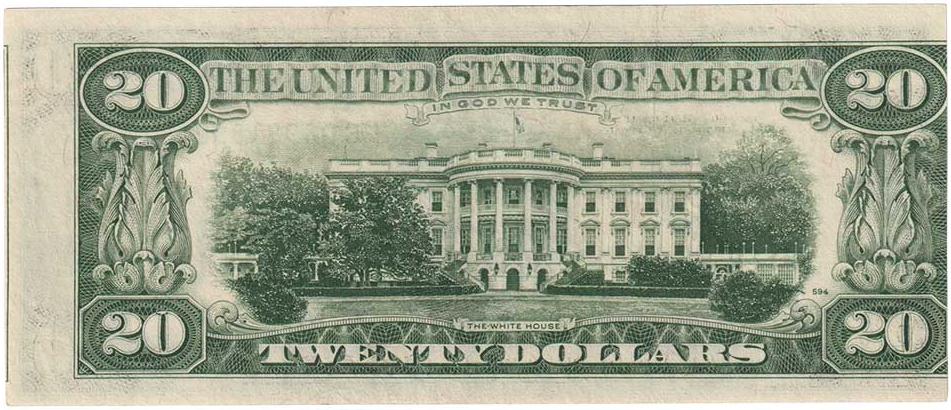
The back design sits close to the right edge. Record which printed layer moved; compare the opposite face before diagnosing your own note.
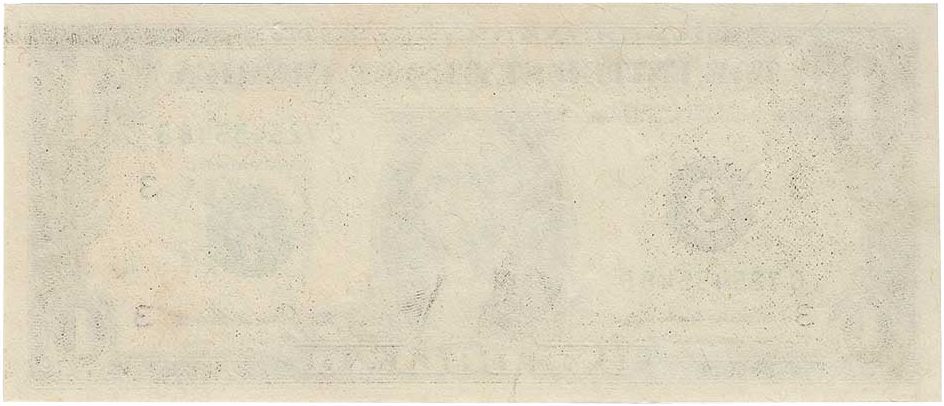
The back design is absent on this attributed specimen. A blank-looking surface on another note still needs examination.
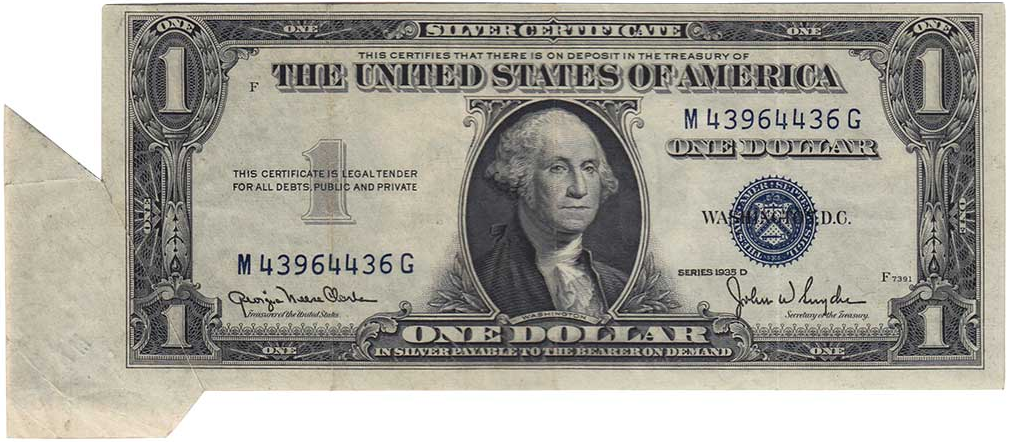
Notice the projecting paper at the left. This is a printed foldover example, not an illustration of an ordinary circulation crease.
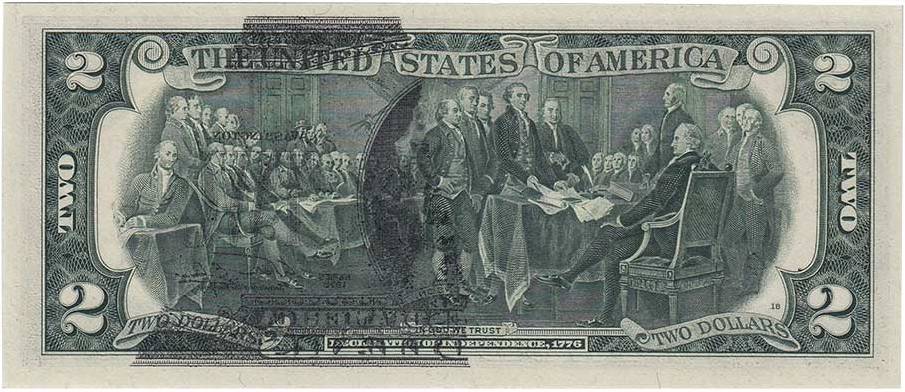
An extra portion of the face design appears over the back. Observe its position and orientation.
For an inverted image, photograph the note in a fixed orientation and turn it over left to right, keeping the top edge at the top. Two independently rotated seller photographs cannot establish an inversion. Also distinguish a transferred image from an extra direct impression; the appearance and production mechanism are not interchangeable.
3. Is an off-center or miscut dollar bill valuable?
Not automatically. First distinguish a shifted print, an abnormal cut and ordinary centering variation. PCGS states that slight misalignments can fall within tolerance. A wider margin on one edge does not, by itself, establish a collectible error.
Ask three separate questions:
- What moved? Compare the face design, back design and overprint with the paper’s edges.
- How clear is the departure? Note whether a design is clipped, another note’s design appears, or one printed layer crosses another. Describe the visible evidence rather than inventing a universal millimeter cutoff.
- Could the paper have been cut later? A photograph of a dramatic border cannot establish who cut it or when.
PMG has documented notes cut from collector sheets to imitate errors. A genuine banknote can therefore have an artificial “error.” Do not trim an irregular edge to make it tidy, and do not assume that a genuine-paper result authenticates the cutting history.
For valuation, compare confirmed examples of the same error and similar severity. A strong shift and a barely uneven border are not interchangeable sale comparisons.
4. Real error, wear or alteration?
Check whether the abnormality fits the production sequence and the surrounding paper. Start with non-destructive observation. Washing, rubbing, erasing or applying chemicals can remove evidence and damage the note.
| What you see | Why it needs checking | Useful evidence |
|---|---|---|
| A pale area | Weak printing, wear and chemical removal can look similar in a small photo. | Full-face photographs plus a close-up of the transition into unaffected printing. |
| A white line or fold | A production fold and a circulation crease have different histories. | Both sides, showing how the design meets the line. |
| An extra image or mark | It might be production-related or added later. | Orientation, ink appearance and specialist examination of the original. |
| Missing serials | Missing digits alone do not explain the cause. | Both serial areas, seals, surrounding design and issue details. |
Documented counterexample: missing numbers on an altered $1 note
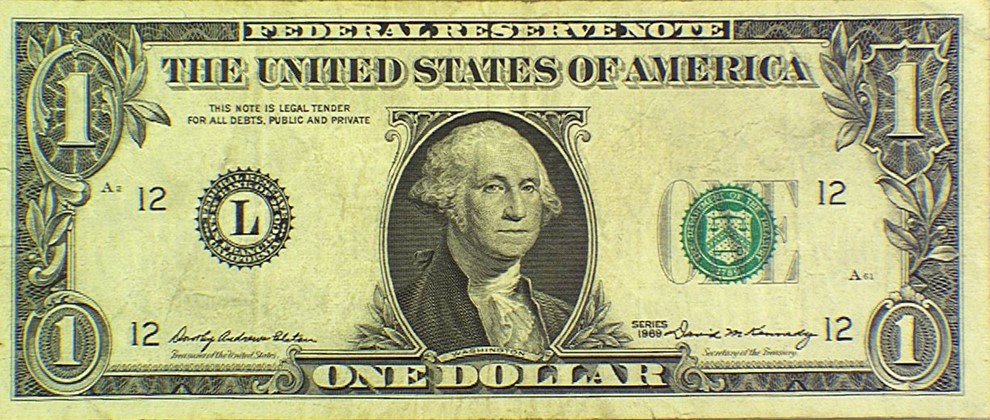
The serial areas are empty, while the green seal remains. PMG’s examination found evidence of removal.
PMG examined this Series 1969 $1 note and determined that its serials had been chemically removed. The green Treasury seal remained, and examination under special lighting revealed discoloration in the serial areas.
That is a finding about this specimen—not a rule that every missing serial is fake. The useful lesson is to test the proposed cause against all the evidence. A photograph may reveal a concern without settling it.
When a review cannot establish the cause, describe it as unresolved. “Possibly altered” and “confirmed production error” are different conclusions and should lead to different valuation decisions.
5. What if the two serial numbers do not match?
A genuine mismatch concerns two serials printed on the same note. It is different from a fancy sequence or a claim that two separate notes share a number.
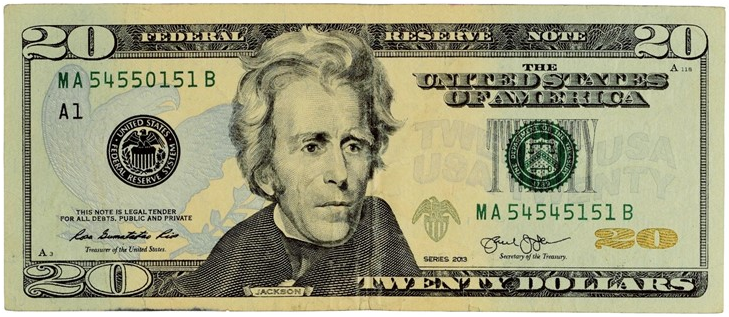
Compare the middle digits in both locations. The complete note is shown so both serials can be checked together.
PMG documented the photographed Series 2013 $20 Boston note with MA54550151B at one location and MA54545151B at the other. The middle pair differs: 50 versus 45. PMG certified it as a mismatched serial number error and graded it 30 Very Fine.
To check your note, write the serials on separate lines and compare them character by character, including prefixes and suffixes. Check the original under clear light; text recognition, glare and a folded corner can create an apparent mismatch. Keep one full-face photograph showing both locations together, plus readable close-ups.
A discrepancy is a reason to request review, not permission to skip authentication. Do not use a seller’s typed serial or a novelty serial-number score as proof of the physical printing.
6. What determines an error note’s value?
There is no reliable flat price for “a misprinted dollar bill.” Establish what the note is, then judge whether the available sale evidence actually matches it.
- Confirmed error type: a label should describe a supported diagnosis, not merely the owner’s guess.
- Extent and clarity: compare how much of the design is affected and how readily the feature can be seen.
- Issue and denomination: record the series, district and other relevant issue details. Compare premiums as well as total prices.
- Condition: folds, stains, tears, repairs and paper quality affect comparability even when the production error is genuine.
- Demand and evidence: look for actual buyers of similar examples, not just unusual asking prices.
Keep the production abnormality separate from later damage. A note can have both; the error does not erase a tear or a repair. A certificate can clarify the opinion on an item, but it does not guarantee a buyer or a profitable resale.
If confirmed comparable sales cannot be found, leave the premium open. An unsupported precise figure is less useful than a clearly explained uncertainty.
7. How to research actual sold prices
Use completed transactions for similar individual notes, and record what the price includes. A listing price, estimate or reserve is not a sale result. A hidden best-offer amount cannot be recovered from the crossed-out asking price.
- Search with the denomination, series and suspected error, then inspect the full lot description and photographs.
- Confirm the sale date and whether the lot sold. Separate single notes from groups.
- Compare the error’s extent, grade and condition comments. Record material differences.
- Record currency, buyer’s premium and other known charges. A buyer’s total is not the seller’s net proceeds.
- Use several close comparisons when available. If only one exists, call it a single historical reference rather than a market range.
The Del Monte note: an exceptional result, not a general price guide
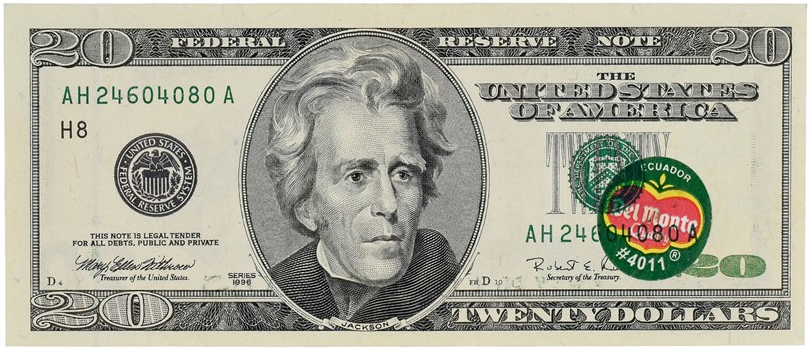
Look at the relationship between the sticker and the later printing. The significance is when the obstruction was present.
The Series 1996 $20 “Del Monte” note retains a banana sticker with part of the later printing on top. PMG attributed a retained obstruction and graded it 64 EPQ; EPQ means Exceptional Paper Quality. PMG’s auction report records US$396,000 including buyer’s premium at Heritage on January 22, 2021.
This is a historical result for one distinctive, certified specimen. It cannot price an ordinary sticker, stain, slight shift or unverified obstruction on another note. An object attached after manufacture does not gain the same significance.
A compact research record is: note identity → observed feature → attribution and grade → comparable lot → sale date and price basis → differences that limit the comparison. Keep the photographs with that record so the reasoning can be checked later.
8. Identify the note, then resolve the uncertainty
HeriBase identification → human expert review → physical examination if needed
Use HeriBase to photograph and identify the banknote’s issue. Compare the result with the denomination, printed series and issuer information. An automated identity suggestion does not, by itself, confirm a production error, authenticity, professional grade or selling price.
If you disagree with the result or remain unsure about the abnormality, request a human expert appraisal in HeriBase. Ask a specific question: for example, “Does this missing area fit an obstruction, or is there evidence of removal?” Include:
- Full photographs of both sides with all four edges visible.
- Close-ups of the abnormal feature and both serials.
- The initial identification, relevant holder information and any comparison records.
- A short description of what you observed and what you want checked.
Check the selected expert’s scope, fees and photo requirements; see the HeriBase user guide for the appraisal workflow. If remote review cannot resolve authenticity, alteration or condition, arrange physical examination through a professional banknote authentication or grading institution. Consider the expected benefit against review, shipping and certification costs.
Until then, keep the note as found. Do not remove attached material, force open a fragile fold, iron it, wash it or repair it. Avoid unnecessary handling, and ask the receiving specialist for packing instructions before shipping an unusual or fragile example.
Summary
Confirm the cause before assigning the premium. Identify the issue, record both faces, compare the abnormal feature with documented production errors, and keep normal variation, damage and alteration in the comparison. Then research completed sales of genuinely similar notes.
An uneven edge is not automatically a valuable miscut, an attractive serial is not a printing error, and a famous auction result is not a price for your bill. HeriBase can help establish identity; use human review for disputed or uncertain findings and physical examination when photographs cannot settle the question. Preserve the evidence and leave the value open when the evidence is incomplete.
FAQ
Are all misprinted dollar bills worth more than face value?
No. The feature must be identified correctly, and an asking price does not establish demand. Slight variation, damage and artificial errors should not be valued as confirmed production errors.
Is a larger border on one side enough to prove a cutting error?
No. Compare both printed faces and all edges. Uneven centering can fall within normal tolerance, and a note may have been cut after production. Stronger evidence and sometimes physical examination are needed.
Does a star mean the note itself is an error?
No. A star indicates replacement status; it is not proof that the replacement note has a printing error. Check any suspected abnormality separately.
Can a photograph prove that a serial number was never printed?
Not reliably on its own. An absent serial may need examination of the ink, paper and surrounding features to distinguish a production cause from later removal. Do not test the note with chemicals.
Should I remove a sticker or flatten a folded corner?
No. Leave the note and attached material as found. If they are relevant to a possible production error, changing them can destroy useful evidence. Ask a specialist how to handle a fragile example.
Can HeriBase confirm an error and its value automatically?
An automated identification result is a starting point for the banknote’s identity, not a definitive error attribution or price. Request human expert review for disputed or uncertain findings; arrange physical examination when the evidence cannot be resolved remotely.
References
Sources and further reading
- Bureau of Engraving and Printing: How Money Is Made — Printing, inspection and finishing context.
- PCGS Banknote: Error Designations — Definitions, centering tolerance and the four illustrated comparison examples.
- PMG: Error Is Human, Part I — Misalignment, cutting, ink, folds and obstructions.
- PMG: Error Is Human, Part II — Serial mismatches, inversions and double denominations.
- PMG: Altered Notes vs. Repaired Notes — Artificial errors, including later cutting and added printing.
- PMG: Federal Reserve Note with Missing Serial Numbers — The altered 1969 $1 case and the limits of diagnosing missing serials from appearance.
- PMG: Mismatched Serial Number Error on a US $20 Bill — The photographed Series 2013 Boston note and its two serials.
- PMG: Del Monte Note Auction Result — January 22, 2021 result, grade and buyer’s-premium basis.
- Heritage Auctions: Del Monte Note Sale Announcement — Auction-house confirmation of the US$396,000 historical result.
References checked October 12, 2026. Auction figures describe a particular historical sale, not an offer for another note. Photographs: PCGS and PMG / Certified Collectibles Group. Image credits.