

 App Store

PAPER MONEY GUIDES · REPLACEMENT NOTES
Star Note Value:Replacement Bills, Print Runs and Real Premiums
Identify a replacement star on U.S. currency, separate it from fancy serial patterns and decide which issue and condition evidence can support a premium.
 HeriBase TeamPublished
In this article
Quick answer
A star at the end of a modern U.S. Federal Reserve note’s serial number identifies a replacement note. It does not automatically make the bill rare or establish a collector premium. A common worn $1, $2 or $20 star note still has its respective face value unless issue, condition or market evidence supports more.
To evaluate a star note, record the denomination, complete series, Federal Reserve district, full serial and condition. Then investigate the matching replacement issue and comparable completed sales. No universal “star note multiplier” can turn the denomination or a print-run count into a reliable price.
Note photos
Basics & note story
Replacement notes are part of production quality control. When imperfect notes or sheets must be replaced, the Bureau of Engraving and Printing uses a distinct serial convention rather than simply recreating the rejected number. The star belongs to the replacement identification; the replacement itself is not automatically a printing error.
A printed series year identifies a design or signature issue rather than necessarily the year that a particular sheet was printed. Modern $1 and $2 Federal Reserve notes use one prefix letter, while redesigned higher denominations use two. Check the format for the actual issue rather than applying one letter rule to every bill.
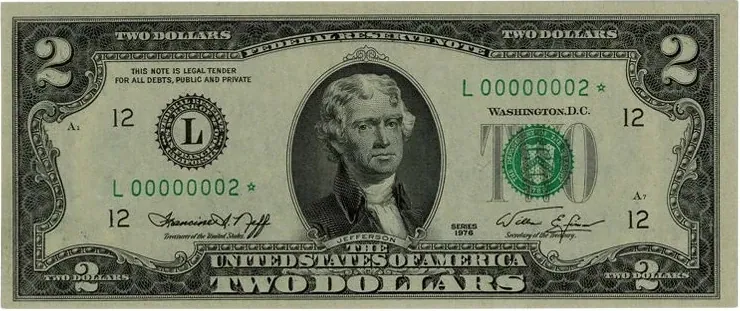
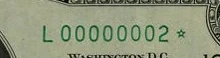
The photographed Series 1976 $2 has serial L00000002★. It combines replacement status with the very low number 2. It illustrates where to read the star, but it is not a representative common star note or a basis for pricing a random replacement bill.
| Feature | What to check |
|---|---|
| Scope | Modern U.S. Federal Reserve replacement notes |
| Replacement indicator | Star in place of the normal suffix letter |
| Essential issue fields | Denomination, series with suffix and Federal Reserve district |
| Serial record | All digits, leading zeros, prefix and star |
| Separate feature | Fancy digit pattern, if any |
| Condition | Folds, handling, tears, stains and original paper |
| Production evidence | Match denomination, series and block before using a report |
| Value basis | Face value plus any issue- and condition-supported collector premium |
Identification
Read the star and digit pattern independently
Transcribe the complete serial from both printed locations. The numeric string 00000002 is a low-number pattern; the star records replacement status. A replacement note can have an ordinary-looking number, while a fancy number can occur without a star. The fancy-serial guide handles exact pattern definitions and examples.
Use a star-note lookup as a production reference
Check which issues a lookup covers and match the denomination, series, district and serial block. If it reports a print run, establish what that number counts: a particular run is not necessarily the full replacement issue. A production count is not a surviving-population census.
The BEP’s monthly reports are primary production records. They do not grade the note in your hand or quote a collector price. A small run can justify further research, but no fixed threshold makes every note valuable. Demand, survival, distribution and condition still matter.
Separate a printed star from a holder designation
PMG’s Star designation on a grading label concerns exceptional eye appeal. It is different from the replacement star printed in the serial. Use the physical note’s serial to establish replacement status and the holder’s certification number for certification lookup; they are different identifiers.
Condition & value
Face values below are denominations, not promised premiums. No universal current premium is asserted without matching issue and condition evidence.
| Issue | Grade / condition | Value or reference | Basis | Important condition |
|---|---|---|---|---|
| Common worn replacement note | No premium independently established | Its printed denomination | Face-value starting point | A star alone does not supply a market premium |
| Crisp, problem-free star note | Exact issue and condition | Compare matching sold notes | Collector evidence | Do not assume an uncirculated grade from a flat photo |
| Documented scarcer replacement issue | Series, block and report verified | Issue-specific comparison | Production plus market evidence | A run count is not a price |
| Star plus fancy serial | Exact pattern and issue | Compare the combined attributes | Different collecting interest | Do not use a low-number result for an ordinary serial |
| App or lookup estimate | Assumptions and scope known | Research lead only | Reference estimate | Not authentication or a guaranteed offer |
A useful star note value chart is a decision chart, because a denomination does not identify a single replacement issue. For a $1 note, $1 is face value; for a $20 note, $20 is face value. Any additional amount needs relevant evidence rather than a copied range for another series.
Search completed single-note sales using the denomination, series, district, replacement status and realistic condition. Keep lots of multiple notes and unusually low serials out of ordinary comparisons. Record the date, currency and buyer’s premium; a seller’s asking price is not a completed sale.
Examine folds, corners, stains and repairs without ironing or washing the paper. Use the paper-money identification guide to build a complete record. HeriBase can help organize an initial identification, but an important authenticity or condition question may require expert or physical examination.
Summary
A star identifies replacement status, not a price. Record the complete issue and serial, check any production claim, then compare matching notes in matching condition. Keep a fancy pattern and a holder’s Star designation separate from the printed replacement symbol.
FAQ
Are star notes always worth more than face value?
No. A common worn replacement note may have no established collector premium. The exact issue, condition and matching sales determine whether more is supported.
What does a star on a dollar bill mean?
On the modern Federal Reserve notes covered here, a star replaces the serial suffix letter to identify a production replacement.
Does a small print run guarantee a valuable star note?
No. First establish what the report counts, then consider survival, demand and condition. A production number is not a price formula.
Is a PMG Star label the same as a replacement note?
No. The holder designation concerns eye appeal. Replacement status comes from the star printed as part of the note’s serial.
References
References and further reading
- BEP: serial formats and replacement stars
- BEP: monthly production reports
- U.S. Currency Education Program: note identifiers
- PMG: grading scale and designations
- PMG: fancy serials and the documented low-number example
References consulted October 26, 2026. Price tables retain the update dates stated in the text; guide estimates, face values and completed transactions are different forms of evidence.