

 App Store

PAPER MONEY GUIDES · TWO-DOLLAR NOTES
$2 Bill Value:Series, Seal Colors, Serial Numbers and Condition
Identify modern and older U.S. two-dollar bills, separate red-seal United States Notes from green-seal Federal Reserve notes and check when a premium needs evidence.
 HeriBase TeamPublished
In this article
Quick answer
A common worn modern $2 Federal Reserve note usually starts at its $2 face value. The denomination, a 1976 series date or consecutive serials alone do not establish a large collector premium. Older red-seal issues, scarcer series, exceptional condition, verified printing errors and desirable serials require their own comparisons.
Read the printed issue title, complete series, seal, signatures and serial, then assess the paper. There is no single reliable price for all two-dollar bills. A high-grade low-number replacement note and an ordinary circulated green-seal note are different items even though both say TWO DOLLARS.
Note photos
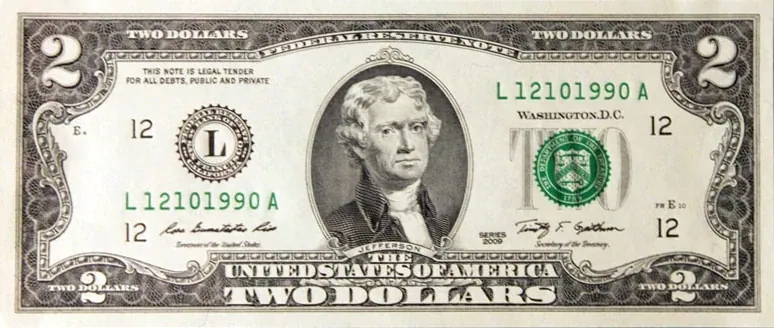
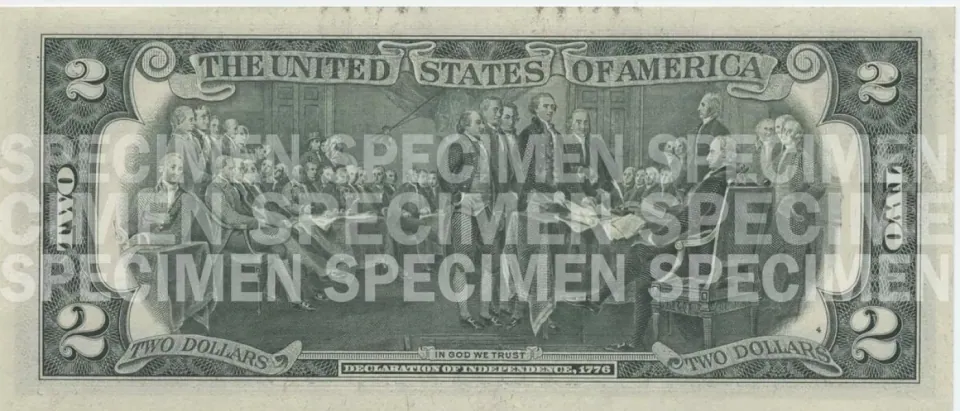
Basics & note story
U.S. $2 notes have existed in several forms since the nineteenth century. The first 1862 Legal Tender issue pictured Alexander Hamilton; later issues adopted Thomas Jefferson. The smaller 1928 format continued Jefferson and used Monticello on the reverse.
The modern Federal Reserve version was released in 1976 for the Bicentennial, with a reverse vignette depicting the signing of the Declaration of Independence. That historical scene does not turn each surviving 1976 note into a rarity. A printed series year identifies the issue, not necessarily the individual note’s printing date.
The front photograph shows an existing Series 2009 note; the reverse is an official educational SPECIMEN image illustrating the modern design, not the back of that same physical note. Older red-seal United States Notes use different issue inscriptions and reverse designs. Begin with the whole note rather than applying a modern green-seal reference to every Jefferson portrait.
| Feature | What to check |
|---|---|
| Denomination | Two U.S. dollars; face value is $2 |
| Modern issue class | Federal Reserve Note; green Treasury seal |
| Earlier common small-size class | United States Note; red Treasury seal |
| Modern portrait / reverse | Thomas Jefferson / Declaration of Independence vignette |
| Modern format | Approximately 6.14 × 2.61 inches |
| Identifiers | Full series including suffix, signatures, district and complete serial |
| Paper condition | Folds, handling, corners, stains and repairs |
| Separate premium features | Verified special issue, fancy serial, replacement status or printing error |
Identification
Read Federal Reserve Note or United States Note
The green-seal modern note is not the same issue class as a red-seal United States Note. Read the title and series and compare the reverse. A red seal can guide your research without proving that a damaged example has a high value.
Check the full serial rather than its first few digits
Keep the leading zeros, district letter and suffix or replacement star. A low serial must be low across the complete numeric portion; an interesting-looking prefix alone is not the same thing. The fancy-serial guide explains exact patterns, and the replacement-note guide separates a star from scarcity.
Consecutive notes are simply a sequence. They do not automatically form a rare ladder or printing error. A seller’s name for a pattern should be checked against the actual eight digits and the issue’s numbering format.
Identify additions and damage before pricing
A privately added stamp, sticker, gilding or colorized portrait does not by itself create an official special issue. A first-day postmark is not the same as a BEP printing error. Describe any addition and its provenance separately, then find comparable items with the same alteration and context rather than borrowing an unaltered-note price.
Condition & value
The $2 amount is face value for an ordinary modern note, not a guaranteed collector premium. Older issues and specialized attributes need matching evidence.
| Issue | Grade / condition | Value or reference | Basis | Important condition |
|---|---|---|---|---|
| Common worn modern Federal Reserve note | Ordinary issue; no premium established | $2 starting point | Face value | An uncommon denomination in change is not proof of rarity |
| 1976 modern note | Series and condition confirmed | Compare its actual issue | No universal premium asserted | Bicentennial date alone does not establish scarcity |
| Older red-seal United States Note | Exact series, signatures and grade | Separate catalog and sold-note comparison | Different issue class | Do not use a generic green-seal price |
| Star or fancy serial | Complete attributed identity | Compare combined attributes | Collector evidence | An ordinary sequence is not automatically fancy |
| High-grade or verified error | Exact grade and attribution | Use matching completed lots | Specialized market | A flat photo or fold alone is insufficient |
If an ordinary circulated modern note has no verified premium feature, $2 is the useful baseline. Crisp original notes and specific older issues may attract collectors, but a premium should be supported by comparable notes rather than an unsupported internet range.
Compare the same denomination, series, signature combination, replacement status and condition. Record the sale date, lot number, currency and fee basis. A pack of consecutive notes, an uncut sheet and one loose bill are different products; do not divide a whole set price without understanding what buyers paid for.
Do not iron or wash a note to make it look uncirculated. Retain original packaging, collector envelopes and any sales record as leads to verify. HeriBase can help organize the initial identification; the paper-money value guide covers detailed photographs and specialist review when condition or authenticity remains unresolved.
Summary
Identify the issue class, full series and serial, then assess original paper condition. Start an ordinary worn modern note at $2. Research older red seals and verified premium features separately, using completed sales of comparable notes rather than a denomination-wide price claim.
FAQ
Are two-dollar bills always worth more than $2?
No. A common worn modern Federal Reserve note usually starts at its $2 face value unless additional evidence supports a collector premium.
Is every 1976 $2 bill rare?
No. The series date marks a historic modern design issue, but date alone does not establish rarity or condition.
What does a red seal on a $2 bill mean?
On the small-size issues discussed here it identifies a United States Note, a different issue class from the modern green-seal Federal Reserve note. Read the full title and series.
Are consecutive $2 bills automatically fancy serials?
No. Consecutive numbers are a sequence. A recognized fancy pattern must be checked within the full numeric serial of each note.
References
References and further reading
- U.S. Currency Education Program: modern $2 identification
- PCGS: historical $2 designs and red-seal issues
- BEP: serial-number formats
- PMG: grading and original paper
References consulted October 26, 2026. Price tables retain the update dates stated in the text; guide estimates, face values and completed transactions are different forms of evidence.