

 App Store

PAPER MONEY GUIDES
1976 $2 Bill Value:Series, Star Notes and Condition
Check the Bicentennial $2 note’s district, replacement star, paper condition and postal cancellation before comparing a price.
 HeriBase TeamPublished
In this article
Quick answer
An ordinary circulated 1976 $2 Federal Reserve note is generally a face-value starting point, not a rare Bicentennial treasure. Collectors assess uncirculated paper, district and serial-number combinations, replacement stars and documented postal cancellations separately.
The dated sale below is $195.20 for five graded, postally cancelled notes together. It is not a $195 price for every 1976 two-dollar bill.
Banknote reference photos
What this series represents
The return of the $2 denomination in 1976 paired Jefferson’s portrait with a new back adapted from John Trumbull’s Declaration of Independence painting. Earlier small-size red-seal twos used Monticello. That reverse change is a useful way to separate the Bicentennial Federal Reserve issue from the older United States Note.
The denomination’s relaunch on April 13 encouraged collectors to attach postage stamps and obtain first-day cancellations. Later cancellations also exist. A stamp is a collectible addition to a note, rather than evidence of a Bureau of Engraving and Printing production error. The postal date and place need to be read as carefully as the currency series.
How do you identify the right issue?
Which seal and district should I see?
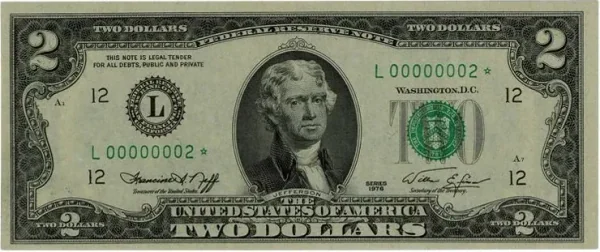
Read FEDERAL RESERVE NOTE above the portrait and locate the green Treasury seal and green serials. The black district seal identifies the issuing Federal Reserve Bank. Record the district letter and full serial, including the suffix, before researching prices. A district letter is not a coin mint mark.
What does the star mean?
A printed star at the end of the serial identifies a replacement note. It does not automatically establish a scarce run or a large premium. Match the 1976 district, replacement status and condition; do not apply a modern run lookup without checking its historical coverage. The pictured exceptionally low serial is a special-number example, not an ordinary star-note baseline.
Is my cancellation actually from the first day?
A 1976 series date is not enough. Read the postmark: April 13, 1976 is different from a July 4, 1980 cancellation. Check that the cancellation and any stamp are visible in the photographs, then compare notes with a similar postal treatment. Do not add a stamp to an unmarked note in an attempt to create a historical first-day issue.
Which apparent errors should be separated?
An uneven margin can be an ordinary cutting variation. Genuine mismatched serial numbers, folds printed into the design or missing printing need exact attribution. A handwritten star, a torn corner or a postal stamp is not the same as a replacement star or printing error. Use the banknote error guide for the mechanism rather than a price inferred from appearance.
What does the value evidence actually show?
| Issue / check | Condition / identification | Value / composition | Evidence / basis | Comparison limit |
|---|---|---|---|---|
| Ordinary non-star | Circulated; normal serial | $2 face value | Legal-tender baseline | A premium needs matching sales |
| Non-star | Uncirculated | Compare same district and grade | Collector condition market | Crisp appearance alone does not certify a grade |
| Replacement star | Exact district and grade | No universal star price | Separate replacement issue | Special serials can distort comparisons |
| Five sequential Fr.1935-G notes | PMG Choice Uncirculated 64; postal cancellations | $195.20 for the entire five-note lot | Heritage 142622, lot 81329; June 2, 2026 | Includes 22% buyer’s premium; not a single-note price |
Heritage’s five-note lot carried sequential serials and July 4, 1980 Mokena, Illinois postal cancellations. The reported total of USD $195.20 includes the buyer’s premium; shipping and applicable taxes are separate. It illustrates a graded postal group, not an April 13, 1976 first-day group and not ordinary change.
For a loose note, compare at least several completed sales with the same district, star status and paper grade. A dealer’s purchase offer can be lower than an auction buyer’s total. Read the broader $2 bill value guide when sorting a mixed collection, and the star-note guide before paying for a replacement symbol.
Summary
Keep the note unaltered, record its district and entire serial, and read any postal date independently. Ordinary circulated paper, high-grade replacements and cancelled collector groups need different comparables.
Frequently asked questions
Is every 1976 $2 bill valuable?
No. Ordinary circulated examples generally start at their $2 face value. A premium requires a particular condition, serial, replacement issue or collectible treatment.
Does a 1976 $2 bill have a red seal?
The normal 1976 issue is a green-seal Federal Reserve note. Older small-size red-seal twos are a different currency class and series.
Are 1976 star notes automatically rare?
No. Identify the issuing district, full replacement serial and condition before comparing availability and completed sales.
Does a postage stamp make the note a printing error?
No. A postal stamp or cancellation is an added postal collectible feature, not an error in currency production.
Is every postmarked 1976 note a first-day issue?
No. Check the actual cancellation date. Later dates, including 1980, occur on Series 1976 notes.
Should I remove a stamp or flatten the note?
No. Leave the note and postal treatment as found. Removal or pressing can damage paper and erase evidence collectors need.
References
References and further reading
- U.S. Currency Education Program: $2 design and denomination history
- Heritage: five-note postal group, June 2, 2026
- PMG: paper grades and originality
Historical sale dates and conditions are retained beside each example. References reviewed November 17, 2026; historical results are not live offers.