

 App Store

PAPER MONEY GUIDES
1953 $2 Bill Value:Red Seal, Series and Star Notes
Read the red-seal $2 note’s series letter, distinguish ordinary paper from replacements, and understand why a certified Gem sale is a separate market.
 HeriBase TeamPublished
In this article
Quick answer
A 1953 $2 bill is a red-seal United States Note whose collector value depends on the full series, replacement status and paper condition. A worn ordinary example should not be priced from a superb uncirculated sale.
A verified Fr.1509 Series 1953 note graded PCGS Banknote 67 PPQ sold for $240 on December 23, 2025, including buyer’s premium. That is one high-grade comparison, not a minimum value for every 1953 two.
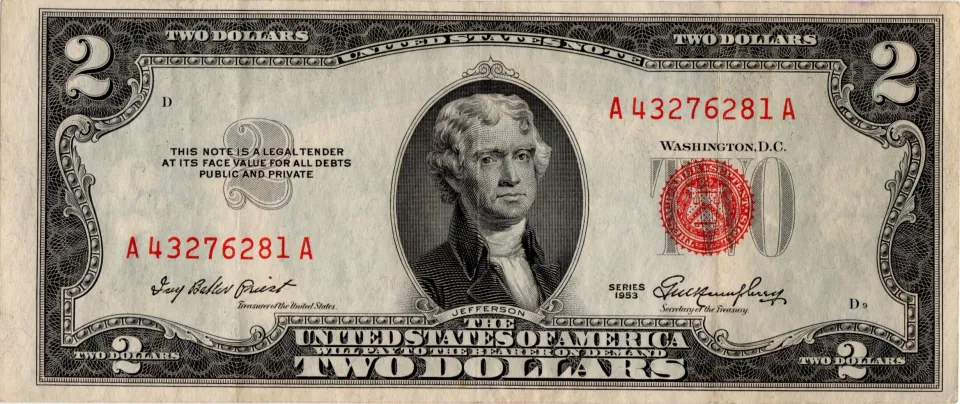
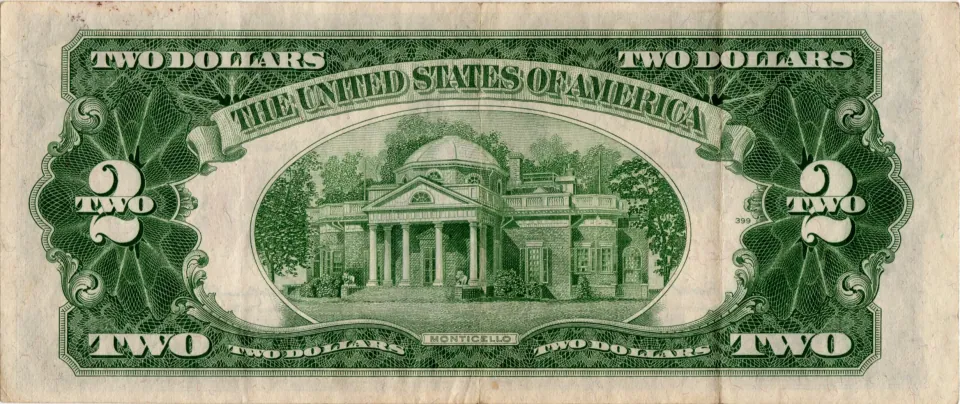
Banknote reference photos
What this series represents
The small-size 1953 two continued the Jefferson portrait and Monticello reverse of the United States Note series. It belongs to the red-seal legal-tender tradition, before the green-seal Federal Reserve $2 returned with a Declaration of Independence back in 1976.
The family includes Series 1953, 1953A, 1953B and 1953C. These printed series distinguish signature combinations rather than four interchangeable descriptions of a note’s age. Collectors building a series set can want an ordinary example of each combination, while star-note collectors pursue replacement issues within those series.
How do you identify the right issue?
Which series and signatures should match?
Series 1953 pairs Ivy Baker Priest with George M. Humphrey; 1953A pairs Priest with Robert B. Anderson; 1953B pairs Elizabeth Rudel Smith with C. Douglas Dillon; and 1953C pairs Kathryn O’Hay Granahan with Dillon. Read both printed names and the series letter. Friedberg numbers Fr.1509 through Fr.1512 distinguish the ordinary issues.
How do I recognize a replacement?
Look for a printed star before the digits in the red serial. Record its position, the full number and the series suffix. A replacement does not become a printing error merely because a star takes the place of a letter; that was an intended replacement-numbering device.
Can I judge the grade from a flat scan?
A flat, bright scan can conceal a pressed fold. Inspect both sides under gentle angled light for fold intersections, edge tears, stains and repairs. Uncirculated banknotes use paper-money grades, not a coin’s MS designation. PPQ and EPQ are service-specific paper-quality designations, not synonyms for a star serial.
What makes a useful comparison?
Match the series and replacement status first, then paper grade and any special serial. For an ordinary serial, exclude single-digit numbers and error notes. Start with the two-dollar denomination guide if a group also contains older large-size or modern green-seal notes.
What does the value evidence actually show?
| Issue / check | Condition / identification | Value / composition | Evidence / basis | Comparison limit |
|---|---|---|---|---|
| Ordinary red seal | Circulated; normal serial | $2 face value plus any verified collector premium | Denomination baseline | No current circulated range established by the Gem sale |
| Fr.1509, Series 1953 | PCGS Banknote Superb Gem Unc 67 PPQ | $240 | Heritage 142552, lot 84217; Dec. 23, 2025 | Includes 20% buyer’s premium |
| 1953A / B / C | Match full series and paper grade | Use that series’ sales | Different signature varieties | Do not transfer a 1953 Gem price blindly |
| Star replacement | Exact series, grade and serial | Research separately | Replacement-note market | A star is not automatically an error or rarity |
The USD $240 sale is an ordinary Fr.1509 note with a certified 67 PPQ grade. Its premium reflects a much stronger condition claim than “looks crisp.” The public sale record gives a 20% buyer’s premium, which is included in the realized total; taxes, shipping and the seller’s own costs are separate.
For a circulated note, gather comparable circulated sales rather than reducing that Gem result by an arbitrary percentage. If the paper has damage, compare damaged examples as well. A grading submission should be justified by the likely premium over its total cost, not just by the date. The replacement-note overview explains why star status is only one part of the decision.
Summary
Identify 1953, A, B or C and record the red replacement star if present. Preserve the paper as found and choose comparable grades; the documented $240 Gem sale cannot appraise a folded ordinary note.
Frequently asked questions
Is a 1953 $2 bill a silver certificate?
No. The red-seal 1953 $2 is a United States Note, also called a legal-tender note. Its denomination and issue title differ from silver certificates.
Does the letter after 1953 matter?
Yes. 1953, 1953A, 1953B and 1953C identify different signature series and should be included in comparisons.
Does a red seal guarantee a high price?
No. It identifies the currency class. Condition, series, replacement status and demand still determine a collector premium.
Where is the star on a 1953 $2 note?
Inspect the beginning of the red serial number for a printed replacement star.
Does the $240 sale apply to circulated notes?
No. That sale was a PCGS Banknote Superb Gem Uncirculated 67 PPQ example on December 23, 2025.
Should I press out its folds?
No. Pressing does not restore original uncirculated paper and can reduce the note’s appeal to collectors.
References
References and further reading
- Heritage: Fr.1509, 67 PPQ, December 23, 2025
- PMG: cataloged legal-tender series
- PMG: banknote grade definitions
- U.S. Currency Education Program: $2 historical context
Historical sale dates and conditions are retained beside each example. References reviewed November 17, 2026; historical results are not live offers.