

 App Store

COIN VALUE GUIDES · NICKELS
Most Valuable Jefferson Nickels:Key Dates, Errors and Full Steps
Find valuable Jefferson nickels by date, mint mark, and variety. Compare documented auction prices, Full Steps nickels, wartime silver and common 5-cent coins.
 HeriBase Editorial TeamPublished
In this article
Which Jefferson nickels are worth money?
Most worn Jefferson nickels without an attributed variety start at five cents. First check 1939 Doubled Monticello, 1942-D D over Horizontal D, low-mintage 1950-D and wartime issues with a large mint mark. Full Steps can make a much bigger difference on tough dates than on sharply struck common issues.
Selected certified 1939 Doubled Monticello and 1964 special-strike examples sold for five figures. Those sales apply to the exact grade and attribution listed below. When sorting change, focus first on the date, the location of the mint mark, and obvious wear.
Valuable Jefferson nickels with documented sales
These reported sales are in U.S. dollars. They illustrate specific coins and are not a ranking of every Jefferson nickel sale. MS means Mint State, SP is a special-strike or specimen grade, and FS is Full Steps on a PCGS label.
| Issue | Certified grade | Reported sale | Sale and date | Why this comparison matters |
|---|---|---|---|---|
| 1939 Doubled Monticello | PCGS MS67FS | $23,500 | Legend · Sept. 26, 2019 | Attributed doubled reverse and Full Steps |
| 1964 special strike (SMS) | PCGS SP67 | $18,000 | Heritage · Aug. 31, 2025 | Special strike, separate from ordinary 1964 nickels |
| 1942-D D over Horizontal D | MS66 | $15,275 | Heritage · Apr. 24, 2013 | Repunched Denver mint mark, regular copper-nickel alloy |
| 1950-D Full Steps | PCGS MS67+FS | $1,732.50 | GreatCollections · May 22, 2022 | Certified Full Steps, not the ordinary 1950-D baseline |
Where to look on the reverse
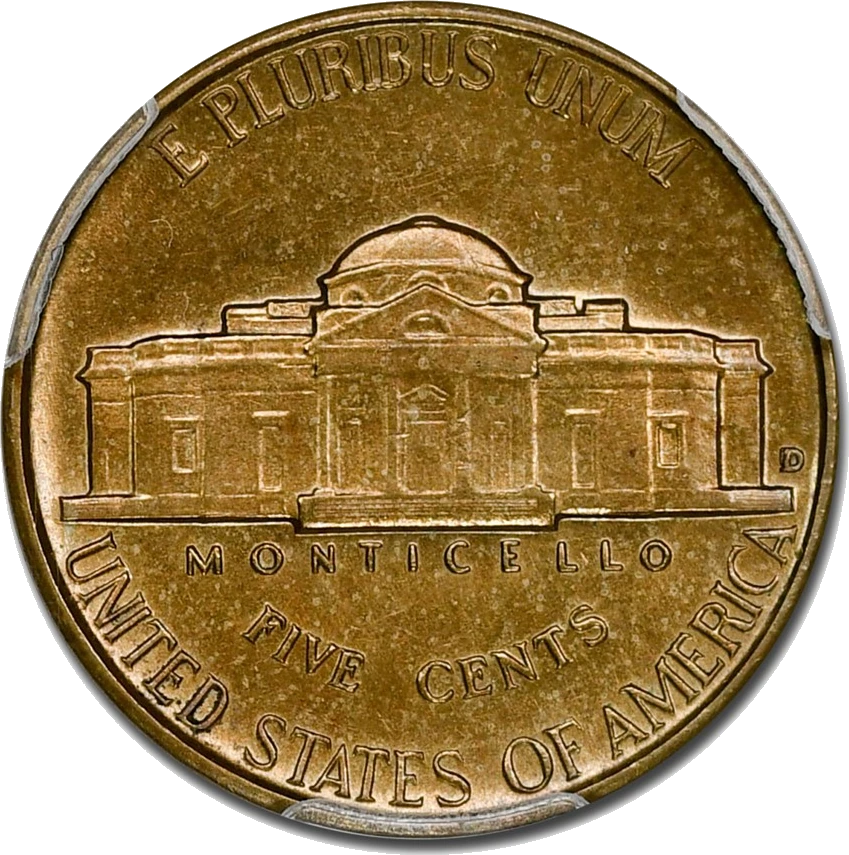
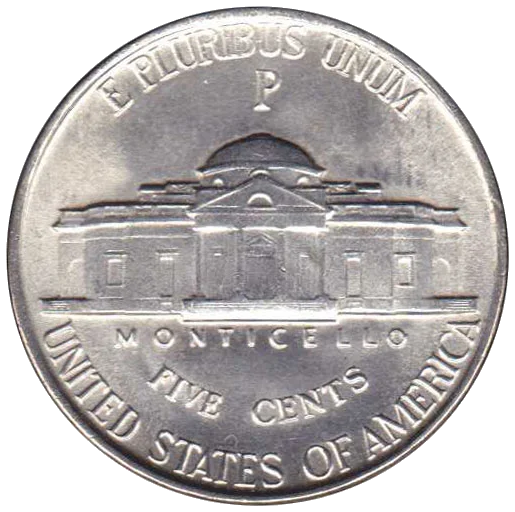
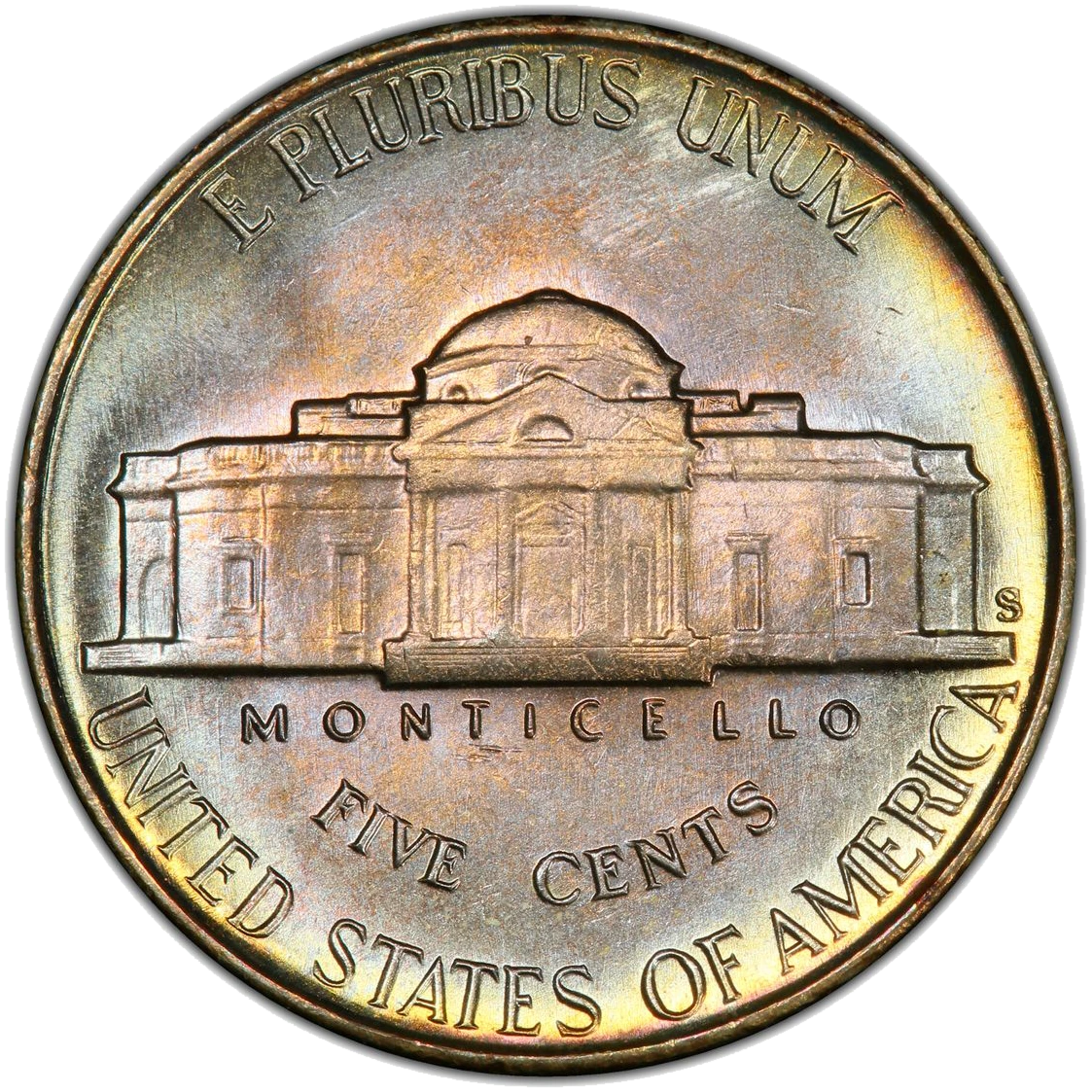
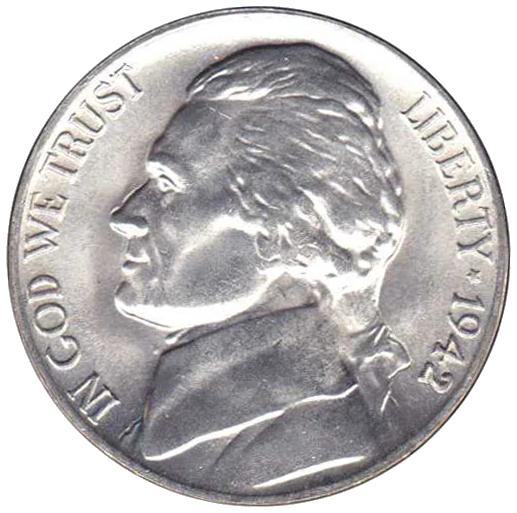
Jefferson nickel dates and varieties to check
| Issue | Where to look | How to compare it |
|---|---|---|
| 1938-D and 1938-S | Read the date and look just right of Monticello. Both are first-year branch-mint coins. | Use a same-mint and same-grade guide row. |
| 1939 and 1939-D | Compare the standard Reverse of 1938 and Reverse of 1940 subtypes before assigning a rare attribution. | Philadelphia Doubled Monticello shows genuine doubling in reverse lettering. |
| 1942-D repunched mint mark | Use magnification to inspect the upright D and underlying horizontal D at the right of Monticello. | Compare documented images. Scratches or a flattened shelf alone do not identify it. |
| 1942–1945 wartime silver | Large P, D or S above Monticello means the 35% silver wartime issue. | Ordinary 1942 issues also exist. Use the location and alloy, not the date alone. |
| 1950-D | Small D at the right of Monticello. PCGS lists a mintage of 2,630,030. | Collectors saved many, so a low mintage does not imply a four-figure price. |
| 1950s Full Steps candidates | Check the staircase beneath the building under angled light. Look for unbroken steps and weigh the effect of marks and wear on the coin. | Compare exact date, mint, grade and designation. |
| 1964 or 1964-D | Sort ordinary business strikes separately from Proofs and attributed special strikes. | A bright or satin-looking surface alone is insufficient for an SMS attribution. |
How Full Steps affects value
The designation judges how continuously the steps under Monticello are struck. It sits alongside the numeric grade. NGC distinguishes 5FS (five complete steps) from 6FS (six complete steps), while PCGS uses FS. Check the exact designation and population before comparing the price of a 1952 nickel or another date with sharper steps.
Wartime silver has its own value basis
The wartime alloy contains 35% silver. At the nominal 5 g coin weight that is 1.75 g of fine silver. The silver coin melt calculator uses the coin specification and the daily reference price. Check collector demand and condition separately.
How to sort a roll of Jefferson nickels
Match the date and mint-mark position first. Photograph both sides and enlarge the lettering or stairs only after checking the normal design. Use the same issue, variety, grade and designation when comparing completed sales. If the coin is ordinary and worn, avoid using certified gem or special-strike prices.
Frequently asked questions
Are Jefferson nickels from the 1930s always valuable?
Early dates are worth sorting by date and mint. Most individual coins need a grade and variety check before you can assign a premium.
How can I tell whether my 1942 nickel is silver?
On the 35% wartime alloy, look for a large mint mark above Monticello. Ordinary copper-nickel 1942 varieties also exist, including the 1942-D repunched-mark variety.
Are all 1964 no-mint-mark nickels special strikes?
No. Philadelphia struck ordinary 1964 nickels with no mint mark. A genuine 1964 SMS requires special-strike attribution and evidence beyond surface brightness.
What does Full Steps mean on a Jefferson nickel?
It describes the clarity and completeness of the steps below Monticello. NGC recognizes five and six full steps separately, and PCGS uses FS.
Does a 1950-D nickel always sell for hundreds of dollars?
No. Use a regular 1950-D comparison for a typical example. High auction prices often reflect unusually high grades, Full Steps or a specific specimen.
References
References and further reading
- https://www.pcgs.com/auctionPrices/category/84
- https://www.pcgs.com/coinfacts/coin/1939-5c-doubled-monticello-fs/84004
- https://www.pcgs.com/coinfacts/coin/1942-d-5c-horizontal/4015
- https://www.pcgs.com/coinfacts/coin/1964-5c-sms/4170
- https://www.pcgs.com/coinfacts/coin/84042
- https://www.ngccoin.com/news/article/6752/learn-grading-full-steps-nickels/
- https://www.usmint.gov/learn/collecting-basics/mint-marks
- https://www.ngccoin.com/news/article/1019/Wartime-silver-nickels/