

 App Store

COIN VALUE GUIDES · NICKELS
1942 Jefferson Nickel Value:No Mint Mark, D and Silver P or S
Tell early copper-nickel 1942 Jefferson nickels from 35% silver war nickels by reading the mint mark’s size and position.
 HeriBase Editorial TeamUpdated
In this article
Quick answer
A 1942 nickel can be copper-nickel or 35% silver. A blank area or small D to the right of Monticello indicates the early copper-nickel issue. A large P or S above the dome marks the standard wartime silver issue.
USA Coin Book’s February 2026 numismatic tables list no-mark Philadelphia at $0.18 in G4 and $19 in MS65, and large-P silver at $27 in MS65. These are grade-specific retail estimates. The 1942-D D over Horizontal D is an attributed variety of the early alloy.
Coin photos
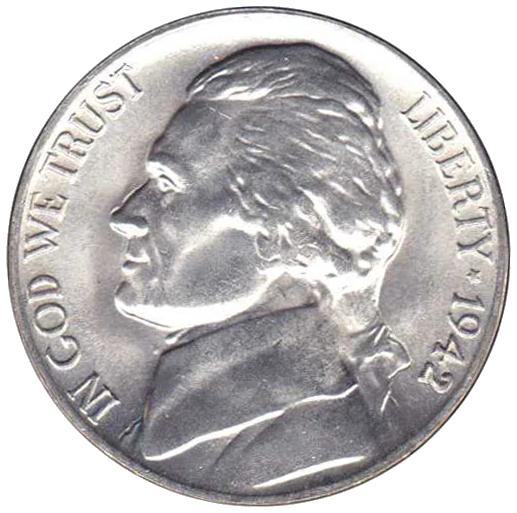
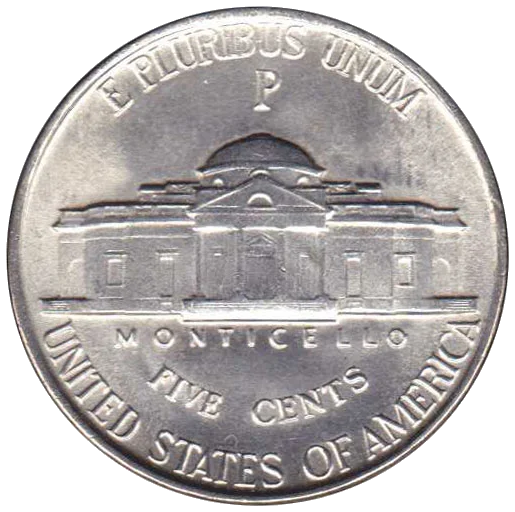
Basics & coin story
The Mint needed to conserve nickel for the war effort and introduced a substitute alloy during 1942. Five-cent pieces of the year therefore show a transition within one date. Denver struck the earlier copper-nickel type, while the two standard silver issues carry a large P or S.
The new large letters made the alloy easy to sort visually. This wartime composition continued through 1945. Compare an earlier small mint mark in the 1941 Jefferson nickel guide to see the difference in position.
| Feature | What to check |
|---|---|
| Early alloy | 75% copper, 25% nickel |
| Wartime alloy | 56% copper, 35% silver, 9% manganese |
| Early mint positions | Blank Philadelphia or small D to right of Monticello |
| Wartime mint positions | Large P or S above the dome |
| Nominal weight | 5.00 g for both types |
Identification
Look for a large mint mark first
Turn to the reverse and look at the field above the building. A large P or S identifies the wartime type. If the field is blank, check to the right of Monticello for the early D before settling on no-mark Philadelphia.
Use silver math only for the wartime type
A standard silver issue contains about 0.05626 troy ounce fine silver. Since both alloys weigh approximately 5 g, weight alone does not distinguish them. Compare the mint position before using a silver calculation.
Check a suspicious D against the recorded die
The 1942-D D over Horizontal D has a specific underlying mint punch visible at magnification. A worn, flattened or scratched D is insufficient to establish that attribution.
Condition & value
Amounts are in U.S. dollars. Retail guide values are estimates for the stated grade, mint and designation. A dated sale is a record of one coin. Neither is a guaranteed purchase offer.
| Issue | Grade / condition | Value or reference | Basis | Important condition |
|---|---|---|---|---|
| 1942 no mark | G4 / MS65 | $0.18 / $19 | USA Coin Book retail guide | Early copper-nickel |
| 1942-P large P | MS65 | $27 | USA Coin Book retail guide | Wartime silver; normal strike |
| 1942-P or 1942-S wartime | Nominal metal | 0.05626 × silver price per troy oz | Metal calculation | Full nominal weight; not an offer |
| 1942-D small D | Regular strike | Compare early 1942-D at same grade | Separate mint issue | No silver calculation |
| 1942-D D over Horizontal D | Attributed die | Compare matching sales | Cataloged repunched mark | Verify exact punch and grade |
Summary
Read above and to the right of Monticello before deciding what you have. Use a dated silver price per troy ounce only for the wartime alloy and compare each of the early mints and later silver issues separately.
Frequently asked questions
Is a 1942 nickel with no mint mark silver?
A standard 1942 with no mint mark is the early Philadelphia copper-nickel issue. Philadelphia’s normal silver 1942 has a large P above Monticello.
Is a 1942-D nickel silver?
A normal 1942-D with a small D beside Monticello uses copper-nickel. Do not apply 1943-D wartime specifications to it.
What are the 1942 war nickel mint marks?
The normal silver issues have a large P or S above Monticello.
Why does metal matter to the price?
The silver issues have a metal-content benchmark. Collector pricing also depends on mint, grade and attributed varieties.