

 App Store

PAPER MONEY GUIDES
2003 $2 Bill Value:2003 vs. 2003A, Stars and Condition
Distinguish Series 2003 from 2003A, check replacement stars and special numbers, and understand what an original-pack auction actually proves.
 HeriBase TeamPublished
In this article
Quick answer
An ordinary circulated 2003 or 2003A $2 bill generally starts at its $2 face value. The less familiar denomination does not make every example scarce. Full series, replacement issue, special serial and original paper condition can create separate collector categories.
A 100-note Series 2003 Minneapolis pack sold for $268.40 in August 2026. Its $200 combined face value and group sale are essential context; the result is not a $268 single-note value.
Banknote reference photos
What this series represents
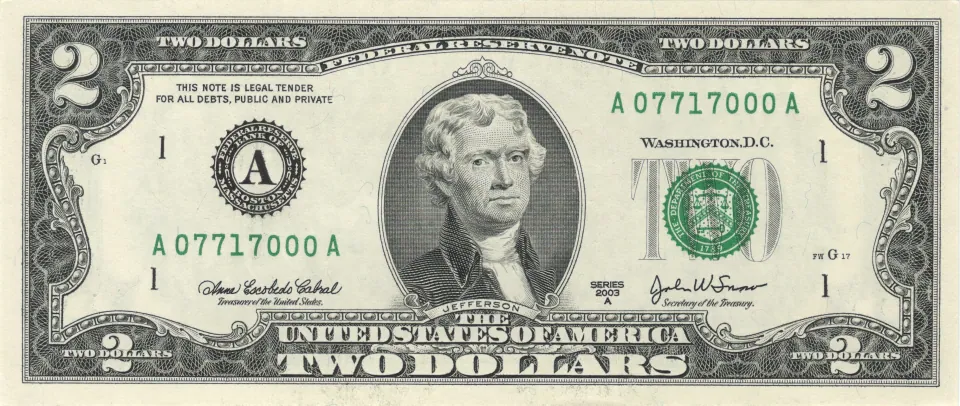
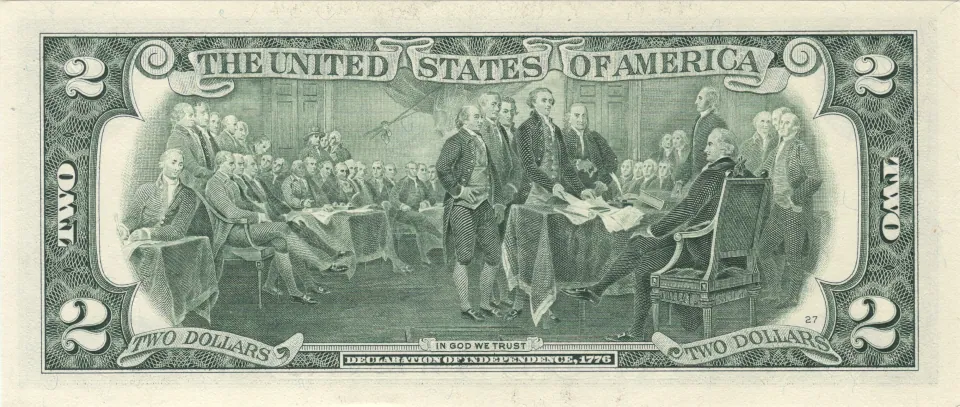
The modern $2 continues Jefferson on the face and the Declaration of Independence vignette on the back. Its green seal identifies a Federal Reserve note, unlike the older red-seal United States Notes. The modern design’s continued use explains why the printed date and signatures are more informative than the reverse alone.
Series 2003 and 2003A are separate signature series. The ordinary 2003 issue pairs Rosario Marin and John W. Snow; 2003A pairs Anna Escobedo Cabral and Snow. Both can look nearly identical in a small photograph. The letter after the year must be read directly rather than guessed from a listing title.
How do you identify the right issue?
How do I distinguish 2003 from 2003A?
Read the printed SERIES marking near the portrait and confirm the Treasurer’s signature. This guide’s paired photographs show 2003A, explicitly a comparison design rather than the plain 2003 pack in the auction example. Do not assign the pack’s district or condition to the pictured note.
What information belongs in a lookup?
Record the series, district letter, all serial digits and the last character. A suffix star denotes a replacement. Preserve leading zeros when checking a low number. A partial serial or a series date entered in place of the number cannot identify the actual note.
When does a fancy serial matter?
The full number must meet a clear pattern, such as a true radar or repeater. A number that merely looks memorable is not necessarily a collector category. The fancy serial overview explains patterns; the existing serial-number checker can help examine supported numerical patterns without authenticating the note or assigning a sale price.
Does an original band prove Gem condition?
No. An original pack can have corner handling, counting marks or damage to the band. Inspect individual notes before transferring a grade. A sequential run is a group characteristic; it does not automatically turn each member into a high-value special serial.
What does the value evidence actually show?
| Issue / check | Condition / identification | Value / composition | Evidence / basis | Comparison limit |
|---|---|---|---|---|
| Ordinary 2003 / 2003A | Circulated; normal serial | $2 face-value starting point | Denomination baseline | A premium needs specific evidence |
| Series 2003 Fr.1937-I pack | 100 notes; Crisp Uncirculated or Better, auction description | $268.40 for the entire pack | Heritage 142632, lot 82260; Aug. 11, 2026 | Includes 22% buyer’s premium; combined face value $200 |
| 2003A / district or star | Match complete series and condition | Separate matching sales | Different signature or replacement entry | Do not assume every star run has the same availability |
| Fancy serial or genuine error | Verified pattern or attribution | Research exact feature | Specialized collector demand | Not established by an asking price |
The Minneapolis Series 2003 pack realized USD $268.40 on August 11, 2026, with the 22% buyer’s premium included. Heritage described the 100 notes as Crisp Uncirculated or Better, noted handling on the first few notes and stated that the BEP band had been taped. It did not certify each note as a numerical Gem grade.
Subtracting the $200 face value helps put the premium in perspective, but dividing the total by 100 does not produce a guaranteed single-note retail price or seller payout. Single-note shipping, platform costs and collector preferences differ. Use the $2 denomination guide and star-note value guide to keep the comparison focused.
Summary
Read 2003 or 2003A directly, preserve the full serial and district, and inspect the actual paper. Treat pack totals as pack totals. Ordinary modern twos, scarce replacements and unusual serials require different evidence.
Frequently asked questions
Is a normal 2003 $2 bill rare?
The date and denomination alone do not establish rarity. Ordinary circulated notes generally start at $2 face value.
Are 2003 and 2003A identical?
No. They are different signature series. Read the letter after the year and the Treasurer’s name.
Where is a replacement star?
Inspect the final character of the serial for a printed star. Then record the full series, district and number.
Is the $268.40 auction price for one note?
No. It is for an original pack of 100 Series 2003 notes with a combined $200 face value.
Does a bank band guarantee a Gem grade?
No. A pack may include handling or corner issues. The condition of each note must be assessed separately.
Does the serial checker appraise or authenticate a bill?
No. Numerical pattern results do not establish paper grade, authenticity, replacement-run scarcity or a realized sale price.
References
References and further reading
- Heritage: 100-note 2003 pack, August 11, 2026
- U.S. Currency Education Program: modern $2 note
- BEP: serial-number identifiers
Historical sale dates and conditions are retained beside each example. References reviewed November 17, 2026; historical results are not live offers.