

 App Store

COIN VALUE GUIDES
2001 New York Quarter Errors: Pictures, Identification and Value
Compare real 2001-P New York quadruple-strike photos with normal features, missing-clad and multiple-strike records, damage checks and dated auction prices.
 HeriBase TeamPublished
In this article
Which 2001 New York quarter errors have documented value?
A normal worn 2001 New York quarter is a 25-cent coin. Genuine errors include multiple strikes and missing clad layers, but each needs its own attribution. A PCGS MS63 quadruple-struck example sold for $603.75 in 2003; that result does not price ordinary Statue of Liberty quarters or unverified damage.
Evidence reviewed November 13, 2026. Prices retain their original reference dates and stated conditions.
Which coin details should I compare?
How do the issues and values compare?
What should a normal New York quarter look like?
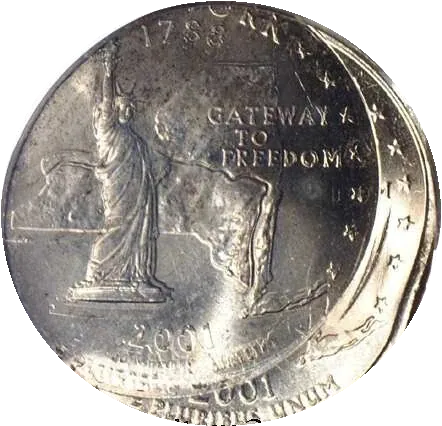
The Statue of Liberty is normal on the New York state quarter. Released January 2, 2001, it was the eleventh design in the 50 State Quarters program. The reverse combines Liberty, the state outline, eleven stars and Gateway to Freedom, recognizing New York’s role in immigration. The 1788 inscription commemorates statehood; 2001 is the issue year. Those two dates are intentional.
The Washington obverse carries the mint mark. Philadelphia P and Denver D circulation coins are standard clad quarters, nominally 5.67 grams and 24.3 millimeters with a reeded edge. Collector Proof issues require their own finish and composition checks. For the other four designs released that year, use the 2001 quarter checklist; for the entire program, see state quarter identification and values.
| Observation | Normal comparison | Possible error | Evidence needed | Common misidentification |
|---|---|---|---|---|
| Liberty, 1788 and 2001 | Intended reverse design | None established | Match the complete New York reverse | Treating statehood date as a wrong-date error |
| Overlapping full designs | One intended impression on each face | Multiple strike | Coherent repeated features and matching displacement | Machine doubling or two coins pressed together |
| Design displaced with blank area | Centered design and normal rim | Off-center strike | Complete uncropped coin and both faces | Uneven rim or damage alone |
| Copper-colored reverse face | Copper-nickel outer surface | Missing reverse clad layer | Weight, edge, surfaces and attribution | Plating, corrosion or ground surface |
| Copper line at edge | Normal copper core | Usually normal | Edge structure and face comparison | Every clad edge called missing cladding |
| Fine extra groove | No such intended line | Often scratch / damage | Relief, direction and disturbed metal | A scratch labeled a doubled die |
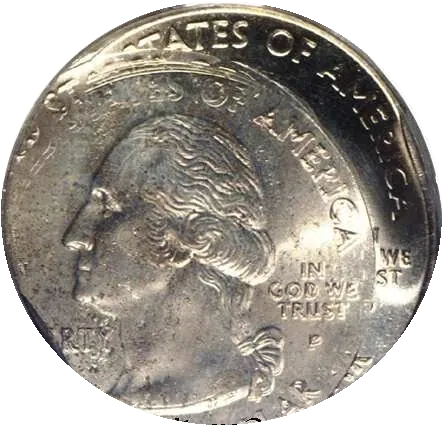
How does the pictured quadruple strike differ from doubling?
The auction catalog identifies four strikes, with the later three approximately 20% off-center. Read the repeated design together with the altered planchet outline. This is not merely a second thin edge along one letter. A doubled die transfers a repeated design from a particular die; multiple striking subjects one coin to additional impressions.
The pictured coin was graded PCGS MS63 and sold at Heritage on May 3, 2003 for $603.75. That historical published total belongs to this specimen and its condition. It is neither a current asking price nor a return available for any New York quarter.
What does the reverse add to the diagnosis?
The reverse provides an independent view of the strike displacement. Follow how the later impressions relate to the Statue of Liberty, date and rim. A genuine multi-strike explanation should fit the whole object rather than a single attractive close-up.
The light appearance of this coin does not make it a silver error. Its auction attribution is multiple striking. Composition and missing-clad claims require separate evidence; a striking error does not automatically imply an unusual alloy.
What have other certified New York errors sold for?
Compare similar categories, grades and surfaces rather than selecting the largest number with the same year. Heritage’s archive includes the following distinct specimens. The missing-layer and triple-strike rows are transaction comparisons; they are not additional photographs of the pictured quadruple-struck coin.
| Error / variety | Certified condition | Historical realized total | Sale date / auction lot | Comparison limit |
|---|---|---|---|---|
| Quadruple struck; later strikes 20% off-center | PCGS MS63 | $603.75 | May 3, 2003; Heritage 318, lot 7879 | Pictured specimen; 15% buyer’s premium stated by auction |
| Reverse clad layer missing | PCGS MS65 | $575 | Mar. 28, 2010; Heritage 1138, lot 10609 | Different error category; not pictured |
| Triple struck; later strikes about 30% off-center | NGC MS64 | $546.25 | Apr. 7, 2006; Heritage 402, lot 1441 | Different strike count, grade and specimen |
| Ordinary worn New York quarter | No attributed error | $0.25 denomination | Normal circulating baseline | Not a value for an authenticated error or exceptional grade |
| Suspected clip / off-center / doubling | Unattributed | Not established | Requires evidence for that particular coin | Do not reuse another error’s result |
These are historical auction totals rather than inflation-adjusted values or estimated seller proceeds. Fees, buyer competition, preservation and the visual strength of an error can change comparisons. A coin with recoloring, cleaning or other damage should not be matched uncritically to a problem-free numerical grade. For the broader distinction between condition value and error value, compare the selected state-quarter auction ranking.
How can I check a missing-clad-layer claim?
A missing outer layer can expose copper across one face and reduce weight. A normal copper-colored edge, however, simply shows the core between clad layers. Look at both surfaces and the edge, record a reliable weight and check for scratches, grinding or chemical changes. Artificially removing metal can make a coin lighter without making it a mint error.
The $575 example is useful because it is a specifically attributed missing-reverse-layer coin. It does not establish a price for a quarter that only looks brown in a photograph. Physical examination remains necessary when surface alteration or composition is uncertain.
What should I do about a suspected clip or doubled die?
For a clip, examine how the design and rim meet the missing portion and whether surfaces suggest cutting after manufacture. A crescent shape alone is not an attribution. For doubling, decide whether the repeated feature is part of the die, a striking artifact or damage. The normal New York state outline contains many small lines, so begin with an intact design comparison.
Keep a credible candidate uncleaned and photograph it square to the lens. The coin appraisal guide explains useful documentation. For newer quarter designs and different error evidence, see 2023 quarter error checks. A name such as “rare Statue of Liberty error” is too broad to establish either identity or value.
How can I check my coin in three steps?
- 01Confirm the New York reverse, 2001 issue year and obverse mint mark. The Statue of Liberty, 1788 statehood date and Gateway to Freedom are normal design elements.
- 02Compare the entire coin with the paired multi-strike photos. Record both faces, edge and measurements. For a missing layer, do not substitute color alone for physical and surface evidence.
- 03Separate die varieties, striking errors, planchet errors and damage. Match a credible attribution to the same grade and error category, then compare several completed sales before estimating value.
For more illustrated mint-error comparisons, explore the coin errors and varieties guides.
What should I remember before pricing?
The useful New York error evidence is physical: coherent additional strikes, a verified missing layer or another attributable production fault. The Statue of Liberty and the two intended dates are normal.
Use the paired photographs to screen a possible multi-strike coin, and keep the three dated sales separate. An unverified mark has no established premium merely because a different 2001-P error sold for hundreds of dollars.
What else do collectors ask?
Is every 2001 Statue of Liberty quarter an error?
No. The Statue of Liberty is the intended New York reverse design. An error requires an additional production fault, such as attributable multiple striking or a missing clad layer.
Why does the New York quarter have both 1788 and 2001?
1788 marks New York’s admission to the Union. 2001 is the quarter’s issue year. Both dates belong to the intended design.
What did the pictured quadruple-struck quarter sell for?
The PCGS MS63 coin sold for $603.75 at Heritage on May 3, 2003, auction 318, lot 7879. The amount is a historical published auction total for that specimen.
Is a quadruple strike the same as a doubled die?
No. A quadruple strike involves additional impressions on one coin. A doubled die originates in the die’s design and requires its own repeatable diagnostics.
Are there documented missing-clad-layer New York quarters?
Yes. Heritage records a 2001-P reverse-clad-layer-missing quarter graded PCGS MS65 selling for $575 on March 28, 2010, auction 1138, lot 10609. A new candidate still needs authentication.
Does a copper edge make my New York quarter valuable?
No. A copper core visible at the edge is normal for a clad circulation quarter. A missing-layer candidate needs both-face, edge, weight and surface examination.
Can I price my coin from a photograph alone?
A photograph can help identify features, but it cannot establish composition, authenticity or a certified numerical grade. Compare prices only after the specific error and condition are supported.
Which references support this guide?
References and further readingExpand
- NGC: variety versus mint errorProduction errors and recurring die varieties are different categories. Checked November 13, 2026.
- NGC: coin grading scaleCondition and preservation affect collector value. Checked November 13, 2026.
- Heritage 318, lot 7879: New York quadruple strikePictured PCGS MS63 specimen, May 3, 2003; $603.75 published total. Checked November 13, 2026.
- Heritage archive: 2001-P New York errorsReverse missing clad layer, $575, March 28, 2010, lot 10609; triple strike, $546.25, April 7, 2006, lot 1441. Checked November 13, 2026.
- U.S. Mint: New York State QuarterJanuary 2, 2001 release, eleven stars, statehood date and intended design. Checked November 13, 2026.
- U.S. Mint: the Empire State quarter launchGateway to Freedom and the Hudson River / Erie Canal design context. Checked November 13, 2026.
- PCGS CoinFacts: 2001-P New YorkNormal circulation-issue dimensions and nominal weight. Checked November 13, 2026.