

 App Store

COIN VALUE GUIDES
2023 Quarter Errors: Real Photos, Die Clashes and Clad Checks
Check 2023 quarter errors against real die-clash photos and certified missing-clad records. Separate genuine errors, normal designs, IN COD claims and damage.
 HeriBase TeamPublished
In this article
Which 2023 quarter errors are worth checking?
Ordinary worn 2023 quarters have a 25-cent face value. Documented error candidates include the 2023-P Edith Kanakaʻole die clash and certified missing-clad-layer Bessie Coleman and Jovita Idar coins. Identify the design, compare both faces and measure the coin. An IN COD appearance or unusual artwork alone does not establish a valuable error.
Evidence reviewed November 13, 2026. Prices retain their original reference dates and stated conditions.
Which coin details should I compare?
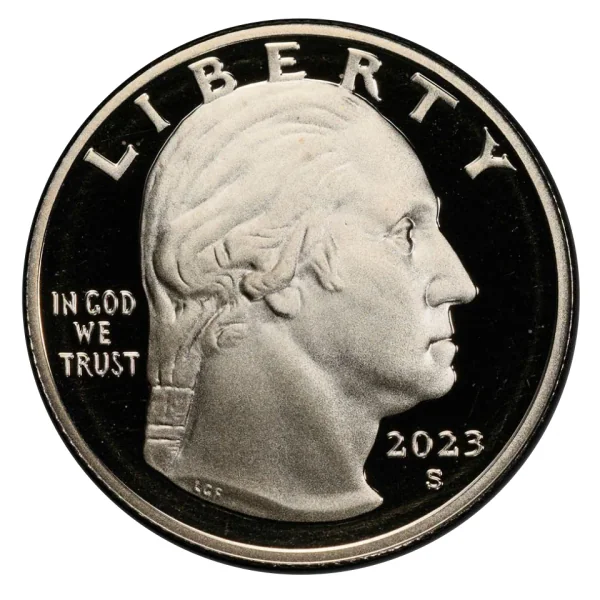
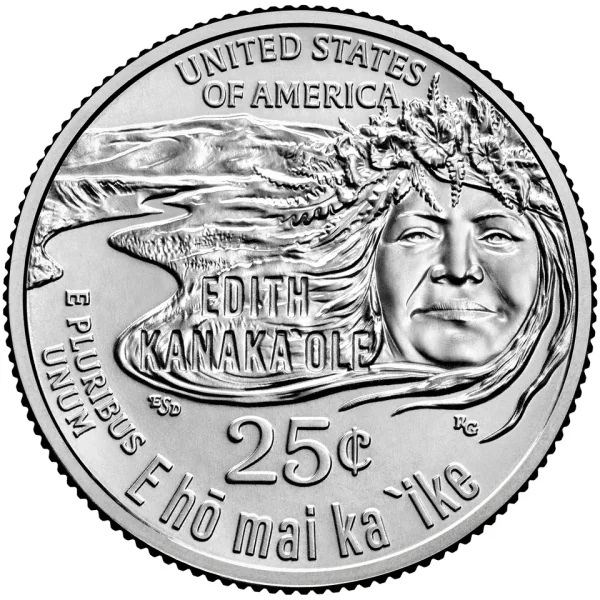
How do the issues and values compare?
Which normal designs can look unusual?
The five 2023 American Women quarters honor Bessie Coleman, Edith Kanakaʻole, Eleanor Roosevelt, Jovita Idar and Maria Tallchief. Their common Washington portrait comes from Laura Gardin Fraser’s design originally prepared for the 1932 quarter competition. New artwork can look unfamiliar without being defective. Use the complete 2023 quarter design guide to identify the reverse before diagnosing an error.
Coleman’s reverse includes the historical date 6.15.1921, associated with her pilot’s license. It is not a second issue year. Idar’s figure incorporates words and names into her clothing, while Kanakaʻole’s hair and lei merge into the landscape. Missing familiar open space, unusual lettering placement or an extra historical date should first be checked against the intended design.
| Observation | Normal reference | Possible error category | Evidence needed | Avoid this conclusion |
|---|---|---|---|---|
| G in GOD looks like C | Inspect the full motto in clear light | No error established by that reading alone | Sharp close-up, relief and attribution | IN COD is not an automatic rare spelling error |
| Lines near Washington’s hair | Compare with normal obverse and reverse | Possible die clash | Coherent transferred reverse details; expert comparison | A scratch is not a clash |
| Copper-colored whole face | Normal coin has two clad faces and a copper core | Possible missing clad layer | Both faces, edge, weight and certification | Color alone proves missing cladding |
| Copper visible only at edge | Normal clad construction | Usually normal | Edge comparison and nominal weight | A copper edge is not a missing layer |
| Words within Idar’s clothing | Part of the intended reverse | Normal design | Compare the complete design | Not a random lettering error |
| Displaced design / blank crescent | Normally centered strike | Possible off-center strike | Full uncropped coin, both faces and attribution | An uneven rim alone proves off-center |
What does a real 2023-P Kanakaʻole die clash look like?
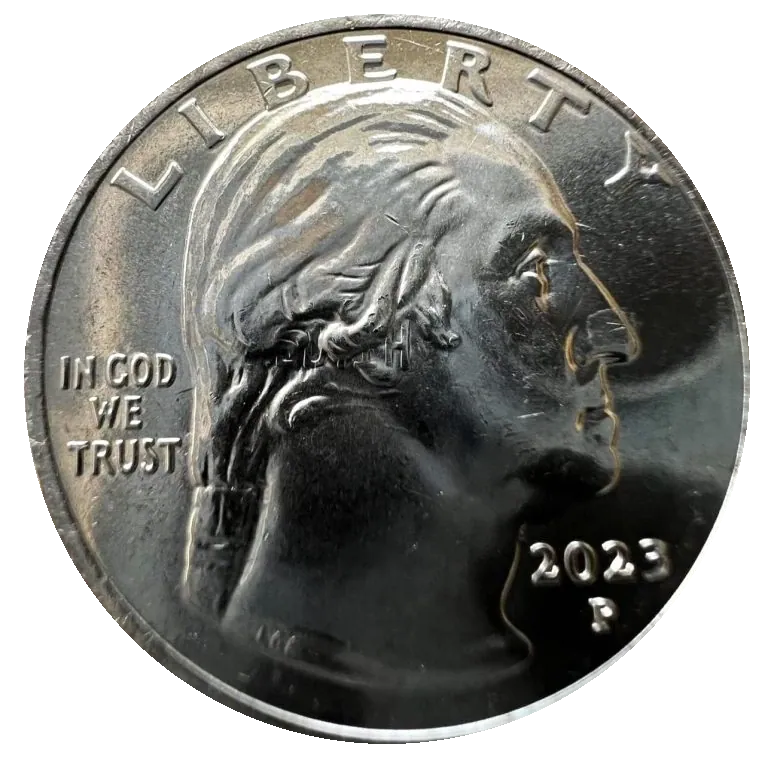
When opposing dies contact without a planchet between them, one die can acquire traces of the other design. Later coins may show those transferred details. The photographed reference shows coherent extra forms near the hair rather than a single isolated line. The P is visible below 2023; this photo is not assigned the certification number of a different auction specimen.
A specialist published this photographic example in 2023. Separately, GreatCollections archived an NGC MS66 Clashed Dies specimen, certificate 8494301-008, ending October 4, 2026. That record corroborates the recognized category; it does not prove every similarly marked coin is the same die state.
Which close-up details distinguish a clash from a scratch?
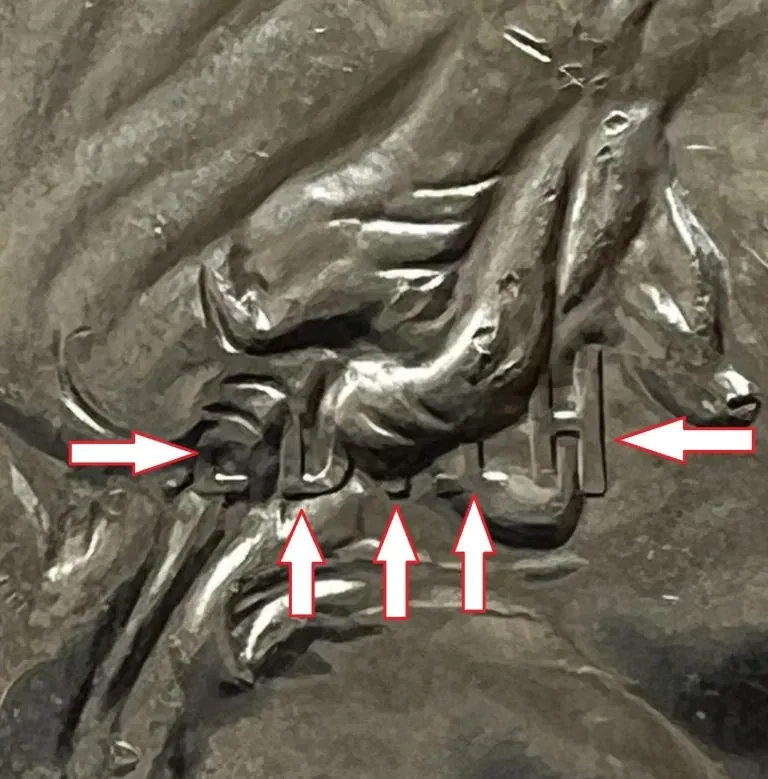
Study the shapes, positions and relief together. A random incuse scratch that cuts across the surface is different from a repeatable group of transferred design elements. Rotation and lighting can help make relief legible, but a photograph cannot replace examination of an uncertain coin.
This detail is a comparison reference, not a valuation certificate. Stronger visibility, surface preservation and the exact attribution matter when comparing offers. A minor die chip elsewhere on a 2023 quarter should not inherit a die-clash premium.
What do the certified missing-clad records establish?
A standard clad circulation quarter is nominally 5.67 grams and 24.3 millimeters. Its copper-nickel outer layers cover a copper core. Removing an outer layer during manufacture can expose a copper-colored face and reduce weight. Grinding, chemical treatment, plating and ordinary damage can also change appearance, so weight and color are screening evidence rather than authentication.
| Issue / category | Grade / certificate | Recorded physical detail | Auction record | Price evidence |
|---|---|---|---|---|
| 2023-P Bessie Coleman; reverse clad layer missing | NGC MS64; 6974385-001 | 4.8 g in lot title | GreatCollections 2108260; Apr. 12, 2026 | Sold archive; final amount requires login; no realized figure quoted |
| 2023-P Jovita Idar; reverse missing clad layer | NGC MS63; 8294878-001 | 4.7 g in lot title | GreatCollections 2080651; Mar. 8, 2026 | Ended archive; final amount requires login; no realized figure quoted |
| 2023-P Edith Kanakaʻole; clashed dies | NGC MS66; 8494301-008 | Named error attribution | GreatCollections 2248624; Oct. 4, 2026 | Sold archive; final amount requires login; no realized figure quoted |
| Ordinary worn 2023 quarter | No attributed error | Normal clad specifications | $0.25 denomination | Face value; not a quote for Proofs or exceptional grades |
The two missing-layer weights belong to those particular coins, not a universal tolerance defining all genuine errors. A light coin may be worn or altered. Conversely, a scale with insufficient precision may obscure a meaningful difference. A suspected wrong-planchet coin additionally needs diameter, thickness and composition evidence; do not identify one from a silvery or golden hue alone.
How should I interpret a 2023 quarter error price?
Keep three numbers separate: an asking price, the opening bid and the final published transaction. The archive pages above restrict their final amount to signed-in users. Their publicly visible starting bids are not used as realized values here. No authenticated price range is assigned to an unexamined coin simply because it resembles one of those listings.
For a transparent older comparison with publicly readable sale totals, use the New York quarter error case study. To compare errors with high-grade normal issues, see ten selected state-quarter auction cases. Those earlier coins are not evidence that a 2023 error commands the same amount.
When is an unusual mark simply damage?
Look for a cut groove, scraping, flattened high points, corrosion or displaced metal around an impact. An intentionally altered rim may look off-center in a tightly cropped photo. A die chip is typically raised where a piece of die has broken away, while a scratch generally cuts into the coin. Neither description alone establishes a market premium without examining the actual feature.
Use neutral lighting, rotate the coin and photograph the complete reverse as well as the problem area. The Jovita Idar design guide is useful for the text-filled reverse, and the grading guide separates preservation from error attribution. Leave a credible candidate uncleaned.
How can I check my coin in three steps?
- 01Identify the 2023 date, mint mark and one of the five reverse designs. Establish circulation strike or collector Proof; the normal S-mint Proof pictured above is not a P-mint error specimen.
- 02Photograph both faces, edge and suspected detail. Compare the exact clash forms or missing-layer evidence; for planchet concerns record weight, diameter and thickness with suitable equipment.
- 03Exclude normal artwork, scratches, corrosion and altered surfaces. Seek specialist attribution for a credible candidate, then compare the same error and grade with actual completed sales rather than opening bids.
For more illustrated mint-error comparisons, explore the coin errors and varieties guides.
What should I remember before pricing?
Start with the intended design. The photographed Kanakaʻole clash and the archived certified missing-layer pieces are useful specific comparisons, whereas IN COD wording alone does not establish a high-value error.
Record the coin’s physical evidence and preserve its surfaces. No public final price was verified for the three archive entries, so their starting bids have not been presented as sales.
What else do collectors ask?
Is a 2023 quarter that says IN COD WE TRUST automatically valuable?
No. An apparent C-shaped G by itself does not establish a recognized valuable error. Compare the intended lettering, strike quality, wear and any specialist attribution before pricing it.
Which 2023 quarter has a documented die clash?
The 2023-P Edith Kanakaʻole quarter has published photographic clash references. GreatCollections also archived an NGC MS66 Clashed Dies example, certificate 8494301-008, ending October 4, 2026.
Are the clash reference photos the NGC auction specimen?
No such identity is claimed. The published diagnostic photographs and the separately certified auction coin are different records; their roles are kept separate.
Are there documented 2023 missing-clad-layer quarters?
Yes. GreatCollections records include a 2023-P Bessie Coleman reverse-missing-layer coin, NGC MS64, 4.8 g, and a 2023-P Jovita Idar example, NGC MS63, 4.7 g. Physical examination is still needed for any new candidate.
What are the verified sale prices for those 2023 examples?
The public archive pages consulted require login for final amounts. This article does not quote their opening bids as realized prices or assign an unsupported range to similar coins.
Is the 1921 date on the Bessie Coleman quarter a mistake?
No. The reverse includes 6.15.1921 to commemorate Coleman’s pilot-license date. The coin’s issue year is 2023 on the obverse.
Does a copper-colored edge prove a quarter error?
No. A copper core visible between outer clad layers is normal. A possible missing layer needs examination of both faces, edge, weight and surfaces; color alone is insufficient.
Which references support this guide?
References and further readingExpand
- NGC: variety versus mint errorProduction errors and recurring die varieties are different categories. Checked November 13, 2026.
- NGC: coin grading scaleCondition and preservation affect collector value. Checked November 13, 2026.
- NGC: 2023 American Women quartersFive honorees, Fraser obverse and intended reverse symbolism. Checked November 13, 2026.
- Mint Error Coin App: 2023-P Kanakaʻole major die clashPublished photographic diagnostic reference. Its old marketplace screenshot is not used as verified price evidence. Checked November 13, 2026.
- GreatCollections 2248624: 2023-P Kanakaʻole Clashed DiesNGC MS66, 8494301-008; auction ended October 4, 2026. Final price login-restricted. Checked November 13, 2026.
- GreatCollections 2108260: Coleman missing reverse clad layerNGC MS64, 6974385-001, 4.8 g; April 12, 2026 archive. No public realized amount quoted. Checked November 13, 2026.
- GreatCollections 2080651: Idar missing reverse clad layerNGC MS63, 8294878-001, 4.7 g; March 8, 2026 archive. No public realized amount quoted. Checked November 13, 2026.
- U.S. Mint: quarter specificationsNormal circulating quarter dimensions and clad construction. Checked November 13, 2026.