

 App Store

COIN VALUE GUIDES · QUARTER GUIDES
State Quarters Value:Complete Checklist, Silver Proofs and Varieties
Use the 50-state checklist, distinguish ordinary 25-cent coins from collector versions, and assess valuable state quarters without relying on misleading top-ten lists.
 HeriBase TeamPublished
In this article
Quick answer
Most ordinary worn state quarters from 1999–2008 remain 25-cent coins. Completing a fifty-design set does not automatically turn it into a rare investment. Premiums belong to specified coins: original uncirculated examples, collector Proofs, silver versions and authenticated varieties or errors.
A useful state quarters value guide therefore starts with the design-and-mint checklist, then checks manufacture and preservation. The 2004-D Wisconsin Extra Leaf High and Low entries are examples requiring exact attribution; they do not make every Wisconsin quarter valuable.
Coin photos
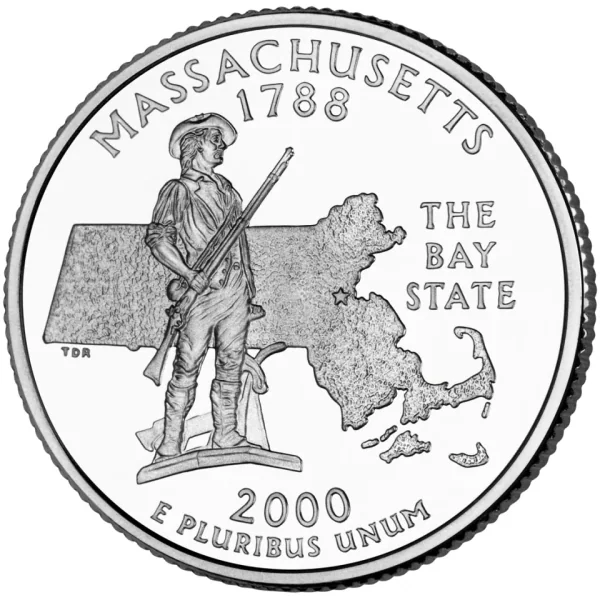
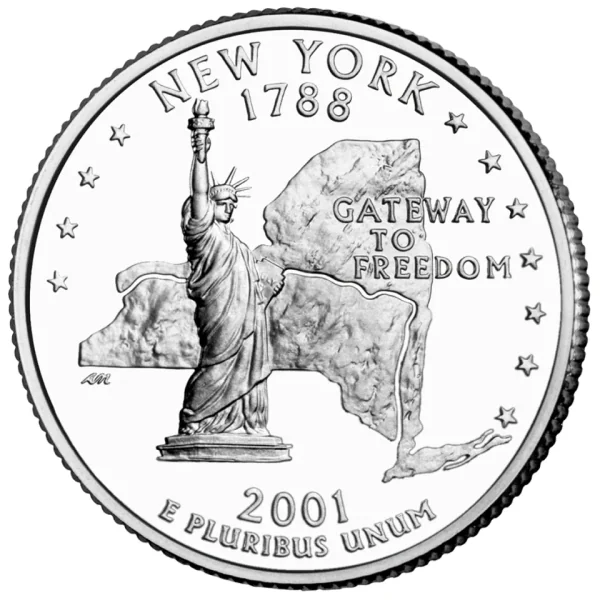
Basics & coin story
The 50 State Quarters program released five state designs annually from 1999 through 2008. Its admission-order structure turned pocket change into a manageable collecting project. Each reverse presents a different state story while Washington remains on the other face.
The fifty states are the core set. The six 2009 District and territory reverses form a subsequent program, even though many albums include them. Count fifty or fifty-six deliberately rather than assuming a missing state when a territory slot appears.
A one-per-state set, a Philadelphia-and-Denver set and a Proof collection have different completion rules. Fifty designs can mean fifty coins, while one P and one D per state requires one hundred normal issues. Silver Proofs should be recorded as a separate layer.
| Feature | What to check |
|---|---|
| Program | 1999–2008 / fifty state reverse designs |
| Ordinary denomination | 25 cents |
| Circulation production | P and D clad issues |
| Clad specifications | 5.67 g / approximately 24.3 mm |
| Proof products | S clad and S 90% silver |
| Design-only set | 50 coins; face-value total $12.50 |
| P-and-D design set | 100 coins; face-value total $25 |
| 2009 extension | Six District/territory designs; separate program |
Design checklist
| Year | States in release order |
|---|---|
| 1999 | Delaware, Pennsylvania, New Jersey, Georgia, Connecticut |
| 2000 | Massachusetts, Maryland, South Carolina, New Hampshire, Virginia |
| 2001 | New York, North Carolina, Rhode Island, Vermont, Kentucky |
| 2002 | Tennessee, Ohio, Louisiana, Indiana, Mississippi |
| 2003 | Illinois, Alabama, Maine, Missouri, Arkansas |
| 2004 | Michigan, Florida, Texas, Iowa, Wisconsin |
| 2005 | California, Minnesota, Oregon, Kansas, West Virginia |
| 2006 | Nevada, Nebraska, Colorado, North Dakota, South Dakota |
| 2007 | Montana, Washington, Idaho, Wyoming, Utah |
| 2008 | Oklahoma, New Mexico, Arizona, Alaska, Hawaii |
Identification
Choose the collection definition
An album with one reverse for each state is a design collection, not a full mint-and-finish set. Specify whether matching P/D marks, original uncirculated surfaces or Proof products are required before comparing a set price.
A retail set may include an album, sorting work and packaging. Those costs are not the same as an underlying rarity premium or the amount a dealer will pay for a mixed circulated group.
Identify the Wisconsin extra leaf correctly
The recognized Extra Leaf High and Extra Leaf Low are 2004-D Wisconsin varieties. Compare the position and shape of the additional corn-leaf feature against the exact specialist entry. A random nick or unrelated raised spot is insufficient.
Likewise, the informal labels on other state-quarter listings need a physical explanation. A die chip, grease-filled letter, major doubled die and damage should not be grouped under one invented error price.
Keep silver and clad Proofs apart
The S letter appears on both. Silver Proof quarters in this program use 90% silver and nominal 6.25 g mass, while ordinary clad quarters use 5.67 g. Set identity and suitable examination settle the product; surface brightness alone does not. A silver Proof is intentional manufacture, not an accidental silver state quarter.
Condition & value
USD references checked October 28, 2026. Face value is a denomination, not an estimate for every collector version. No unsupported current retail price is assigned to a special grade or unverified error.
| Issue | Grade / condition | Value or reference | Basis | Important condition |
|---|---|---|---|---|
| Ordinary circulated state quarter | Normal P/D clad | 25¢ baseline | Face value | Design alone is not rarity |
| 50 ordinary design coins | One of each state | Face-value total $12.50 | Arithmetic, not retail quote | Album and quality may add cost |
| 100 ordinary P/D coins | Two mints per state | Face-value total $25 | Arithmetic, not resale guarantee | Confirm every mint |
| S silver Proof | Exact state and Proof grade | Use metal and collector comparison | Separate product | 90% silver |
| 2004-D Wisconsin Extra Leaf | High or Low attributed | Use matching variety sales | Specialist catalog | Do not transfer price to ordinary reverse |
A “top 10 state quarters worth money” list can mix fifty-cent group finds with unique high-grade auction lots. Compare categories instead: genuine varieties, major mint errors, collector products and exceptional preservation. Each demands different evidence.
A grade-sensitive coin should be compared with the same numerical grade and designation. Population counts describe coins graded by a service, not all surviving coins. Small populations can change, and they do not establish that an uncertified pocket find has the same quality.
Photograph both faces and the edge, keep packaging where relevant, and do not clean the coin. Use the grading guide for condition terminology and post-1965 quarter comparison for the wider denomination beyond the state program.
For a focused comparison, see ten selected state-quarter auction examples.
Summary
Build the state checklist before shopping for premiums. Most worn normal coins use a 25-cent baseline, while silver Proofs and attributed varieties need independent comparisons. A carefully defined collection is easier to complete and value than a mixed group assembled from auction headlines.
FAQ
How many state quarters are in the original program?
Fifty reverse designs were released from 1999 through 2008. The six 2009 District and territory designs are a subsequent program.
What is a complete circulated fifty-state set worth?
Its face-value total is $12.50. Retail and resale amounts depend on condition, completeness, packaging and the market; that arithmetic is not a retail quote.
Are state quarters silver?
Normal P/D circulation coins are clad. San Francisco silver Proof state quarters are separate 90% silver products.
Which Wisconsin extra leaf is valuable?
Both Extra Leaf High and Extra Leaf Low have distinct attributed entries for 2004-D. Exact diagnostics, condition and current comparable sales are required.
References
References and further reading
References consulted October 28, 2026. Price tables retain the update dates stated in the text; guide estimates, face values and completed transactions are different forms of evidence.