

 App Store

PAPER MONEY GUIDES
1963 $5 Bill Value:Seal Colors, Series and Star Notes
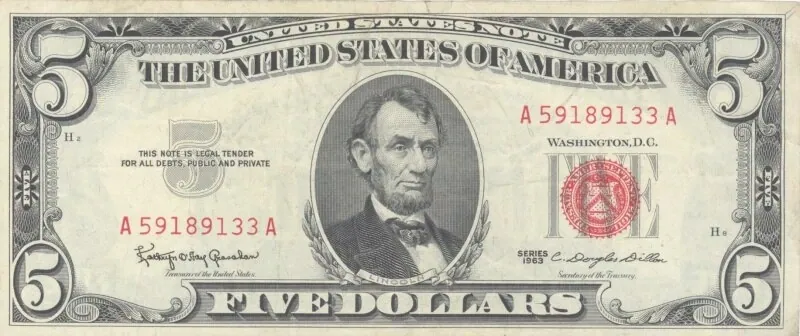
Separate the red-seal United States Note from the green-seal Federal Reserve issue before comparing 1963 five-dollar bill values.
 HeriBase TeamPublished
In this article
Quick answer
A 1963 $5 bill needs a currency-class check before a value check. A red seal identifies a United States Note; a green seal identifies a Federal Reserve note. Series, district where applicable, replacement status and paper condition then narrow the comparison.
The historical $109.25 sale below is a red-seal replacement described as Gem Crisp Uncirculated in 2006. It is neither a current quote nor a price for an ordinary circulated green-seal five.
Banknote reference photos
What this series represents
The 1963 date appears during the final period of small-size red-seal five-dollar United States Notes and also on Federal Reserve currency. Lincoln and the Lincoln Memorial make the designs look familiar, but the issue titles and seals distinguish different collecting categories.
The later transition to Federal Reserve notes did not make older United States Notes invalid. Their collector market concerns surviving paper and issue details, not an automatic exchange bonus for a red seal. Compare 1953 red- and blue-seal fives to see why a denomination and printed year are not enough to select a price guide.
How do you identify the right issue?
How do I separate the two currency classes?
Read UNITED STATES NOTE above Lincoln and the red Treasury seal for the legal-tender issue. The green-seal counterpart reads FEDERAL RESERVE NOTE and has a district seal. Record the complete series and all serial characters. A red or green seal is an identifying category, not a numerical grade.
What does Fr.1536 identify?
Fr.1536 is the Series 1963 $5 United States Note with Granahan–Dillon signatures; the replacement entry is written Fr.1536*. The asterisk in a catalog reference denotes star status. It is different from a grading service’s eye-appeal star, which can appear beside a grade.
Which star am I looking at?
On the older red-seal replacement, inspect the beginning of the serial. On a Federal Reserve replacement, inspect the serial’s final position. A printed star can be ordinary replacement production; do not label it a rare error merely because a listing uses an asterisk.
Which photographs should a seller provide?
Ask for the full face and back, the complete series and signatures, all four corners and close views of folds. A bright face-only photograph can hide reverse stains or repaired tears. Do not infer an uncirculated grade from stiff or flattened paper.
What does the value evidence actually show?
| Issue / check | Condition / identification | Value / composition | Evidence / basis | Comparison limit |
|---|---|---|---|---|
| Red seal; Fr.1536 | Ordinary circulated | $5 face value plus any supported premium | Denomination baseline | Full series and paper needed |
| Green seal; Federal Reserve | District, series and grade | Use matching Federal Reserve sales | Separate currency class | Red-seal star prices do not apply |
| Red-seal star; Fr.1536* | Gem Crisp Uncirculated; auction description | $109.25 | Heritage 36114, lot 22117; Nov. 28, 2006 | Includes 15% buyer’s premium; historical sale |
| Star / fancy serial / impaired paper | Exact feature and condition | Compare separately | Different collector attributes | No universal price for the date |
Heritage’s November 28, 2006 sale realized USD $109.25 for one Fr.1536* red-seal replacement. The catalog used the descriptive grade Gem Crisp Uncirculated rather than giving a third-party numerical grade. Its reported total includes the sale’s 15% buyer’s premium. Almost two decades of market change make it historical context, not a present valuation.
For a present transaction, seek recent matches for the same class and paper condition. One modern high-grade auction may cost far more than an ordinary circulated example, and certification fees can exceed a modest premium. Use the banknote identification workflow and star-note explanation before deciding whether specialist assessment is worthwhile.
Summary
Read the issue title and seal first. Record the full series, appropriate district and replacement star, then compare equivalent paper. Keep the old red-seal Gem result separate from current ordinary-note expectations.
Frequently asked questions
Is a 1963 $5 bill always red seal?
No. Distinguish red-seal United States Notes from green-seal Federal Reserve notes by the printed issue title and seal.
What is Fr.1536?
It identifies the Series 1963 five-dollar United States Note with Granahan–Dillon signatures. Fr.1536* denotes its replacement-star entry.
Is a red seal a printing error?
No. Red is the normal seal color for this United States Note issue.
What does the $109.25 result represent?
One red-seal replacement described as Gem Crisp Uncirculated, sold November 28, 2006 with buyer’s premium included. It is historical, not a current quote.
Does an asterisk beside a grade mean a serial star?
Not necessarily. A service’s eye-appeal designation and a replacement star in the serial are different features.
Can I use a green-seal price for a red-seal note?
No. Match currency class, series, replacement status and paper grade before comparing prices.
References
References and further reading
- Heritage: Fr.1536* historical sale, November 28, 2006
- PMG: legal-tender and Federal Reserve catalog distinctions
- PMG: paper grading
- BEP: older currency questions
Historical sale dates and conditions are retained beside each example. References reviewed November 17, 2026; historical results are not live offers.