

 App Store

PAPER MONEY GUIDES
1953 $5 Bill Value:Red Seals, Blue Seals and Condition
Compare 1953 red-seal United States Notes with blue-seal silver certificates, then match series, replacements and paper condition.
 HeriBase TeamPublished
In this article
Quick answer
A 1953 $5 bill can be a red-seal United States Note or a blue-seal silver certificate. Those are different currency classes. Identify the full series, signature pair, replacement star and paper condition before assigning a collector premium.
The old $25 sale below is one circulated red-seal replacement in 2003. A separate 2026 eleven-note mixed lot realized $451.40 in total. Neither figure prices every ordinary 1953 five.
Banknote reference photos
What this series represents
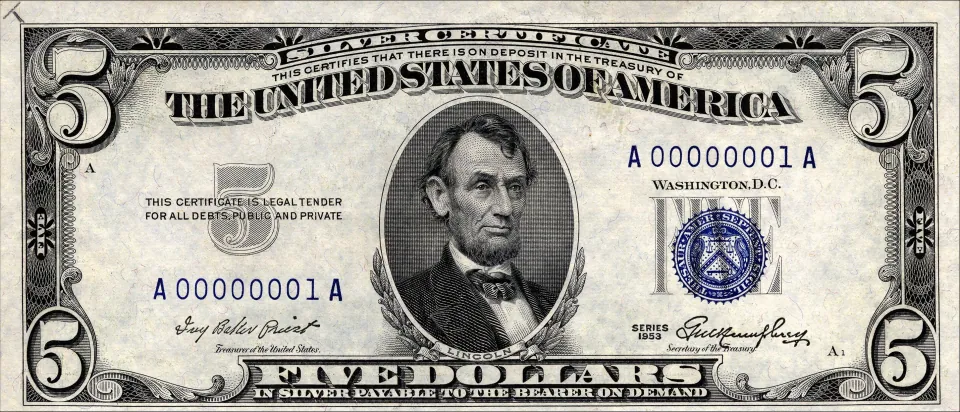
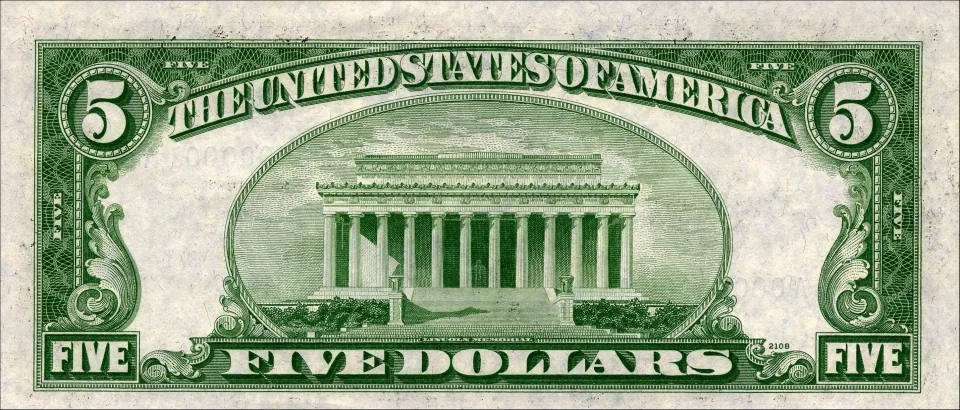
Lincoln’s portrait and the Lincoln Memorial back appear on familiar small-size fives, but the face’s printed title tells collectors what kind of note they have. Red United States Notes and blue silver certificates coexisted as distinct obligations, rather than one being a printing mistake.
The printed 1953 family includes plain 1953 and lettered series. For legal-tender fives, the ordinary entries run Fr.1532 through Fr.1535 for 1953, A, B and C; silver certificates use a different catalog sequence. That separation prevents an impressive blue-seal error sale from becoming a misleading price for an ordinary red-seal five.
How do you identify the right issue?
Which title should match the seal?
Read UNITED STATES NOTE for the red-seal legal-tender issue and SILVER CERTIFICATE for the blue-seal issue. The illustration here shows a blue-seal Series 1953 Fr.1655 reference specimen. Its appearance cannot establish a red-seal note’s catalog identity or a sale price for either specimen.
Do the series letters mean the same thing in both classes?
They distinguish signature series within the identified class. Copy the whole date and pair of names rather than comparing only “1953B.” Red-seal 1953 uses Priest–Humphrey, A Priest–Anderson, B Smith–Dillon and C Granahan–Dillon; confirm the actual note before selecting a catalog entry.
How do stars and errors differ?
A printed replacement star before the serial digits is intended production numbering. A genuine mismatched serial or printed fold is a different kind of feature. Confirm both serials and all relevant printing layers rather than advertising an ordinary replacement as an error.
Which damage can a front photograph conceal?
Back stains, folds through the design, edge repairs and pinholes may be much clearer from the reverse or angled light. Ask for both sides. Pressing or washing the note does not recreate original paper, and a strong-looking face alone is not evidence of an uncirculated grade.
What does the value evidence actually show?
| Issue / check | Condition / identification | Value / composition | Evidence / basis | Comparison limit |
|---|---|---|---|---|
| Ordinary red or blue seal | Full issue and circulated condition | $5 denomination baseline plus any supported premium | No universal date price | Separate the two currency classes |
| 1953 red-seal star; Fr.1532* | Fine–Very Fine; auction description | $25 | Heritage 33122, lot 22290; Dec. 30, 2003 | Includes buyer’s premium; old historical result |
| Mixed legal-tender group | 11 notes; multiple series, grades and stars | $451.40 for all 11 notes | Heritage 142633, lot 83326; Aug. 18, 2026 | Includes 22% buyer’s premium; contains 1963 stars too |
| Blue-seal certificate / error / special serial | Exact issue, feature and paper | Separate matching sales | Different catalog market | Do not copy the red-star result |
The USD $25 historical record is one Fr.1532* replacement described as Fine–Very Fine, sold on December 30, 2003. The auction listed a 15% buyer’s premium; its realized total includes the premium. Its age makes it unsuitable as a current price guarantee.
The USD $451.40 2026 result is a useful warning about mixed lots: its eleven notes included 1953, 1953A, B and C legal-tender examples and five 1963 replacements. It is not eleven identical 1953 notes, and the total must not be divided into a claimed 1953 retail value. Use the 1963 five-dollar guide and certificate overview to sort such a group before pricing it.
Summary
Begin with the printed currency class and seal color, then record the series and replacement status. Match paper condition and use single-note sales where possible; old star-note and mixed-lot totals cannot supply a universal 1953 value.
Frequently asked questions
Is every 1953 $5 note a red seal?
No. The family also includes blue-seal silver certificates. Read the printed currency class.
Is the blue seal a valuable error?
Blue is normal for the silver-certificate issue. A genuine production error needs separate evidence.
Does 1953C identify the same issue in every currency class?
No. Match the currency class, full series and signatures before choosing a catalog reference.
What does the $25 historical result describe?
One 1953 red-seal replacement, Fr.1532*, described as Fine–Very Fine and sold on December 30, 2003. It is not a current quote.
Does the $451.40 result price one note?
No. It is a mixed eleven-note legal-tender lot sold in 2026, including several 1953 series and five 1963 replacements.
Does the picture show the priced red-seal star?
No. It shows a blue-seal Fr.1655 design-reference specimen. Its photograph is not evidence of the red-star lot’s grade or price.
References
References and further reading
- Heritage: circulated red-star historical sale, December 30, 2003
- Heritage: mixed eleven-note lot, August 18, 2026
- PMG: legal-tender and certificate catalog entries
Historical sale dates and conditions are retained beside each example. References reviewed November 17, 2026; historical results are not live offers.