

 App Store

COIN VALUE GUIDES · WASHINGTON QUARTERS
1967 Quarter Value:No Mint Mark, SMS and Collector Premiums
Find out whether your 1967 quarter is ordinary change, a collector-set coin or a specimen that deserves a closer comparison.
 HeriBase TeamPublished
 In this article
How much is a 1967 quarter worth?
A normal worn 1967 Washington quarter is generally worth its face value of $0.25. It is copper-nickel clad, contains no silver, and normally has no mint mark. The missing letter is not an error or a reason for a premium.
Uncirculated regular strikes and Special Mint Set (SMS) quarters have a separate collector market. On October 15, 2026, PCGS guide examples were $16 at Mint State (MS) 65 and $20 at MS66 for regular strikes; ordinary SMS examples were $14 at Special Strike (SP) 65 and $22 at SP67. These are grade-specific estimates, not guaranteed sales or a range for all 1967 quarters.
Very high grades, Cameo or Deep Cameo SMS coins, and authenticated varieties or errors need their own comparisons. Identify the strike type and surfaces before using a price; a bright appearance alone does not prove SMS manufacture or a high grade.
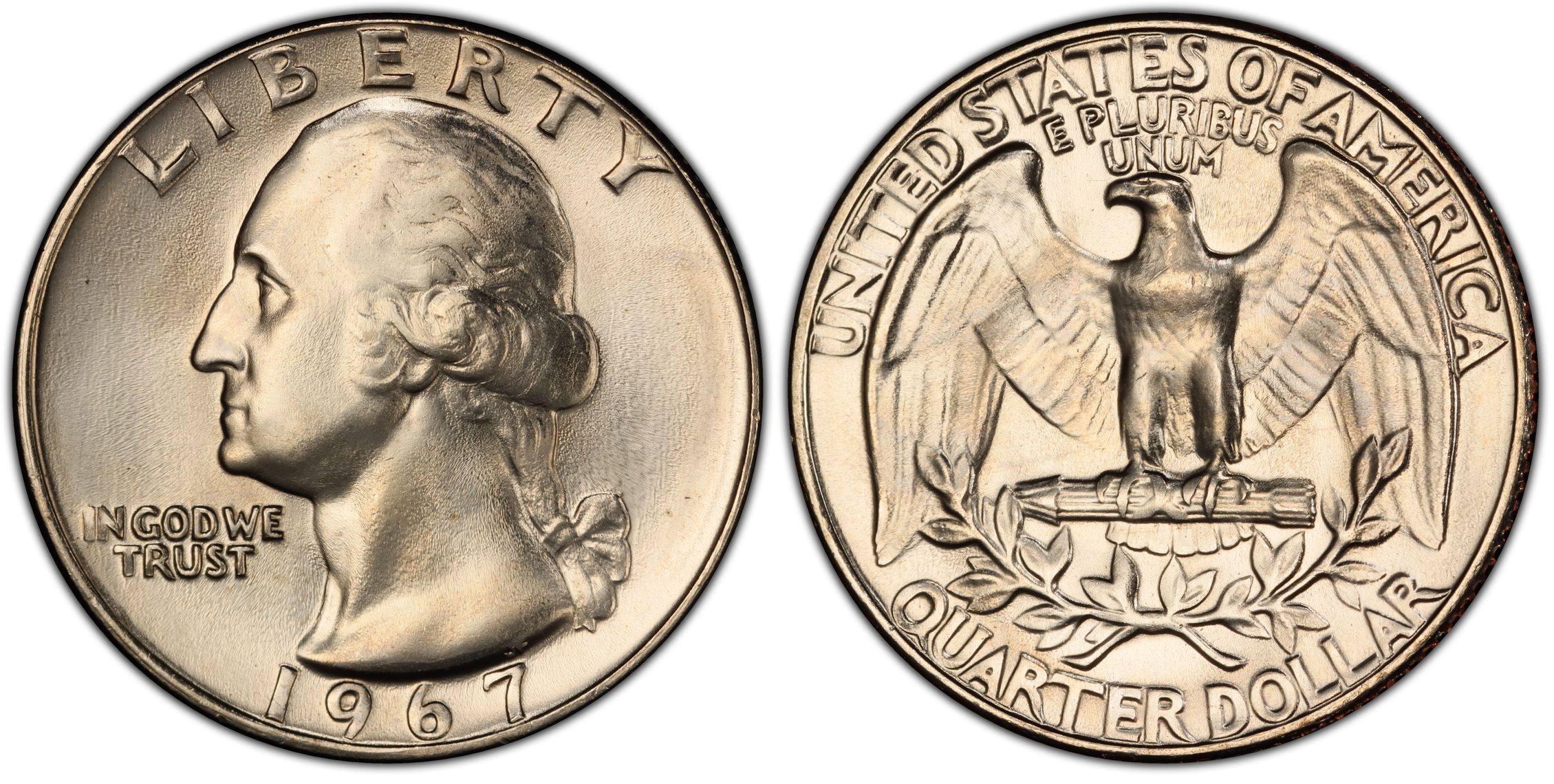
A real 1967 quarter: both sides
Basics and the coin’s story
A familiar quarter during the coin shortage
The 1967 quarter kept Washington’s portrait and the eagle reverse while the United States adjusted to clad coinage. Silver had been removed from the regular quarter starting in 1965. The absence of a mint mark reflects a temporary national policy during the coin shortage, not a missing step on one defective coin.
Collectors also faced a change: Special Mint Sets filled the gap during 1965–1967, before normal Proof production resumed in 1968. The 1967 date therefore belongs to two collecting paths—coins made for circulation and coins made for these special sets. That distinction matters more than the bare date when comparing prices.
For the start of the transition, see the 1965 quarter guide. For the earlier silver issue, compare the 1964 quarter’s silver content and value.
| Feature | What to know |
|---|---|
| Country / denomination | United States / 25 cents |
| Design | John Flanagan’s Washington portrait and eagle reverse |
| Composition | Copper-nickel outer layers bonded to a copper core; no silver in the normal issue |
| Nominal weight / diameter | 5.67 g / approximately 24.3 mm |
| Edge | Reeded; the copper core is often visible |
| Mint mark | None on normal 1967 issues |
| Main issue types | Regular strike and Special Mint Set (SMS) |
Identify the issue before comparing prices
No mint mark is the expected result
Confirm 1967 beneath Washington’s portrait and QUARTER DOLLAR on the reverse. Do not infer Philadelphia merely from the missing letter: mint marks were omitted across facilities during this period. The Mint restored them on 1968-dated coins. A purported D or S on a 1967 coin needs inspection for a misread date, damage or alteration.
Compare regular strikes with SMS coins
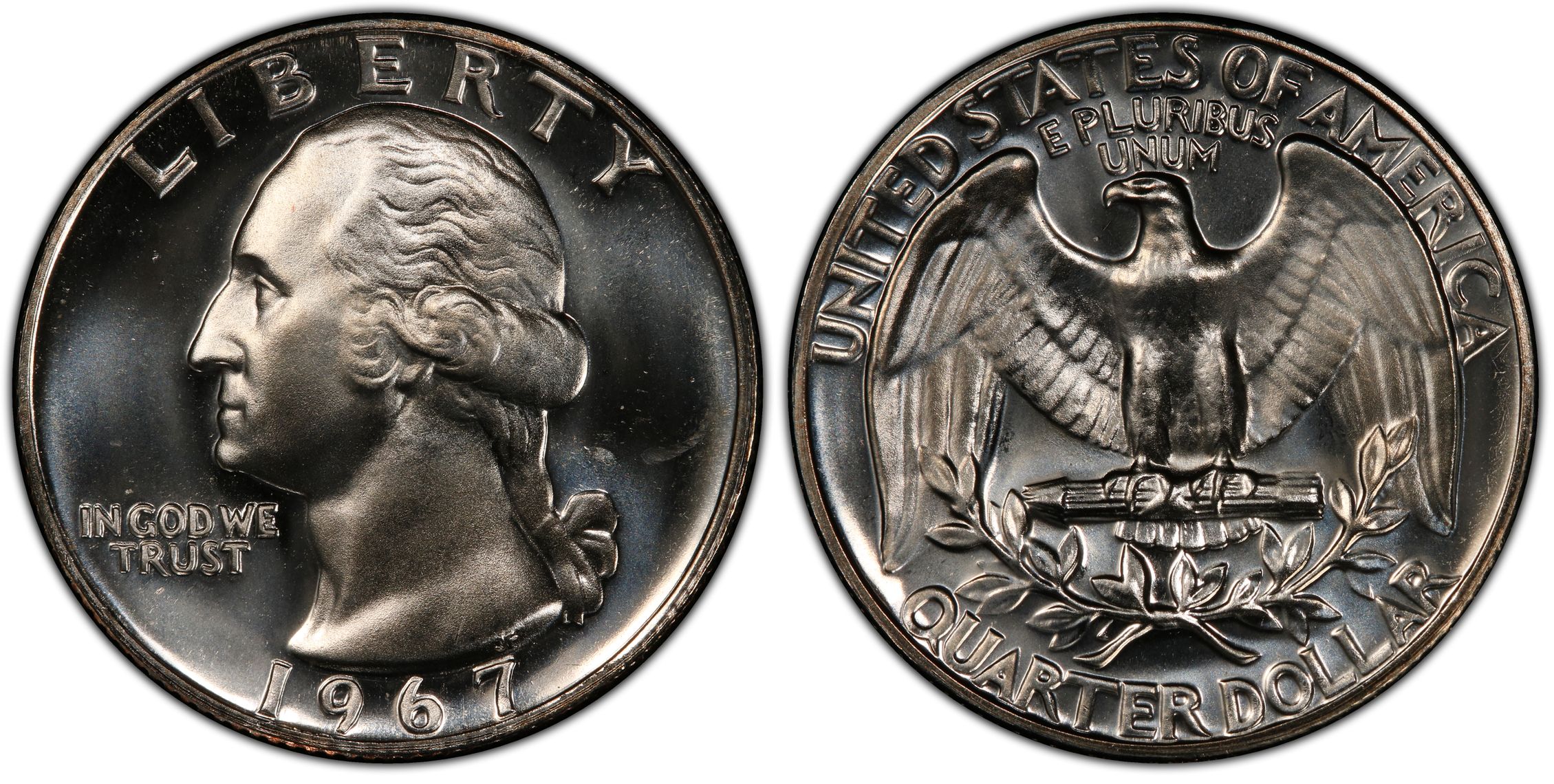
SMS means Special Mint Set, a collector product, not a mint-mark letter. Such coins can show a more reflective finish. Original set context is useful, but a loose bright quarter still needs careful examination. Ordinary circulation strikes can be lustrous, and polishing can make a worn coin misleadingly shiny.
PCGS uses SP grades for these special strikes. Cameo and Deep Cameo describe stronger contrast between frosted devices and reflective fields; neither designation belongs automatically to every SMS coin. Compare the exact designation when researching a price.
Separate varieties from damage
PCGS catalogs SMS doubled-die varieties, including FS-101 on the obverse and FS-801 on the reverse. A correct attribution needs matching details, not merely a blurry or doubled-looking photograph. Scratches, flat spots and discolored edges do not, on their own, establish a mint error.
If the coin has an unusual weight or surface, document both faces and the edge before seeking an opinion. Do not polish it or assume it is a silver rarity. The coin identification guide covers the general checks without replacing specialist authentication.
1967 quarter value by issue and condition
The table separates a face-value baseline, guide estimates and one actual auction result. Prices are USD. Guide entries were checked October 15, 2026; the sale is a dated example for one certified coin.
| Issue | Condition / basis | Value | Evidence / date | How to use it |
|---|---|---|---|---|
| Regular strike | Ordinary worn example | $0.25 | Face value | No silver premium; no mint mark is normal |
| Regular strike | MS65 / MS66 | $16 / $20 | PCGS guide; checked Oct 15, 2026 | Mint State grades; not values for worn coins |
| SMS, no Cameo designation | SP65 / SP67 | $14 / $22 | PCGS guide; checked Oct 15, 2026 | Special strike; compare the same finish |
| Regular strike | PCGS MS68 | $3,960 | Heritage, Aug 12, 2024; lot 3323 | Reported sale including buyer’s premium; exceptional specimen |
| SMS Cameo / Deep Cameo or attributed variety | Exact designation and grade required | Research matching sales | Separate collector categories | Do not use an ordinary SMS estimate or an unrelated record |
What the $3,960 sale actually demonstrates
Heritage’s August 12, 2024 auction sold lot 3323, a PCGS MS68 1967 quarter, for $3,960. It is a specific high-grade specimen, not evidence that a random 1967 quarter has the same value. The listed auction result includes the buyer’s premium; it is not the seller’s net proceeds.
For your own coin, compare issue, grade, designation and surface quality before comparing the dollar figure. An MS68 sale cannot establish an MS65 value, and a Deep Cameo SMS result cannot establish the value of a normal regular strike. Keep asking prices separate from completed sales.
Decide whether closer review is worthwhile
Start by separating worn coins from apparently unworn ones. Check the portrait, eagle and open fields in even light. Use the grading scale guide for terminology rather than guessing a numerical grade from brightness.
Leave the coin uncleaned; see how to recognize altered surfaces. If it appears exceptional or has a convincing variety diagnostic, compare likely value with certification and selling costs. Our appraisal guide explains how to prepare evidence for a closer review.
Summary
A worn 1967 quarter is usually a 25-cent coin; no mint mark does not make it rare. Collector premiums depend on whether it is a regular strike or SMS coin, its condition, and any properly attributed designation or variety.
Keep exceptional auction results in their own category. Match your coin to the same issue and grade, preserve the surfaces, and seek a specialist opinion only when there is a concrete feature worth investigating.
Frequently asked questions
What is a 1967 quarter with no mint mark worth?
An ordinary worn example is generally worth $0.25. No mint mark is normal for 1967. Uncirculated regular strikes, SMS coins and authenticated varieties need separate comparisons.
Does a 1967 quarter contain silver?
The normal United States issue is copper-nickel clad and contains no silver. Its silver-colored surface is not evidence of silver content.
How can I tell if my 1967 quarter is SMS?
Look for the special finish and preserve any original Special Mint Set packaging. Brightness alone is insufficient because regular strikes and altered surfaces can look reflective. A loose uncertain example may need expert inspection.
Can a 1967 quarter be worth thousands of dollars?
Yes, an exceptional certified specimen can be: Heritage sold a PCGS MS68 example for $3,960 on August 12, 2024. That result does not establish the value of an ordinary circulated quarter.
References
Sources and further reading
- U.S. Mint — QuarterWashington design history and the 1965 change in composition.
- U.S. Mint — Mint marks restored to coinsContemporary announcement explaining the restoration of mint marks in 1968.
- PCGS CoinFacts — 1967 regular strikeClad specifications, regular-strike category and grade-specific guide estimates checked October 15, 2026.
- PCGS CoinFacts — 1967 SMSSpecial-strike grades, Cameo categories, cataloged varieties and guide estimates checked October 15, 2026.
- NGC Coin Explorer — 1967 SMSBackground on the 1965–1967 Special Mint Sets.
- Heritage Auctions — 1967 quarter, lot 3323August 12, 2024: PCGS MS68, reported realized price $3,960; auction terms list a 20% buyer’s premium.