

 App Store

COIN VALUE GUIDES · WASHINGTON QUARTERS
1964 Quarter Value:Silver Content, Mint Marks and Proofs
Separate silver value from collector value, identify the mint, and understand why the last silver-era Washington quarter still matters.
 HeriBase TeamPublished
 In this article
How much is a 1964 quarter worth?
A normal 1964 Washington quarter contains 90% silver, so even a worn example is worth more than its $0.25 face value. Its nominal silver content is about 0.1808 troy ounce. Multiply that by the current silver price per troy ounce to estimate metal value; a dealer’s offer and a collector’s retail price can differ from that calculation.
For a dated collector-price benchmark, PCGS’s no-mint-mark guide showed $17–$21 from Good (G4) through About Uncirculated (AU58), and $32–$45 at Mint State grades MS65–MS66 when checked on October 15, 2026. These are guide estimates for the specified issue and grade, not guaranteed sale proceeds or a price for every 1964 quarter.
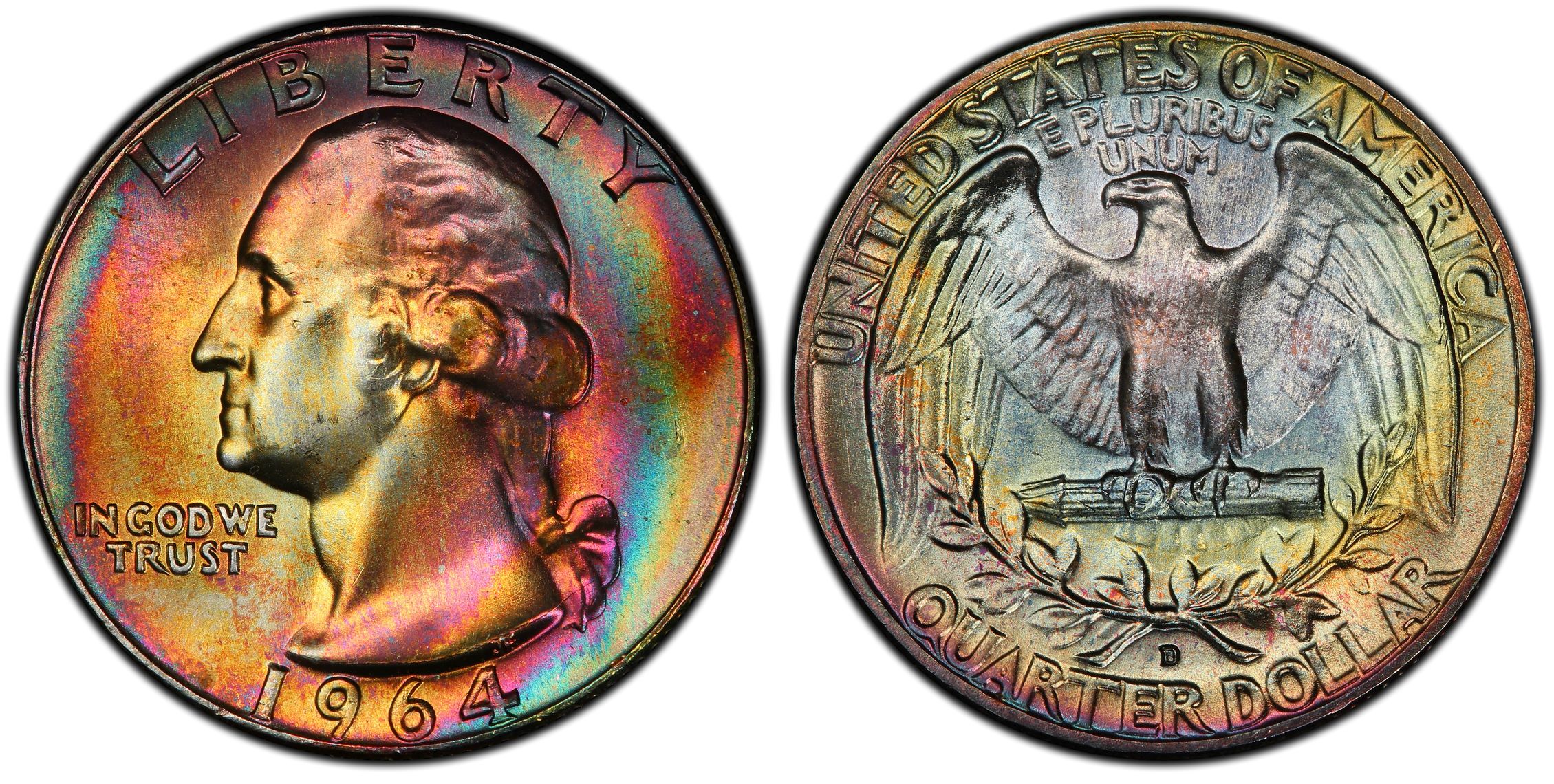
Denver coins carry a D on the reverse; Philadelphia circulation strikes have no mint mark. Proofs, exceptional grades and attributed varieties require separate comparisons. A missing mint mark or a shiny surface alone does not make the coin rare.
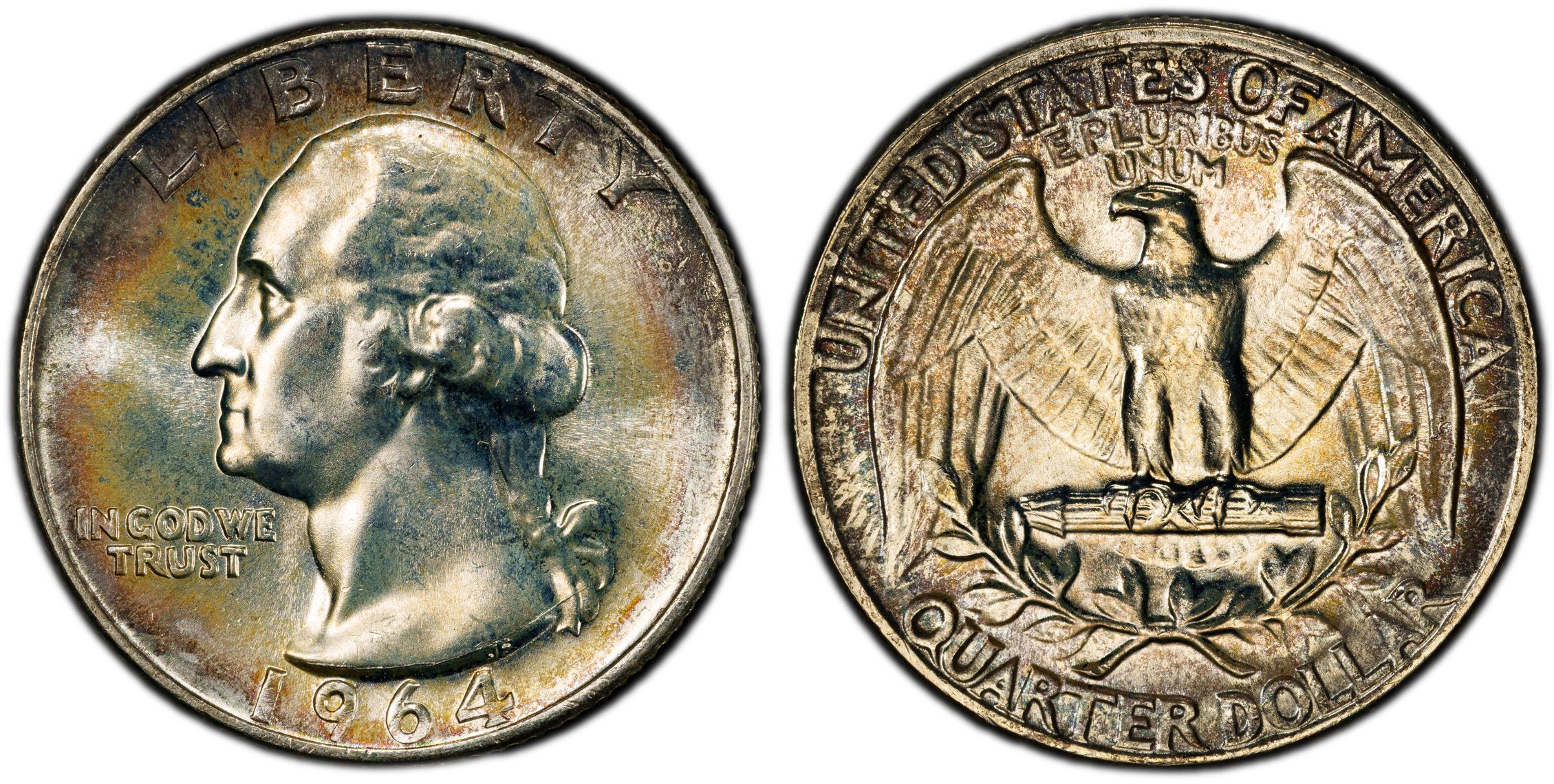
A real 1964 quarter: both sides
Basics and the coin’s story
The silver-era ending hidden in an ordinary date
Washington first appeared on the quarter in 1932 to commemorate the 200th anniversary of his birth. John Flanagan’s portrait and eagle design remained familiar for decades. The 1964 date marks the end of 90% silver quarters intended for circulation; the following date introduced copper-nickel clad metal.
That makes this a useful coin to keep beside a 1965 quarter: the designs look closely related, but the metal changes the starting point for value. A worn 1964 quarter can retain a silver premium even after its fine details have disappeared. Its story is a change in everyday money, not evidence that every surviving example is scarce.
| Feature | What to know |
|---|---|
| Country / denomination | United States / 25 cents |
| Design | George Washington portrait; eagle with spread wings, arrows and olive branches |
| Composition | 90% silver, 10% copper |
| Nominal weight / diameter | 6.25 g / approximately 24.3 mm |
| Silver content | Approximately 0.1808 troy ounce when at full nominal weight |
| Mint identification | No mark: Philadelphia; D: Denver; mark is on the reverse |
| Main issue types | Regular circulation strikes and collector Proofs; specialized attributions are separate |
Identify the issue before comparing prices
Turn the coin over to find the mint mark
Read 1964 on the portrait side, then look below the wreath on the eagle reverse, just above QUARTER DOLLAR. A small D identifies Denver. A clear blank space is normal for Philadelphia. Do not search beside Washington’s ponytail using the layout of a later quarter; the mint-mark position changed.
Use the edge and weight as checks, not a verdict
The silver issue has a nominal weight of 6.25 g. A regular 1967 clad quarter weighs 5.67 g and often exposes its copper core at the edge. Wear, dirt, plating and scale accuracy can complicate a home check. A result that does not fit calls for closer examination, not an immediate rare-error claim.
Keep Proofs and specialist varieties separate
A Proof is a collector production method, not simply a grade for a shiny coin. The 1964 Proof quarters were made at Philadelphia and have no mint mark; PCGS labels their grades PR. Cameo and Deep Cameo designate contrasting frosted devices and reflective fields, and have separate price entries. Reflective fields can be a clue, but polishing can also create shine. Preserve any original set packaging and compare the finish on both sides. PCGS also catalogs 1964 doubled-die and Type B reverse varieties; attribution requires matching their specific diagnostics, not just seeing doubled-looking lettering.
The exceptionally scarce coins cataloged as 1964 SMS are another separate attribution. Do not transfer that label to a regular 1964 coin or confuse it with the widely issued 1965–1967 Special Mint Sets. Get specialist confirmation before relying on such a claim.
1964 quarter value by issue and condition
Use two comparisons: the silver calculation for the metal baseline, then a matching issue and grade for any collector premium. Dollar figures below are in USD. Guide values were checked October 15, 2026; the silver example is deliberately hypothetical.
| Issue | Condition / basis | Value | Evidence / date | How to use it |
|---|---|---|---|---|
| Any normal 1964 quarter | Silver content only | 0.1808 × silver spot price | Metal calculation | Nominal full-weight silver; not a purchase offer |
| Illustrative silver calculation | $50 per troy ounce | $9.04 | Hypothetical example | Not today’s silver quote; excludes fees and premiums |
| 1964, no mint mark | G4–AU58 | $17–$21 | PCGS guide; checked Oct 15, 2026 | Regular issue; grade-specific retail reference |
| 1964, no mint mark | MS65 / MS66 | $32 / $45 | PCGS guide; checked Oct 15, 2026 | Certified-grade comparisons; uncirculated is not one price |
| 1964-D | G4 / AU58; MS65 / MS66 | $17 / $21; $30 / $55 | PCGS guide; checked Oct 15, 2026 | Individual grade examples, not guaranteed offers |
| 1964 Proof, no Cameo designation | PR65 / PR67 / PR69 | $20 / $24 / $36 | PCGS guide; checked Oct 15, 2026 | Proof grades; Cameo, Deep Cameo and varieties require separate comparisons |
Why a guide price and an offer can differ
A dealer buying a small group of worn silver quarters may price the group around bullion demand and a buying spread. A collector buying a certified example may pay for its grade, surfaces and appearance. Compare equivalent transactions: a graded retail listing is not the same as an offer for a loose, worn coin.
Look for wear on Washington’s hair and the eagle’s breast, then examine the open fields for hairlines, scratches or other impairment. Do not clean the coin to improve its presentation. Use our coin grading guide for terminology and cleaned-coin guide for surface warning signs.
Before paying for certification, compare the likely premium with grading, shipping and selling costs. A common worn silver quarter does not need a rare-coin valuation to have metal value. For an unusual variety or questionable authenticity, the coin appraisal guide explains the next step.
Summary
For a 1964 quarter, start with silver, then add only a supported collector premium. The regular coin is 90% silver; no mint mark and D are normal issues. The dated guide examples above show why condition matters, but they are not guaranteed offers.
Record the mint and issue, leave the surfaces untouched, and compare matching recent sales. Treat Proofs, varieties and unusual attributions separately instead of applying their prices to an ordinary worn quarter.
Frequently asked questions
Is a 1964 quarter with no mint mark valuable?
It has silver value because the normal issue is 90% silver. No mint mark identifies Philadelphia and is not, by itself, a rarity. Condition and issue determine any additional collector premium.
How much silver is in a 1964 quarter?
A full-weight coin contains approximately 0.1808 troy ounce of silver. Multiply that amount by the current silver spot price per troy ounce for a metal-value estimate; wear and transaction costs can affect an actual offer.
Where is the D on a 1964 quarter?
Look on the reverse below the wreath and above QUARTER DOLLAR. A small D identifies Denver. Philadelphia quarters normally have no mint mark.
Is every shiny 1964 quarter a Proof or SMS coin?
No. Shine alone does not establish either attribution. Proof manufacture, surface alteration and specialist SMS attribution must be distinguished; original packaging and expert examination can help.
References
Sources and further reading
- U.S. Mint — QuarterWashington design history and the 1965 change in composition.
- U.S. Mint — Mint marks restored to coinsContemporary announcement explaining the restoration of mint marks in 1968.
- PCGS CoinFacts — 1964 regular strikePhiladelphia issue, varieties and grade-specific guide estimates checked October 15, 2026.
- NGC Coin Explorer — 1964-DSilver fineness, nominal 6.25 g weight and silver content.
- PCGS CoinFacts — 1964-D regular strikeDenver issue and grade-specific guide estimates checked October 15, 2026.
- PCGS CoinFacts — 1964 ProofProof category and guide estimates checked October 15, 2026; ordinary Proof entries exclude Cameo and Deep Cameo.
- PCGS CoinFacts — 1964 SMSSpecial-strike attribution, distinct from ordinary 1964 coins.