

 App Store

COIN VALUE GUIDES · WASHINGTON QUARTERS
1965 Quarter Value:No Mint Mark, SMS and Silver Errors
A familiar quarter marks an important change in American coinage. Identify yours, understand its story and choose a meaningful price comparison.
 HeriBase TeamPublished Updated
 In this article
How much is a 1965 quarter worth?
A 1965 United States quarter is a Washington 25-cent coin. A typical circulated 1965 Washington quarter is worth its face value of $0.25. It is copper-nickel clad, not silver. The absence of a mint mark is normal for this date and does not add value.
Uncirculated quarters and Special Mint Set (SMS) quarters can carry a collector premium. SMS quarters were made for special collector sets. For either type, the amount depends on grade, surface quality and comparable sales; this guide does not establish a reliable current price range for those categories.
Authenticated errors, including quarters struck on silver planchets, belong to a separate market. Do not apply their auction prices to an ordinary quarter. For your coin, identify the issue and condition first, then compare matching sold examples; unusual metal or error claims require specialist verification.
A real 1965 quarter: both sides
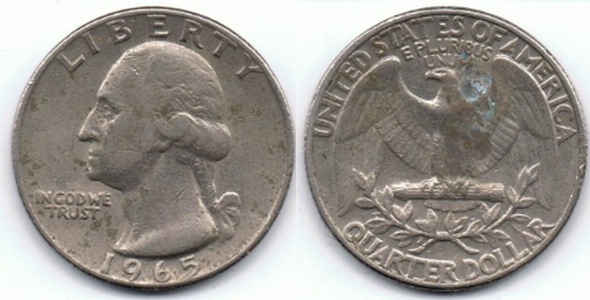
Read the date at the bottom of the portrait side, then confirm QUARTER DOLLAR beneath the eagle. Use both sides together: the Washington portrait alone appears on many other dates.
The story: a familiar design, a different metal
The quarter that crossed the silver divide
The Washington portrait arrived on the quarter in 1932, with a design by John Flanagan. In 1965, the familiar coin became part of a major change in American pocket money: silver was removed from the regular quarter and replaced by copper-nickel clad construction.
The Coinage Act of 1965 came during a coin shortage. Mint marks were also suspended, then restored for 1968-dated coins. That history explains two common surprises today: a silver-colored 1965 quarter normally contains no silver, and a blank mint-mark area is expected.
Its appeal as a collectible can be historical rather than financial. A modest circulated example can illustrate the change from silver coinage without needing to be a rare error.
| Feature | What to check |
|---|---|
| Country / denomination | United States / 25 cents |
| Design | John Flanagan; Washington obverse, eagle reverse |
| Composition | Outer layers: 75% copper, 25% nickel; core: copper. These percentages describe the outer layers, not the whole coin. |
| Standard weight / diameter | 5.67 g / 24.30 mm |
| Edge | Reeded |
| Mint mark | None. Do not assign a mint solely from its absence. |
| Regular-strike mintage | 1,819,717,540; production total, not a count of surviving high-grade coins |
Identify the coin before checking its price
- 01Confirm the date and denomination.Compare the two sides with the photograph above. A blurred final date digit is a reason to take a better photograph, not to assume a rare date.
- 02Record the edge and weight.Photograph the edge in neutral light and weigh the coin on a reliable gram scale. Compare the result with the standard specification, allowing for wear and measurement uncertainty. An unexpected reading is a reason to investigate, not a metal test.
- 03Separate the issue types.Keep ordinary circulation strikes and Special Mint Set coins in separate searches. Preserve original packaging and any existing certification information.
Why “1965 no mint mark” is not a rarity label
The missing letter is part of the normal issue. A listing that highlights “no mint mark” has not established an error. Look instead for a documented variety, an authenticated production mistake or exceptional preservation.
SMS is an issue type, not a synonym for shiny
Special Mint Sets replaced the usual proof and mint sets in 1965–1967. Their coins received special production treatment. Brightness alone is insufficient to identify one: lighting and later surface treatment can also change appearance. Compare certified SMS examples and their attribution, rather than treating any polished-looking quarter as a proof.
For the general identification workflow, see how to identify a coin.
1965 quarter value: face value, collector coins and errors
Start with the likely category, then compare evidence within it. A circulated coin should not be priced from a superb certified specimen, and a normal clad coin should not be priced from a silver-planchet error.
What the real photograph can—and cannot—show
The example above shows wear, contact marks and uneven surface color. Those observations are useful when choosing comparable coins. They do not establish a numerical grade, metal composition or authenticity.
For grading terms, use our coin grading scale guide. For suspiciously altered surfaces, see how to recognize a cleaned coin. Cleaning to make a comparison photo look brighter can remove useful evidence.
Price evidence: baseline versus exceptional sales
All amounts are USD. Historical sales illustrate specific coins, not the current value of every 1965 quarter.
| Type / condition | Amount | Basis | Date | Limits |
|---|---|---|---|---|
| Normal worn clad quarter | $0.25 baseline | Face value; general clad-quarter guidance (S5) | Guide: 2017 | Not a guaranteed sale price or dealer bid |
| Uncirculated regular strike / SMS | Compare recent sales by grade | Requires matching issue, grade and recent sales | Varies by sale | No amount inferred from appearance alone |
| Regular strike, PCGS MS68 | $11,400 | Reported Heritage result; lot 3054 (S3, S6) | 2023-07-20 | Exceptional certified specimen; not a typical example |
| Silver-planchet error, ANACS XF45 | $4,025 | Heritage result recorded by PCGS; lot 9121 (S7) | 2003-02 | Authenticated error; a much older market result |
The auction records identify the grade and lot shown above. Fee inclusion is unconfirmed; these amounts should not be read as seller proceeds.
A practical way to research your example
Search completed sales with the full description, including the date, strike type and any certified grade. Open the actual lot: check photographs, certification, sale date and whether the amount includes a buyer’s premium. Exclude unsold asking prices and bundles whose price cannot be assigned to one coin.
If the weight or other evidence suggests an unusual metal, keep a record of the measurements and request specialist assessment before comparing error prices. A photograph or a high asking price cannot authenticate the claim. HeriBase can be a starting point for organizing an identification; see the HeriBase user guide. For an unresolved or potentially valuable coin, see our appraisal guide.
What to do with your 1965 quarter
The key distinction is ordinary clad coinage versus a coin with a verified collectible premium. A worn 1965 quarter is usually worth face value; the date and missing mint mark alone do not make it rare.
Identify → assess → compare. Separate regular strikes, SMS pieces and authenticated errors, then match condition and recent sold records. Resolve uncertain metal or error claims before assigning extra value.
1965 quarter questions
Is a 1965 quarter with no mint mark rare?
No. Mint marks were deliberately omitted for this period. The absence of a letter does not establish rarity or a mint error.
Are all 1965 quarters silver?
No. The regular issue is copper-nickel clad. Silver-planchet errors are a separate, documented category requiring authentication; a silver-colored surface is not enough.
Can a 1965 quarter be worth thousands of dollars?
Specific certified specimens have achieved such results, as the dated records above show. Those results do not establish the value of an ordinary circulated quarter.
Should I pay to grade every 1965 quarter I find?
First establish a reason why the coin might justify the cost. Compare the likely premium with grading, shipping and selling fees. An uncertain error attribution may call for an initial specialist opinion before a paid submission.
What is a normal worn 1965 quarter worth?
A normal worn 1965 Washington quarter has a face-value baseline of $0.25. The regular coin is copper-nickel clad, and no mint mark is normal. Uncirculated coins, Special Mint Set pieces and authenticated errors require their own condition-matched comparisons.
References and further reading
SourcesOpen
- S1 · U.S. Mint — Quarter historyWashington design and the change in composition.
- S2 · U.S. Mint — Mint Marks Restored to CoinsHistorical announcement explaining the suspension and restoration of mint marks.
- S3 · PCGS CoinFacts — 1965 regular-strike quarterSpecifications, production figure and the cited MS68 sale record.
- S4 · PCGS CoinFacts — 1965 SMS quarterSMS issue context; not used as a current price quote.
- S5 · PCGS — Washington Quarters guide (PDF)2017 general circulated-clad guidance; not a 2026 market survey.
- S6 · Heritage — 1965 quarter MS68, lot 3054July 20, 2023 auction identification. Amount is corroborated through the PCGS census.
- S7 · PCGS Auction Prices — silver-planchet error, lot 9121February 2003 result; ANACS XF45, certification WD6415.
- S8 · U.S. Mint — Historical timelineCoinage Act of 1965 context.
- HeriBase · National Park quartersExplore a later quarter series with a different collecting focus.