

 App Store

COIN VALUE GUIDES · HISTORIC DENOMINATIONS
Two Cent Coin:Shield Design, Motto Varieties and Value
Identify the U.S. two-cent piece, distinguish 1864 Large and Small Motto issues, and compare Brown-grade references without confusing the denomination with a half cent.
 HeriBase TeamPublished
In this article
Quick answer
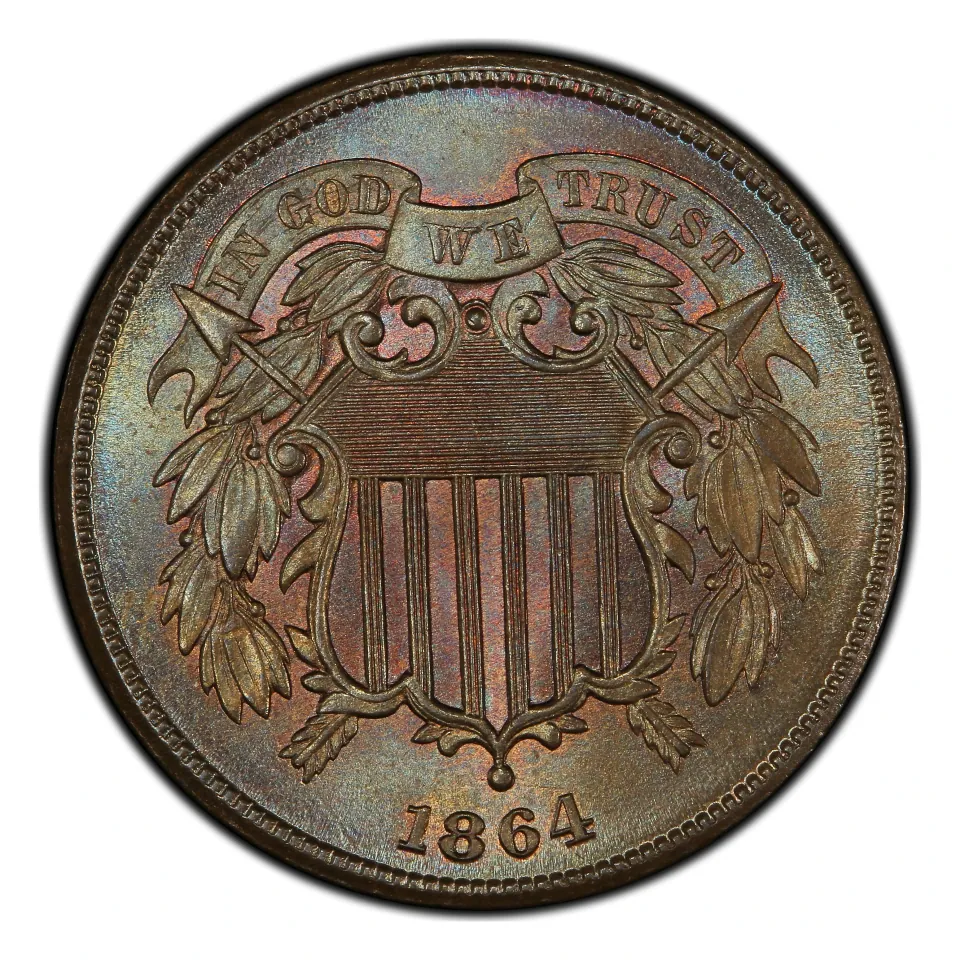
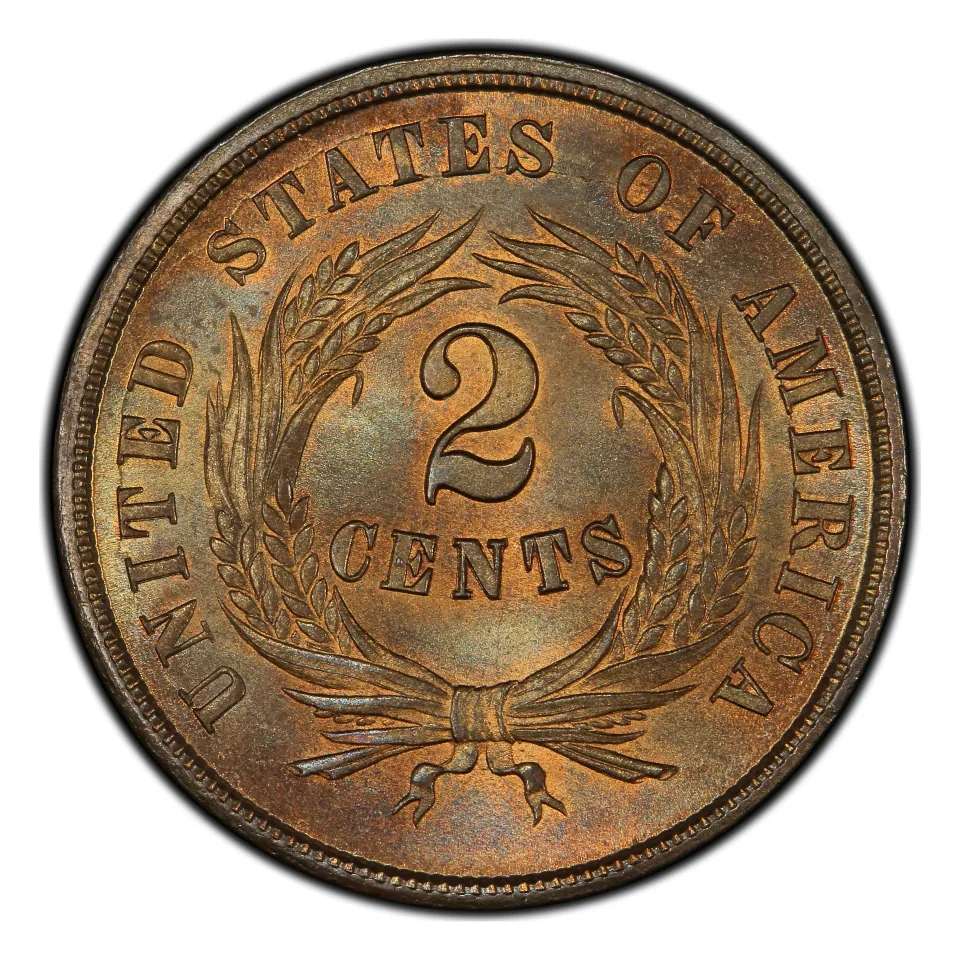
The U.S. two-cent piece is a bronze coin worth two cents in denomination, issued for circulation from 1864 through 1872 and as Proofs in 1873. Its shield and IN GOD WE TRUST are on the obverse; the wreath surrounds 2 CENTS on the reverse. All were made at Philadelphia without a mint mark.
The PCGS retail guide checked October 26, 2026 lists the ordinary 1864 Large Motto Brown entry at $34 in Good 4, $100 in Extremely Fine 40 and $300 in Mint State 63. These are issue-specific estimates. The scarcer Small Motto, other dates, copper-color designations and Proofs need separate comparisons.
Coin photos
Basics & coin story
The denomination emerged during the Civil War, when disruption to coin circulation encouraged substitutes and new small-change solutions. James Barton Longacre designed the shield, arrows and surrounding branches, with the denomination on the opposite face. It was the first regular U.S. coin to carry IN GOD WE TRUST.
The 1864 date has two major motto-size varieties. Large Motto became the standard for the remaining series, while Small Motto requires its own attribution. The presence of the words alone does not decide the variety: their size and design relationships must be compared with a reliable reference.
Interest in a brief denomination is different from scarcity within a date. A collector can begin with an ordinary 1864 Large Motto example without buying a scarce date or a Proof. For another discontinued denomination, the half-cent guide explains a coin with one-quarter of this face value.
| Feature | What to check |
|---|---|
| Denomination | 2 cents, not one-half cent |
| Design / designer | Shield and wreath / James B. Longacre |
| Series | Circulation: 1864–1872; 1873 collector Proofs |
| Standard alloy | Bronze: 95% copper, balance tin and zinc |
| Nominal weight / diameter | 6.22 g / 23 mm |
| Edge / mint | Plain / Philadelphia, no mint mark |
| 1864 major distinction | Large Motto versus Small Motto |
| Color designations | Brown (BN), Red and Brown (RB), Red (RD) |
Identification
Read the denomination on the wreath side
A large 2 CENTS is normal. The coin is neither a half cent nor a modern euro two-cent piece. Confirm the shield, date, English legends and plain edge before selecting a catalog entry.
Attribute the 1864 motto before using a price
The photographs show Large Motto. Compare a claimed Small Motto against the dedicated PCGS entry rather than judging it from apparent letter height in a blurred photograph. Wear, lighting and image scale can make an ordinary motto look different.
Keep wear, color and manufacture separate
BN, RB and RD describe copper color; they do not replace the numerical grade. A worn orange coin is not uncirculated, and polishing cannot establish original Red preservation. An 1873 coin belongs to a collector-Proof context rather than the ordinary circulation comparison.
Condition & value
Amounts are in U.S. dollars. PCGS retail-guide examples were checked October 26, 2026 and apply only to the stated issue, grade and designation. They are not guaranteed purchase offers; current market conditions and selling costs can change the amount received.
| Issue | Grade / condition | Value or reference | Basis | Important condition |
|---|---|---|---|---|
| 1864 Large Motto, BN | G4 | $34 | PCGS retail guide | Ordinary circulated reference |
| 1864 Large Motto, BN | EF40 | $100 | PCGS retail guide | Exact grade and surfaces |
| 1864 Large Motto, BN | MS63 | $300 | PCGS retail guide | Uncirculated Brown |
| 1864 Small Motto / other date / Proof | Exact issue and designation | Use its own comparison | Separate entries | No Large Motto price transferred |
These references answer the price of a particular collectible, not the value of every two-cent piece. The denomination’s two-cent face value is separate from a collector premium. Completed single-coin sales should match date, motto, grade, color and surface status.
Look for friction on the shield and prominent reverse details, then inspect the fields for corrosion, scratches or cleaning. A remaining readable motto does not by itself establish a high grade. For a modest circulated example, certification and selling costs can consume part of the premium; use the grading scale before deciding whether specialist grading is worthwhile.
Summary
Confirm the shield denomination, date and 1864 motto variety, then compare the same color and grade. The first-year Large Motto provides a useful ordinary reference; Small Motto and Proof issues require independent evidence.
FAQ
What is a U.S. two-cent coin?
It is the bronze shield-and-wreath denomination issued for circulation from 1864 through 1872, with collector Proofs dated 1873.
Is a two-cent coin the same as a half cent?
No. Two cents is four times the denomination of a half cent. The U.S. two-cent reverse reads 2 CENTS.
Which 1864 two-cent motto is more common?
The ordinary Large Motto is more common than Small Motto. A Small Motto claim requires the correct catalog diagnostics.
Was the two-cent piece the first coin with IN GOD WE TRUST?
It was the first regular U.S. coin to bear that motto, introduced in 1864.
References
References and further reading
- PCGS CoinFacts: exact issue, specifications and available guide evidence
- PCGS: two-cent denomination and types
- PCGS: condition- and color-specific two-cent guide
- PCGS: motto history
Sources and quoted guide evidence checked October 26, 2026. Guide estimates, historical sales, face value and metal-content calculations are identified separately.