

 App Store

COIN VALUE GUIDES · DIME GUIDES
Mercury Dime Value:Dates, Mint Marks, Silver and Full Bands
Identify 1916–1945 Winged Liberty dimes, locate the reverse mint mark, compare common-date values and keep Full Bands, overdates and key dates separate.
 HeriBase TeamPublished
In this article
Quick answer
A Mercury dime is a 1916–1945 U.S. ten-cent coin showing Winged Liberty and a fasces reverse. Standard examples are 90% silver, containing approximately 0.07234 troy ounce of fine silver. Common dates, the scarce 1916-D and Full Bands examples cannot share one value.
The PCGS reference table consulted October 26, 2026 lists ordinary 1945 Philadelphia dimes at $9 in Good 4, $28 in Mint State 63 and $65 in Mint State 65. These non-Full Bands guide estimates apply to a specific issue and grade. They do not price an unverified key date or a designated Full Bands coin.
Coin photos
Basics & coin story
Adolph A. Weinman designed Liberty with a winged cap to express freedom of thought. The portrait’s resemblance to the Roman messenger god gave the coin its Mercury nickname. A fasces and olive branch appear on the reverse, combining strength and peace in the design.
The new dime arrived during the redesign of U.S. silver coinage in 1916. Barber dimes also carry that year, so a 1916 date alone cannot identify the series. The Barber dime guide shows the earlier wreath reverse. Roosevelt’s portrait replaced Winged Liberty in 1946.
Collectors can choose a short group of later dates, a full date set or a date-and-mint set. Adding major overdates and Full Bands requirements substantially changes the task. Establish that scope before treating every variety listing as a necessary purchase.
| Feature | What to check |
|---|---|
| Dated series | 1916–1945; not every intervening year was issued |
| Designer / denomination | Adolph A. Weinman / 10 cents |
| Alloy | 90% silver, 10% copper |
| Nominal mass / diameter | 2.50 g / approximately 17.9 mm |
| Fine silver | Approximately 0.07234 troy ounce |
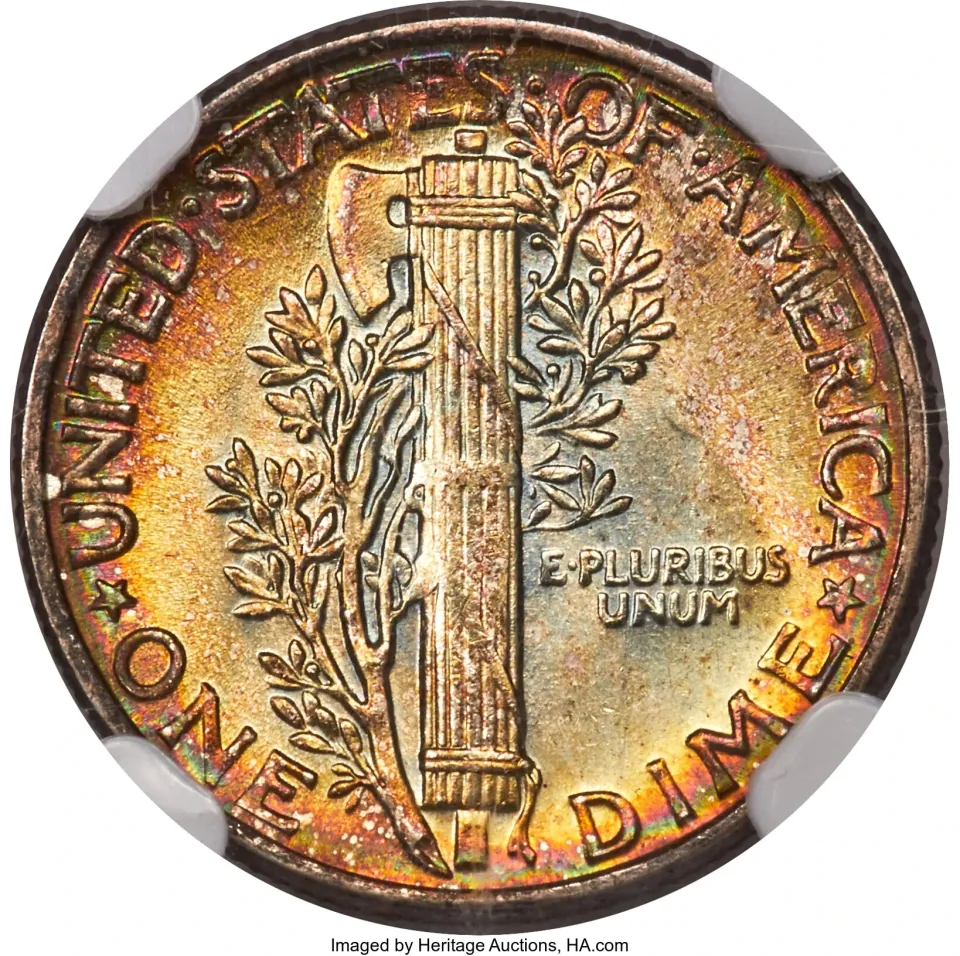
| Mint marks | No mark, D or S where issued; reverse near the lower left of the fasces |
| Proof years | Regular collector Proofs, 1936–1942 |
| Strike designation | Full Bands (FB), separate from numerical grade |
Identification
Find the mint mark on the fasces side
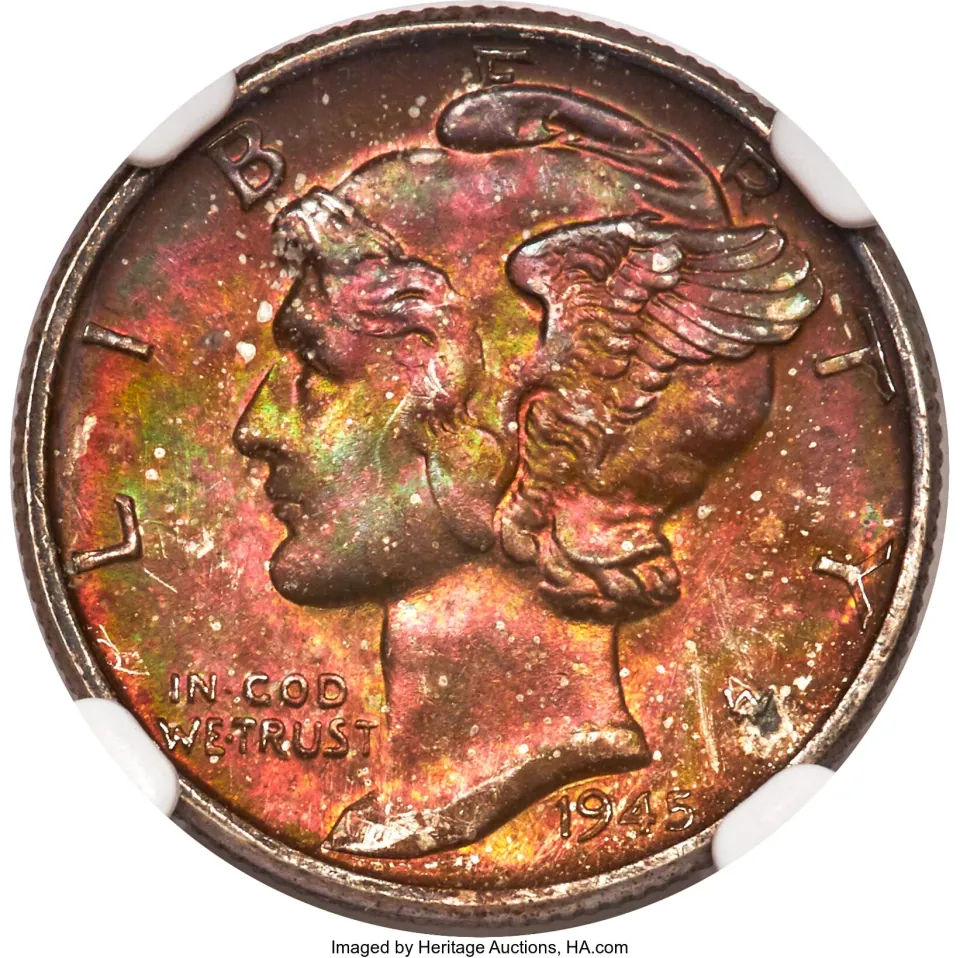
D or S appears near the lower left of the reverse fasces. The AW monogram beside Liberty’s neck identifies Weinman and is not a mint mark. An absent mint letter is normal for Philadelphia. Read the entire date and the correct face together.
Keep key dates and overdates distinct
The 1916-D, 1921 and 1921-D deserve exact issue comparisons. A 1942/1 overdate requires its documented diagnostics; an ordinary 1942 dime or a surface scratch does not receive an overdate price. Added mint marks and altered dates are authentication concerns.
Examine Full Bands without assuming it
Full Bands concerns separation in the horizontal bands at the center of the reverse fasces on eligible regular strikes. Wear, strike weakness and contact marks can affect that area in different ways. Use the grading service’s actual designation instead of assigning FB from a bright photograph.
The pictured 1945 Philadelphia coin is a non-FB example. Its date and toning illustrate identification; a different certified 1945 with Full Bands can trade in a very different market. The grading comparison guide documents why matching a numerical grade alone may still be insufficient.
Condition & value
Amounts are USD. The cited guide was consulted October 26, 2026; its displayed update date is stated below. Values apply only to the specified issue, grade and designation, and are not guaranteed purchase offers.
| Issue | Grade / condition | Value or reference | Basis | Important condition |
|---|---|---|---|---|
| 1945 Philadelphia, non-FB | G4 | $9 | PCGS guide | Common-date circulated reference |
| 1945 Philadelphia, non-FB | MS63 / MS65 | $28 / $65 | PCGS guide | Numerical grade and surfaces must match |
| Contained silver | 0.07234 troy oz | 0.07234 × silver price per troy oz | Metal calculation | No live quotation implied |
| 1916-D, 1921 or attributed overdate | Exact authenticated issue | Use issue-specific evidence | Different scarcity | Do not use common-date rows |
| Full Bands or Proof | Exact grade and designation | Compare separately | Separate manufacture or strike detail | Do not transfer non-FB prices |
The retrieved PCGS guide displays an October 17 update. These dated estimates and the metal-content formula are different references: a changing silver market does not automatically update a guide table. Dealer offers and sale proceeds also include spreads and costs.
For worn ordinary dates, silver provides a useful starting calculation. For a better coin, compare completed sales with the same date, mint, grade and FB status. A coin described as cleaned or damaged is not equivalent to a problem-free guide entry.
Photograph both faces and the mint area without polishing. If a premium depends on 1916-D authenticity or an overdate attribution, resolve that question before paying for a high-grade comparison. The appraisal guide explains how to move from an initial identification to specialist review.
Summary
Identify Winged Liberty, read the reverse mint mark and establish the grade and FB status. Use ordinary 1945 references only for that issue. Keep key dates, overdates and Proofs separate, and preserve the surfaces while gathering matching evidence.
FAQ
How much silver is in a Mercury dime?
A standard Mercury dime contains approximately 0.07234 troy ounce of fine silver in its nominal 2.50-gram, 90% silver alloy.
Where is the mint mark on a Mercury dime?
Look on the reverse near the lower left of the fasces. D and S identify branch mints where issued; Philadelphia normally has no letter.
Is the portrait actually Mercury?
It represents Liberty in a winged cap. The resemblance to Mercury gave the coin its familiar nickname.
Is a 1916 Barber dime the same as a 1916 Mercury dime?
No. Both designs occur in 1916. The rare 1916-D is a Mercury dime, so identify the design before using a price.
References
References and further reading
- U.S. Mint: dime designs and silver transition
- PCGS: Mercury design and mint-mark guide
- PCGS: Mercury price table, 1945 ordinary row
- NGC: Mercury series, key issues and Proof years
References consulted October 26, 2026. Price tables retain the update dates stated in the text; guide estimates, face values and completed transactions are different forms of evidence.