

 App Store

COIN VALUE GUIDES · PENNY GUIDES
Half Cent:Identify the Smallest U.S. Denomination and Its Value
Recognize a U.S. half cent, distinguish its five design types, and compare a documented 1853 example without applying one price to every early copper coin.
 HeriBase TeamPublished
In this article
Quick answer
A U.S. half cent is a copper coin worth one two-hundredth of a dollar in denomination, issued with dates from 1793 through 1857. It is different from a half dime, a five-cent silver coin. Half cents are collectibles today; their prices depend on date, design, die variety, condition and surface quality.
As a concrete comparison, the PCGS guide lists an 1853 Braided Hair half cent at $65 in G4, $95 in VF20 and $175 in XF40, checked October 21, 2026. These figures concern that date and ordinary Brown surfaces. They are not a minimum price for every damaged half cent or a value for a scarce 1790s issue.
Coin photos
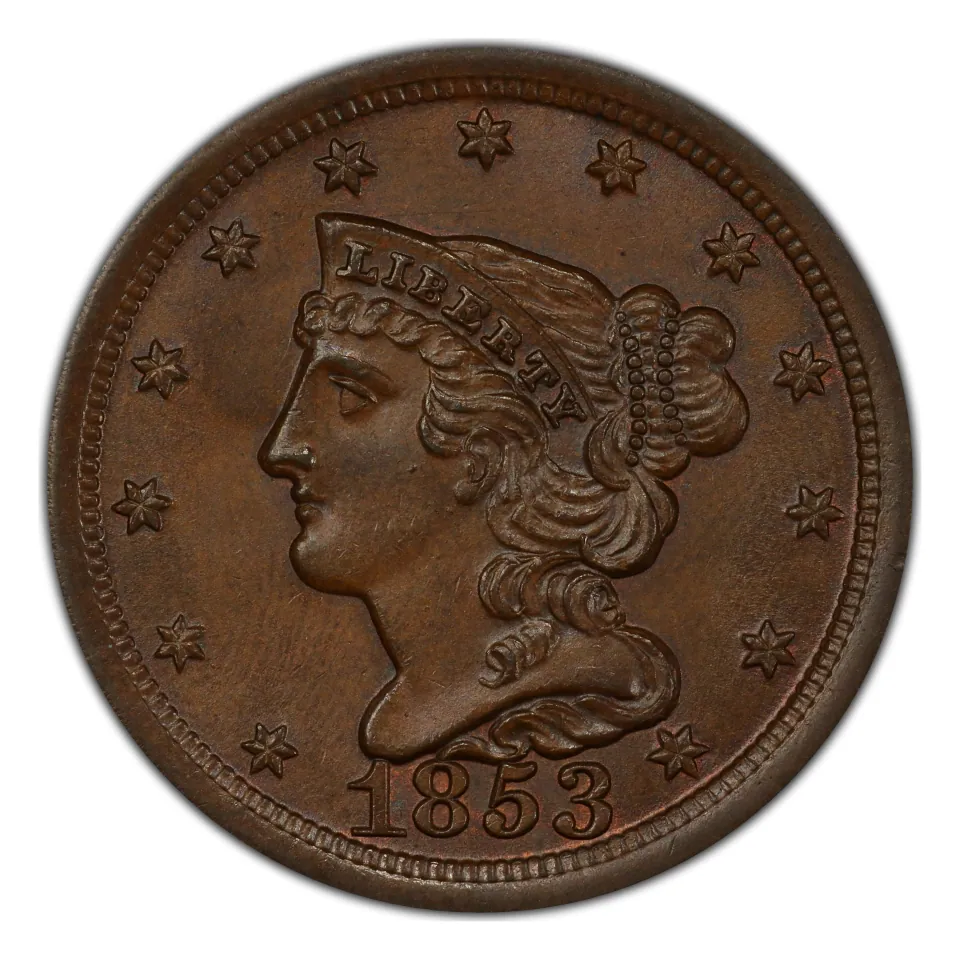
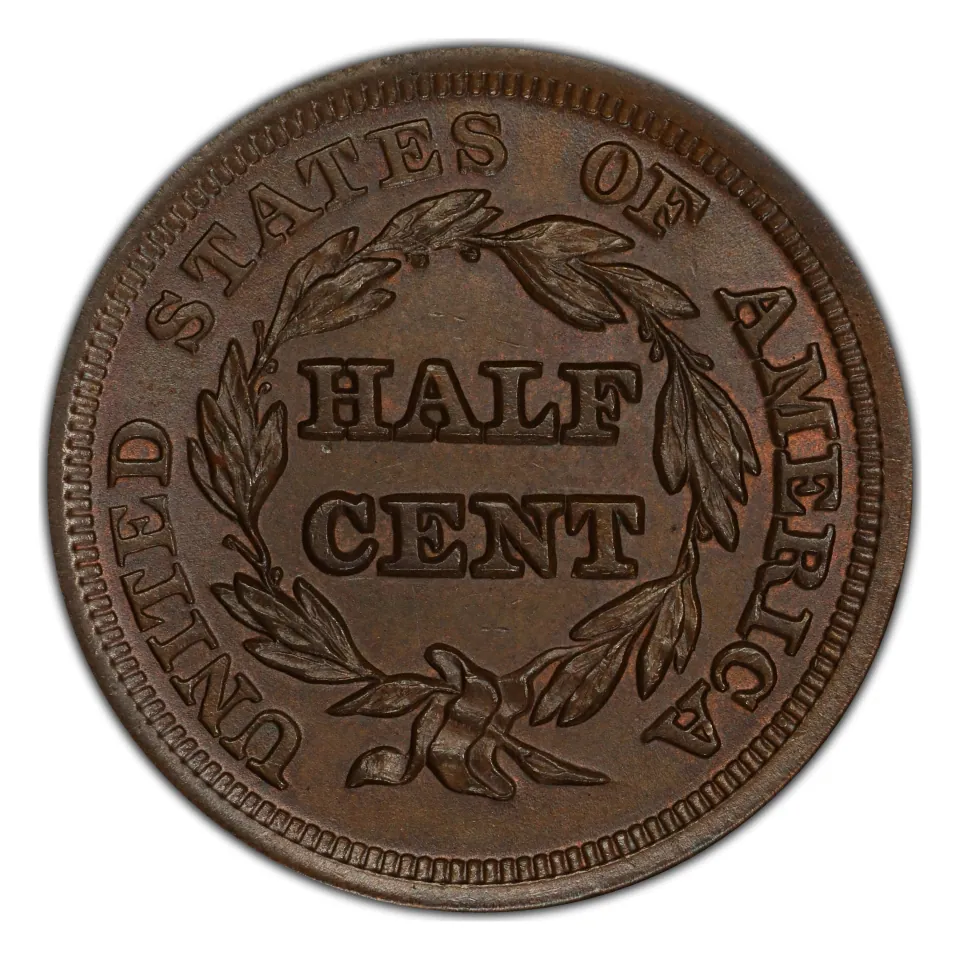
Basics & coin story
The half cent belonged to the original decimal coinage system authorized in 1792. A fraction smaller than one cent made sense when everyday transactions used amounts that now seem tiny. The denomination disappeared in 1857 as Congress changed the copper coinage and introduced a smaller cent.
Its long history contains five familiar design families: Liberty Cap facing left (1793), Liberty Cap facing right (1794–1797), Draped Bust (1800–1808), Classic Head (1809–1836) and Braided Hair (1840–1857). Those spans identify design families, not a promise of regular circulation production in every intervening year. Certain later dates and restrikes require specialized cataloging.
| Feature | What to check |
|---|---|
| Denomination | ½ cent = $0.005 |
| Dated series | 1793–1857, with production gaps |
| Metal | Copper; weight and edge vary by early issue |
| Illustrated issue | 1853 Braided Hair, Philadelphia |
| 1853 nominal specifications | 5.44 g; 23 mm; plain edge |
| Mint mark | No branch-mint letter expected |
Identification
Start with HALF CENT on the reverse
The wreath surrounds the denomination. Read both faces before deciding what the fraction means: a HALF DIME belongs to a different denomination and metal. A half cent is physically much larger than half a modern cent; the name describes monetary value, not size.
Use the portrait to choose the design family, then read the complete date. Do not use the illustrated 1853 weight to reject an early Liberty Cap issue, since early specifications changed. Measure a questionable coin with a suitable scale and compare the exact catalog entry.
Check copper surfaces before assigning a grade
Corrosion, porosity, scratches and old cleaning can affect a half cent more than a small difference in wear. Original brown color can be desirable. An orange surface does not prove original Red preservation. Keep the coin dry and uncleaned; the cleaned-coin identification guide explains why polishing cannot restore collector grade.
Some early copper prices depend on a specific die pairing. Photograph the date, lettering and both complete faces before claiming a variety. An indistinct last digit is a reason to investigate, not to assign the most valuable possible date.
Condition & value
Amounts are U.S. dollars. These PCGS retail-guide examples were checked October 21, 2026 for the stated issue and designation. A raw coin needs its own condition assessment; guide figures are not guaranteed sale proceeds and can lag metal prices.
| Issue | Grade / condition | Value or reference | Basis | Important distinction |
|---|---|---|---|---|
| 1853 Braided Hair, BN | G4 | $65 | PCGS retail guide | Problem-free example |
| 1853 Braided Hair, BN | VF20 / XF40 | $95 / $175 | PCGS retail guide | Same date; increasing detail |
| 1853 Braided Hair, BN | MS63 / MS65 | $550 / $1,150 | PCGS retail guide | Uncirculated Brown examples |
| Early types / scarce dates | Exact date and variety | Use matching evidence | Specialist comparison | No transfer of 1853 values |
| Corroded or cleaned coin | Details condition | Assess individually | Surface-dependent | Numerical guide may not apply |
A type collector can begin by choosing one attractive example from a design family rather than filling every date. A date-and-variety collection requires much more specific comparisons. Record the date, design and any certification number before checking sold examples.
When comparing offers, separate a retail guide from a dealer’s buying price and an auction total. Certification and sale costs may consume a substantial part of a modest coin’s value. The grading-scale guide helps interpret G4, VF20 and Mint State without treating a photograph as a confirmed grade.
Summary
Read HALF CENT, identify the portrait family and date, then assess the copper surface. The 1853 guide examples provide a dated comparison, not a universal half-cent price. Preserve the coin and use an exact issue or variety match before seeking an appraisal.
FAQ
Is a half cent the same as a half dime?
No. A half cent is a copper denomination of $0.005; a half dime is a five-cent silver coin.
When did the United States stop making half cents?
The dated U.S. half-cent series ends in 1857. There were gaps in production before that date.
Does a half cent need a mint mark?
No branch-mint letter is expected on regular U.S. half cents. A missing letter is not evidence of an error.
Is every half cent worth $65?
No. The $65 example is an 1853 Braided Hair coin in G4 in the checked PCGS retail guide. Other dates, varieties and damaged surfaces need separate comparisons.
References
References and further reading
- PCGS: photographed issue, specifications and guide
- U.S. Mint: original denominations and the 1857 change
- U.S. Mint: early copper weight legislation
Sources checked October 21, 2026. Retail guides and historical sales are identified separately; neither guarantees a buying offer.