

 App Store

COIN VALUE GUIDES · SUSAN B. ANTHONY DOLLARS
Susan B. Anthony Dollar:Value, Mint Marks and Key Varieties
Find out which small dollar you have, what makes a variety different, and when a collector premium is worth investigating.
 HeriBase TeamPublished Updated
 In this article
What is a Susan B. Anthony dollar worth?
A common worn Susan B. Anthony dollar usually has little premium over its $1 face value. It is a copper-nickel clad coin, not a silver dollar, and the series carries four dates: 1979, 1980, 1981 and 1999. The year alone does not establish a valuable variety.
The main varieties to check are the 1979-P Wide Rim and the 1979-S and 1981-S Type 2 Proofs. In NGC’s guide checked October 14, 2026, a regular 1979-P Narrow Rim is listed at $5 in Mint State 63 (MS63) and $15 in MS65; the Wide Rim is $25 and $45 at those same grades. These are retail guide comparisons with older underlying updates, not current sale guarantees. Proofs and unusually high-grade coins require their own comparisons.
Read the date and mint mark, identify the correct rim or Proof mint-mark type, then compare condition and recent completed sales. An S alone, a shiny surface or an online asking price does not establish a rare coin.
Recognize the portrait, eagle and mint mark
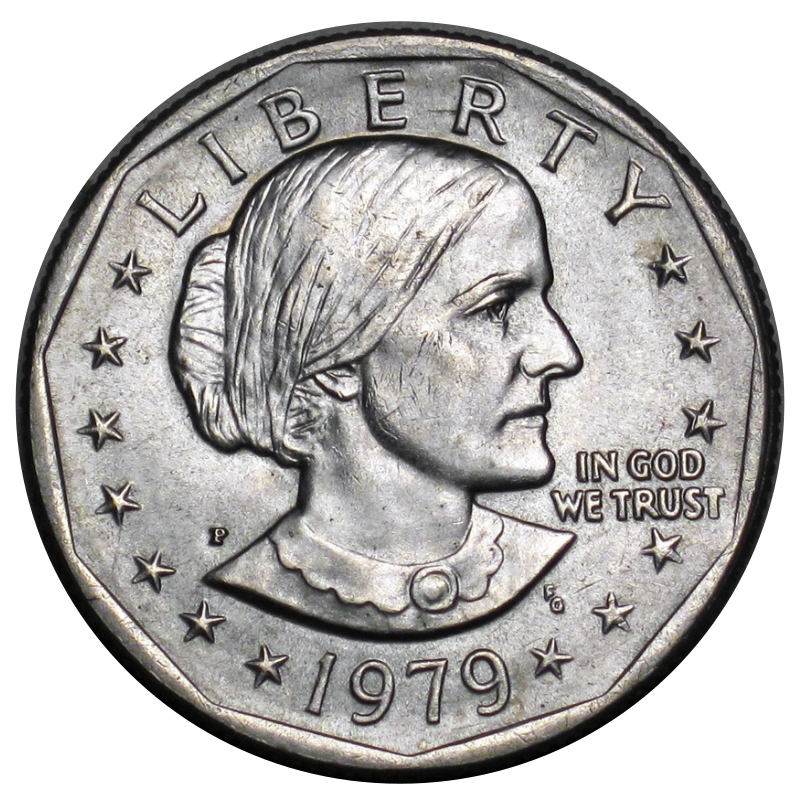
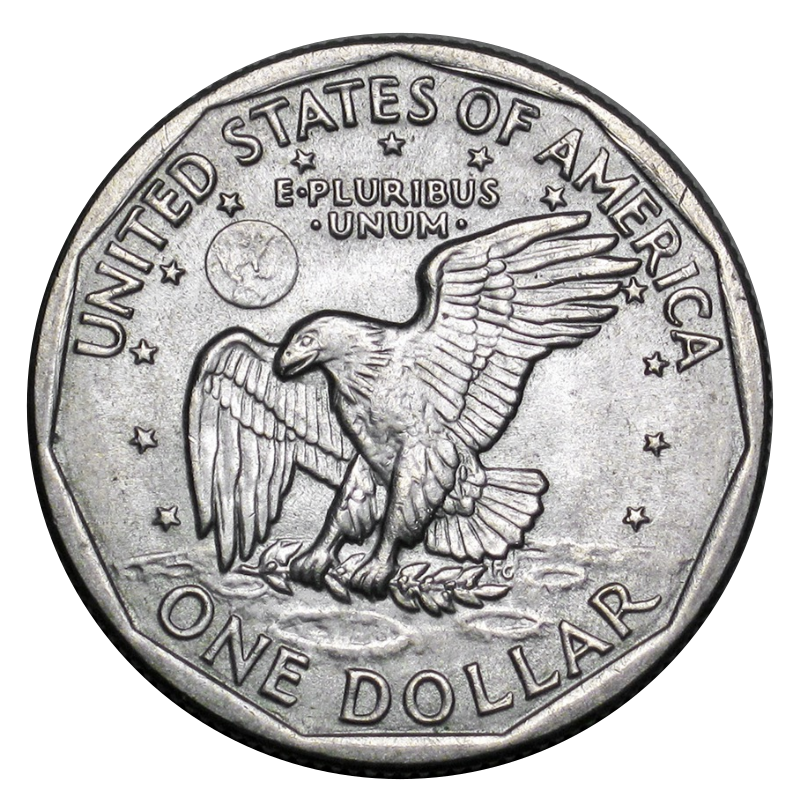
The coin’s outer edge is round and reeded; the eleven-sided shape is an inner border. Standard specifications are 26.5 mm and 8.1 g, with copper-nickel outer layers over a copper core. These are identity checks, not proof of authenticity.
The story and the versions worth separating
A smaller dollar with a new portrait
The Anthony dollar was intended to make the dollar coin easier to carry than the large Eisenhower dollar. Congress chose Susan B. Anthony to recognize her campaign for women’s voting rights. Frank Gasparro designed both sides, pairing her portrait with an eagle landing on the Moon, continuing the reverse theme of the earlier dollar.
Production began in Philadelphia in December 1978 ahead of the 1979 public release. Despite its distinctive inner border, the coin’s size and silver color invited confusion with a quarter. Its short initial run ended with 1981 coins made for collector sets. It returned in 1999 because transit and vending demand was drawing down existing supplies, before the new Sacagawea dollar arrived in 2000.
The later gold-colored dollar belongs to a different series. Use our guide to gold-colored and genuine gold dollars if the portrait or color does not match these photographs.
| Version | Date / mint | Main difference | Where to look | Key distinction |
|---|---|---|---|---|
| Regular strikes | 1979–1981: P, D, S; 1999: P, D | Ordinary manufacturing process | Date, mint mark and surfaces | 1981 issues were distributed in collector sets |
| Wide Rim / Near Date | 1979-P | Wider border, smaller date-to-rim gap | Below the date | Compare with the same-year Narrow Rim |
| Type 1 / Type 2 Proof | 1979-S | Filled-looking versus clearer S | Obverse mint mark | These labels distinguish Proofs |
| Type 1 / Type 2 Proof | 1981-S | Different S punch shapes | Obverse mint mark and serifs | Type 2 has distinct bulbous serifs |
| Final-year Proof | 1999-P | Proof struck at Philadelphia | P mark and Proof finish | A P does not exclude Proof status |
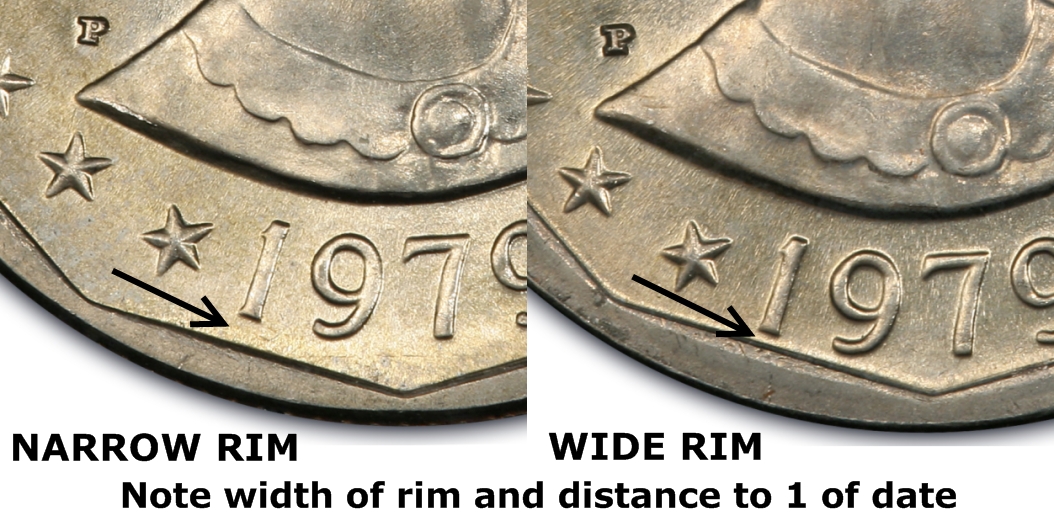
1979-P: Wide Rim versus Narrow Rim
On a Wide Rim, the raised border is broader and the date sits nearer its inner edge. On a Narrow Rim, more space separates the date from that border. Inspect the lower edge near the 1, with the coin upright and the photographs at comparable scale. A thick-looking damaged edge or a tilted photograph is not enough to identify the variety.
1979-S and 1981-S: the Proof mint marks
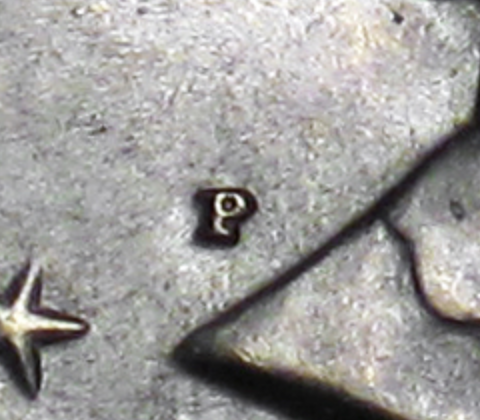
For 1979 Proofs, Type 1 has a filled-looking S; Type 2 has a more distinct letter. The clearer 1979 punch continued into 1981, where it is called Type 1. The later 1981 Type 2 has more pronounced, bulbous serifs. A clear S is therefore not a universal Type 2 test across both dates.
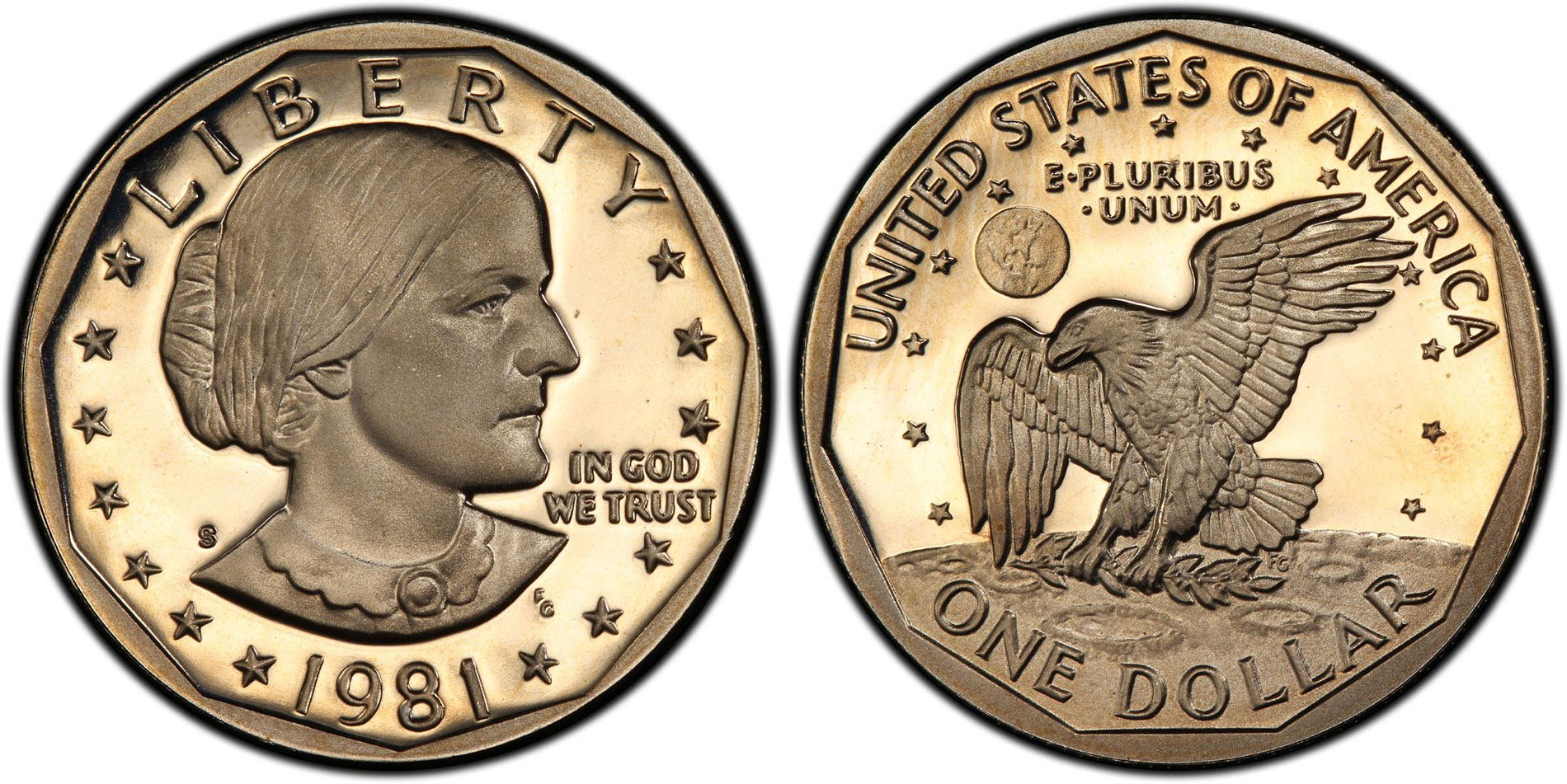
Compare each row below within its own year. Open a photograph to see the full coin and confirm the date. Reflections and wear can obscure the small letter, so an uncertain attribution needs a closer examination.
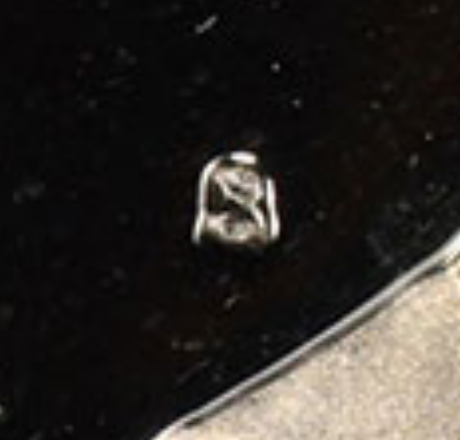
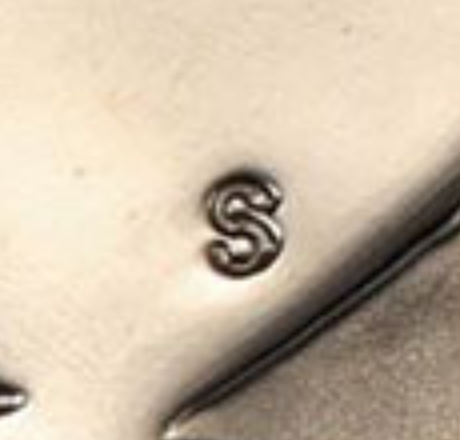
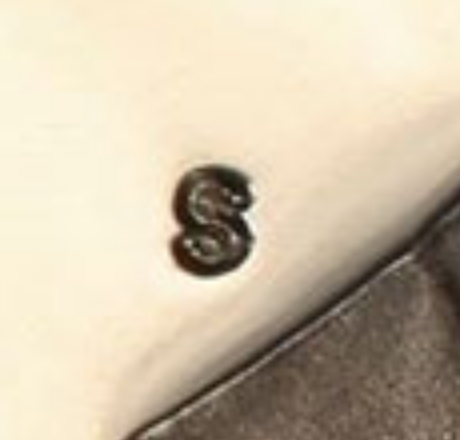
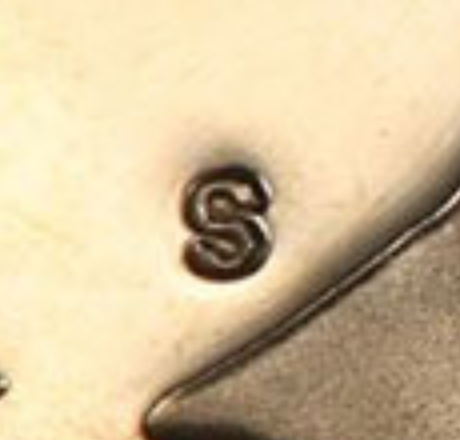
Proof is a manufacturing method, not a synonym for excellent condition. San Francisco also made regular-strike Anthony dollars in 1979–1981. Establish the finish before applying the Proof-type labels.
Susan B. Anthony dollar value by issue and grade
| Regular-strike issue | MS63 | MS65 | Guide row updated | What the comparison shows |
|---|---|---|---|---|
| 1979-P Narrow Rim | $5 | $15 | June 26, 2019 | The ordinary rim is the baseline |
| 1979-P Wide Rim | $25 | $45 | June 26, 2019 | Attribution changes the same-grade comparison |
| 1981-S | $10 | $40 | May 1, 2022 | A collector-set issue still needs a condition match |
| 1999-P | $5 | $20 | May 1, 2022 | The final year alone does not mean high value |
MS means Mint State, the uncirculated grading range. These selected entries exclude Proofs, prooflike designations and problem coins. The older row-update dates matter: use these figures to understand relative value, then check recent sold examples before buying or selling. Retail guide values are not dealer purchase offers.
A large price for an exceptionally high-grade coin does not set the value of every dollar with that date. For the difference between wear, marks and numerical grades, see the coin grading guide. Do not polish a coin to imitate a Proof; the cleaning-signs guide explains why surface changes can reduce its appeal.
The later golden dollar has a different portrait and belongs to the Sacagawea dollar series. For the distinction between gold-colored dollars and actual gold coins, use the gold-dollar guide.
Check your coin before choosing a price
- Record the complete identity. Photograph both sides, read the four-digit year and P, D or S, and confirm ONE DOLLAR on the reverse. Keep any original set packaging with it.
- Resolve the version. On a 1979-P, compare the date-to-rim gap. On a 1979-S or 1981-S Proof, compare the mint mark with the matching year. Separate the 1999-P Proof from the regular strike.
- Match a sale, not just a headline. Look for the same date, mint, variety, strike type and comparable condition in completed auction records. Check photographs, sale date, certification and whether the total includes buyer’s fees. Compare several examples and allow for selling costs.
Use HeriBase to organize the identification
Start with clear front and back photographs in HeriBase, then compare the suggested coin identity with the year and mint mark you can see. Save a close-up of the date or S if it may affect attribution. Follow the HeriBase identification guide for the workflow.
A reference price or suggested identity does not confirm a Wide Rim, a Proof subtype or a numerical grade. If the distinction would materially change the price and the photographs remain unclear, request a human review and use the coin appraisal guide to decide whether an in-person examination or certification is worthwhile.
The key takeaway for a Susan B. Anthony dollar
Most ordinary worn Anthony dollars are close to $1, and the standard series contains no silver. The meaningful checks are the date, mint mark, finish, condition and a confirmed variety—not age or shine alone.
Look more closely at a 1979-P Wide Rim and the 1979-S or 1981-S Type 2 Proofs. Keep 1981 collector-set coins and the 1999-P Proof in the right category. Once the identity is established, use matching recent sales to refine the older guide benchmarks above.
Frequently asked questions
Are Susan B. Anthony dollars made of silver?
No. Standard Susan B. Anthony dollars are copper-nickel clad over a copper core. Their silver color does not indicate precious-metal content.
Is every 1979 Susan B. Anthony dollar valuable?
No. Common worn examples generally have little premium over $1. A confirmed 1979-P Wide Rim, a particular Proof type or exceptional condition can change the comparison.
Does an S mint mark mean my Anthony dollar is a Proof?
No. San Francisco made regular-strike Anthony dollars as well as Proofs in 1979–1981. Check the manufacturing finish before applying Proof Type 1 or Type 2 labels.
Why are there Susan B. Anthony dollars dated 1999?
The U.S. Mint resumed production to meet dollar-coin demand while preparing the Sacagawea dollar for 2000. A 1999 date alone does not make a coin rare; distinguish regular strikes from the 1999-P Proof.
How much is a common Susan B. Anthony dollar worth?
An ordinary worn Susan B. Anthony dollar usually has little premium over its $1 face value. A confirmed 1979-P Wide Rim, a particular Proof type or exceptional preservation needs a separate comparison. The guide figures in this article apply to specified grades, not every coin with the same date.