

 App Store

COIN VALUE GUIDES
Stella $4 Gold Coin: Flowing Hair, Coiled Hair and Pattern History
Identify the four main Stella date-and-design combinations, understand the metric inscriptions, and distinguish a genuine gold pattern from a replica or ordinary denomination.
 HeriBase TeamPublished
In this article
What is a Stella four-dollar gold coin?
The Stella is a U.S. four-dollar gold pattern dated 1879 or 1880, made in Flowing Hair and Coiled Hair designs. It explored an international coinage proposal but never became regular circulation money. Its star reverse and metric inscriptions identify the concept; authenticity, exact design, preservation and provenance govern collector value, not four dollars or gold content alone.
Reviewed November 13, 2026. Historical figures retain their stated dates, currency and comparison limits.
Which real features should I compare?
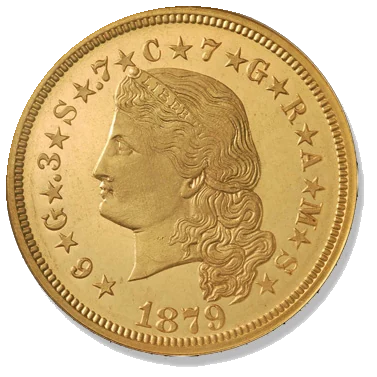
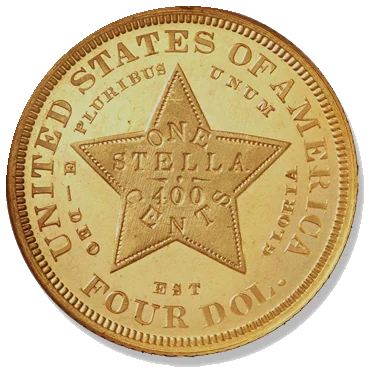
What background helps identify the object?
Why propose an unfamiliar four-dollar denomination?
The Stella belongs to nineteenth-century attempts to make international payments easier. A proposal associated with U.S. minister John A. Kasson called for a coin with metal content stated metrically, facilitating comparisons with familiar European gold denominations. Preparing examples for consideration did not amount to adopting a new circulating denomination.
Charles E. Barber designed the Flowing Hair portrait, while George T. Morgan prepared the Coiled Hair version. The familiar Morgan dollar therefore shares an engraver with one Stella design, not a denomination or a circulating purpose. The Stella’s place is among patterns: coins made to evaluate a proposed design or specification.
How do the issues and evidence compare?
How does Coiled Hair differ visually?
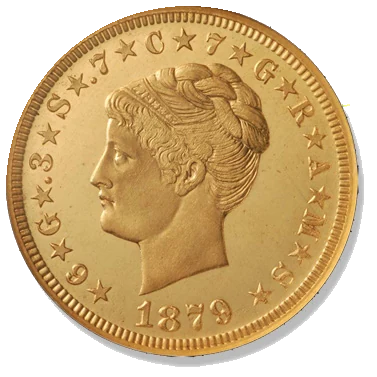
Compare the arrangement behind Liberty’s head rather than the apparent size of a photograph. Establish date and portrait together. The shared star reverse does not merge the two designs into one issue.
| Date | Portrait design | Design attribution | Manufacture / status | Correct comparison |
|---|---|---|---|---|
| 1879 | Flowing Hair | Charles E. Barber | Gold pattern, usually cataloged as Proof | Same date, finish and preservation |
| 1879 | Coiled Hair | George T. Morgan | Separate gold pattern design | Not the commoner Flowing Hair listing |
| 1880 | Flowing Hair | Charles E. Barber | Separate date-and-design issue | Do not substitute an 1879 price |
| 1880 | Coiled Hair | George T. Morgan | Separate date-and-design issue | Specialist pattern records |
What do the inscriptions tell me?
Around Liberty, the pattern states a metric metal formula rather than simply displaying decorative stars. The familiar inscription includes 6 G, .3 S, .7 C and 7 GRAMS, referring to gold, silver, copper and total metric weight. The reverse centers a five-pointed star with the denomination. Read the whole object: a star alone appears on many unrelated coins and souvenirs.
Why do references give different production estimates?
Pattern production and later restriking are harder to reconstruct than a simple annual circulation total. Specialist references give differing estimates, particularly for 1879 Flowing Hair. This guide does not convert one estimate into a proven surviving population or claim an exact number of privately available pieces. An authentication or population report also may include resubmissions and is not a complete census of distinct coins.
What does an actual auction comparison establish?
NGC reported an 1879 Flowing Hair Stella, PF65+ Ultra Cameo, at $222,187 in a GreatCollections sale ending April 26, 2020. That historical published total concerns one certified coin. It neither prices a different design nor establishes the value of an uncertified imitation. The pictured gallery coin is not assigned that auction specimen’s grade or sale.
| Object | Condition / identity | Price basis | Date | Limit |
|---|---|---|---|---|
| 1879 Flowing Hair sale | NGC PF65+ Ultra Cameo | $222,187 published result | Apr. 26, 2020 | Individual GreatCollections result, reported by NGC |
| Another genuine Stella | Exact date, design and grade required | Matching completed sales | Check each record | No blanket price across four combinations |
| Replica or fantasy piece | Not an authenticated U.S. pattern | Its own declared collectible category | Not established here | Cannot inherit genuine-pattern prices |
How can repairs and jewelry use affect the comparison?
Inspect rims, fields and edges for mounting, solder, filing or surface alteration. A genuine pattern with a jewelry history is not equivalent to a problem-free Proof of the same date. Photograph both faces and the edge without polishing. For a serious purchase, provenance and a recognized authentication record matter more than a claim that the metal looks gold.
The one-dollar gold guide and twenty-dollar Double Eagle guide cover different denominations. Neither substitutes for a Stella identification. Use professional appraisal preparation when an important candidate needs direct examination.
What should I check in three steps?
- 01Confirm the date, portrait style, metric obverse legend, star reverse and four-dollar denomination together.
- 02Check original surfaces, the edge and any mounting or repair; keep a pattern attribution separate from appearance or gold color.
- 03Match design, date, manufacture and certified preservation to dated specialist records, with provenance and fee basis preserved.
What should I remember?
The Stella was a proposal, not regular four-dollar circulation money. Establish one of the four date-and-design combinations before comparing value. Preserve original surfaces and keep dated certified sales separate from replicas and repaired examples.
What else do collectors ask?
Did Stella coins circulate as ordinary U.S. money?
They were patterns for a proposed denomination, not an adopted regular circulation series.
Which dates occur on Stellas?
The four main combinations are 1879 and 1880, each with Flowing Hair and Coiled Hair designs.
Who designed the two portraits?
Charles E. Barber designed Flowing Hair; George T. Morgan designed Coiled Hair.
Does the gold value determine a Stella’s price?
No. Authenticity, the exact pattern issue, preservation, provenance and collector demand matter beyond metal content.
Is $222,187 a current value for all Stellas?
No. It is a dated 2020 published result for one 1879 Flowing Hair PF65+ Ultra Cameo specimen.
Can a replica use the same date and star?
Replicas can imitate visible motifs. Those features alone do not authenticate a U.S. pattern or justify its prices.
Which references support this guide?
References and further readingExpand
- NGC: Jeff Garrett on StellasPattern context, international proposal and the two designers; production estimates are not treated as an exact census.
- PCGS: Flowing Hair Stella typePattern classification and uncertainty of production figures.
- NGC: GreatCollections Stella resultPF65+ Ultra Cameo, $222,187, April 26, 2020.