

 App Store

COIN VALUE GUIDES · EARLY COPPER
Large Cent Value:Types, Dates and Copper Condition
Identify U.S. large cents from 1793–1857, distinguish major designs and compare a common Braided Hair cent without overlooking corrosion or altered copper color.
 HeriBase TeamPublished
In this article
Quick answer
A U.S. large cent is a copper one-cent coin from the 1793–1857 era, substantially larger than a modern cent. There is no normal 1815-dated large cent. Type, date, die variety and surface condition determine the relevant value comparison.
For one accessible late-series example, NumisMedia’s October 17, 2026 guide lists 1851 Brown at $23 in G4, $26 in F12 and $84 in XF40. Those figures do not value a 1793 Chain cent, a scarce die variety or a corroded coin.
Coin photos
Basics & coin story
The Mint’s first regular copper cents were delivered in 1793. Early designs changed quickly, from Chain to Wreath and Liberty Cap forms, followed by Draped Bust and Classic Head designs. Later Coronet and Braided Hair cents supplied the large copper coins many collectors encounter today.
The large format used enough copper that its metal cost and handling became persistent concerns. Congress reduced the cent’s size in 1857. The Flying Eagle cent marks that transition; an 1857 date can therefore occur on different cent formats.
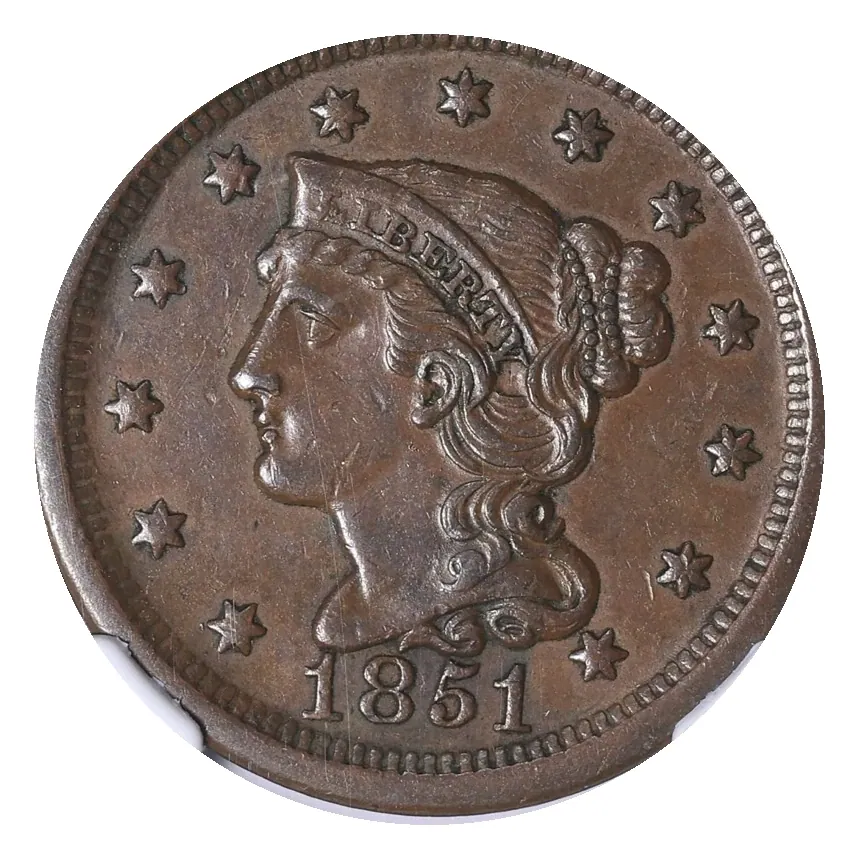
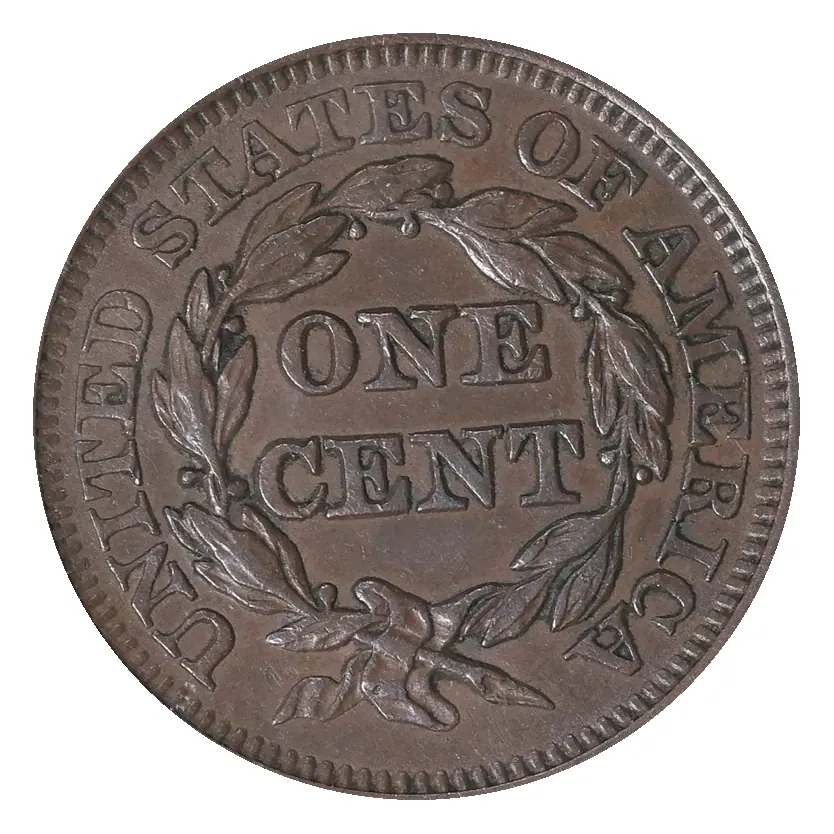
All regular U.S. large cents were made at Philadelphia without a mint letter. The later coin photographed here is an 1851 Braided Hair cent. Its Newcomb-17 attribution identifies a die marriage; the plain-date price benchmark below is not a separate valuation of that specific variety or its certified AU58 grade.
| Feature | What to check |
|---|---|
| Denomination | One U.S. cent |
| Date span | 1793–1857; no regular 1815-dated issue |
| Metal | Copper; specifications differ across early types |
| Photographed type | 1851 Braided Hair cent |
| 1851 nominal mass / diameter | 10.89 g / about 27.5 mm |
| 1851 designer | Christian Gobrecht |
| Mint | Philadelphia; no mint mark |
| Main condition issues | Wear, corrosion, scratches, cleaning and altered color |
Identification
Identify the type before the date premium
A Chain reverse belongs to the earliest 1793 type, while later cents show ONE CENT inside a wreath. The portrait, hair arrangement, reverse and date must agree with a verified type reference. Do not apply late Braided Hair dimensions to every early copper issue.
The half-cent guide covers the separate half-cent denomination. A copper color and nineteenth-century Liberty portrait alone do not tell you which denomination is present; read ONE CENT or HALF CENT.
Check variety diagnostics without assuming an overdate
Large-cent specialists identify combinations of obverse and reverse dies. Numeral shape, position, lettering and die breaks can be useful. A Newcomb number is not automatically a rarity rating, and many attributable varieties remain affordable.
The 1851/81 listing is distinct from an ordinary 1851 listing. A scratch near the date, uneven toning or a thick digit does not prove that attribution. Keep close photographs and compare the full diagnostic pattern before using a variety premium.
Brown is a color designation, not a defect by itself
Copper normally changes from mint red toward brown. BN, RB and RD describe color categories in applicable grading systems; they are not numerical grades. An original brown coin can be desirable, while a bright pink surface may indicate cleaning rather than superior preservation.
Inspect the fields and lettering for porous corrosion, pits and active deposits. Avoid polishing or chemical experiments. Our cleaning guide explains why changed surfaces can separate a coin from ordinary retail-guide comparisons.
Condition & value
USD NumisMedia collector FMV snapshot updated October 17, 2026. Plain-date 1851 BN circulated rows are examples; they do not establish the value of the photographed Newcomb-17 AU58 coin.
| Issue | Grade / condition | Value or reference | Basis | Important condition |
|---|---|---|---|---|
| 1851 Braided Hair, BN | G4 / VG8 | $23 / $24 | NumisMedia FMV, Oct 17, 2026 | Plain-date circulated reference |
| 1851 Braided Hair, BN | F12 | $26 | Same dated guide | No major surface problem |
| 1851 Braided Hair, BN | VF20 / XF40 | $39 / $84 | Same dated guide | Compare actual wear and surfaces |
| Early type or attributed variety | Exact identity | Use its own specialist listing | Type-and-variety research | Not covered by the 1851 benchmark |
| Corroded, cleaned or damaged copper | Problem described | Use comparable problem-coin sales | Condition-specific | Readable detail does not erase corrosion |
The guide’s modest grade-specific 1851 values are useful for an ordinary late large cent, but they are not a floor for damaged copper or a ceiling for the whole series. A late common date and an early rarity solve very different collecting goals.
The pictured AU58 coin should not be assigned an XF40 price simply because both are circulated grades. Match the numerical grade and any color or problem designation before comparing completed lots. Record whether a specialist attributed the variety and whether that attribution affected the sale.
Copper coins are best handled by their edges and stored in stable, suitable materials. If an inherited group has green deposits or suspiciously uniform bright color, preserve it and document it before seeking an appraisal. Removing evidence can make both identification and valuation harder.
Summary
Read ONE CENT, identify the design and date, then assess the copper surface. Use the 1851 table only for matching ordinary Brown examples. Earlier types, verified varieties and damaged coins need their own evidence.
FAQ
How big is a U.S. large cent?
Specifications vary by early type. A standard 1851 Braided Hair large cent is about 27.5 mm in diameter and weighs 10.89 grams.
Is there an 1815 U.S. large cent?
There is no normal 1815-dated U.S. large cent. A coin carrying that date needs careful identification and authenticity review.
Where is a large cent mint mark?
Regular U.S. large cents were made at Philadelphia and do not have a mint letter.
Does Brown mean a copper coin is damaged?
No. BN is a color designation. Corrosion, cleaning and other problems are separate condition questions.
References
References and further reading
- U.S. Mint: circulating coin history
- PCGS: later large-cent history
- NumisMedia: large-cent circulated values
- GreatCollections: photographed 1851 Newcomb-17 AU58 BN
References consulted October 27, 2026. Price tables retain the update dates stated in the text; guide estimates, face values and completed transactions are different forms of evidence.