

 App Store

APP GUIDES
How to Read HeriBase Coin Values: Estimates, Condition, and Sold Prices
Learn to separate a reference estimate from an asking price or sale, verify condition and variety, and research a comparable coin value.

In this article
What does a HeriBase coin value mean?
Treat a displayed HeriBase value as a research reference, not an offer to buy your coin or a guaranteed selling price. First verify the identity, mint mark, variety and condition assumptions. Then compare completed sales of the same issue in similar condition, keeping currency, date and fees on the same basis.
A single number is a display format, not evidence of greater pricing precision. If the result does not show enough information to judge its assumptions, keep the amount provisional and research the underlying coin.
How does HeriBase form and update an estimate?
HeriBase uses a multidimensional assessment rather than one attribute alone. The factors include coin type, year, mint mark, condition, rarity, mintage, material, variety, metal content and market conditions. These factors can change which reference comparison is appropriate; they are not a promise that every field has been independently verified from a photograph.
Reference valuations are updated periodically, without a fixed published schedule. They should not be assumed to be real-time quotes. A gold or silver market-price timestamp does not establish that every collectible coin valuation was refreshed at the same time.
Condition, variety and photographic lighting can affect the suggested identification or condition assessment and therefore the resulting estimate. Compare the visible identification and selected condition before comparing amounts. If the same visible conditions produce unexplained differences, retain both results and contact support rather than assuming a specific technical cause.
What can a historical result illustrate?
How do estimates, asking prices and sales differ?
| Figure | What it records | What to check |
|---|---|---|
| App reference estimate | Displayed value for the proposed identification | Issue, variety, condition, currency and any visible source/date |
| Price-guide entry | A reference for a defined issue and grade | Guide scope, certification assumptions and update information |
| Asking price | What a seller advertises | It does not demonstrate a completed transaction |
| Completed sale | A recorded transaction for a particular item | Exact coin, grade, sale date and fee basis |
| Net proceeds | What a seller receives after applicable costs | Commissions, shipping and other relevant deductions |
A Best Offer label does not prove the public asking amount was paid. Nor does an exceptional certified specimen establish the value of an ordinary circulated coin.
What does the 1964 Kennedy example teach?
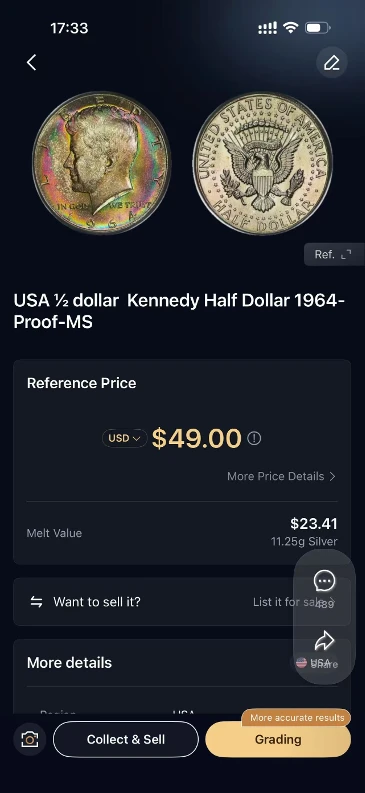
In the September 16, 2026 study, HeriBase 1.3.6 displayed $49 for the selected regular-strike 1964 Kennedy half dollar while labeling it as Proof. The comparison recorded a $100 eBay asking-price observation. Neither amount establishes today’s value, and their difference is not a measured valuation error. The listing was not a verified condition-matched, fee-adjusted completed sale.
This example shows the order of the work: resolve the strike-category mismatch before comparing prices. The the original 12-coin comparison and screenshots preserves the screenshots and explains the asking-price limitations. It does not validate a pricing algorithm or show that every repeat scan returns the same amount.
For a coin you own, record the full identity, actual condition evidence and any certification. Use the 1964 Kennedy half-dollar guide only where its issue and condition descriptions match your coin; check the title and scope before applying a table.
What do MS, VF and other condition labels mean?
MS and VF are established numismatic grading terms, not a special HeriBase certification. For many modern coins, professional services use the Sheldon 1–70 scale. The following is a reading aid for common labels; a photograph or a selected price-table row does not assign a certified grade to your coin.
| Label | Meaning | How to use it in a price comparison |
|---|---|---|
| VF — Very Fine: 20, 25, 30, 35 | Circulation wear is present; principal design details remain. | Match comparable wear, not an uncirculated price. |
| XF / EF — Extremely Fine: 40, 45 | Lighter wear than VF. | Check the high points and actual surfaces. |
| AU — About Uncirculated: 50, 53, 55, 58 | Only limited wear. | Do not automatically substitute an MS price. |
| MS — Mint State: 60–70 | No circulation wear; lower MS grades may still have marks. | MS60 and MS65 are different comparison grades. |
| PR / PF — Proof | A method of manufacture, not simply a higher condition. | Compare Proof with the same strike category and grade. |
Cleaning, damage, altered surfaces and attribution can change the comparison. A problem coin should not be priced as an unimpaired example solely because a numerical row is available. If a coin is certified, verify the grading service, certificate and corresponding item; an App label does not turn a raw coin into a certified one.
Use the Grade view to understand the reference category. The label alone does not show whether the physical coin was assessed by AI, selected by a user or professionally examined. For more examples, see the coin grading scale guide. If uncertain, follow the App’s correction prompts or contact support before relying on a premium-grade value.
How should I use More Price Details?
The documented iPhone interface includes Grade and Category views where entries are available. Use those views to inspect the issue or condition categories behind a price. A selected catalog grade is not a professional grade assigned to your physical coin.
Record any displayed source, date and currency rather than assuming the amount updates live. The screenshots in the illustrated user guide document the visible controls; they document the interface rather than a complete pricing formula or provider list. The reference valuations are updated without a fixed published schedule.
For another concrete identity check, the owner-supplied P-to-D mint-mark mismatch shows why the proposed coin must be checked before relying on its amount. The €1.51 visible on that screen is a recorded reference, not an independently verified value.
If two results show different values, first compare their date, mint, variety, strike type, grade selection and currency. A changed attribution or selection can make the figures incomparable. If those fields appear identical, keep screenshots and ask support to investigate; the historical study did not test repeat-scan price stability.
Are transaction costs included?
For a marketplace purchase, the applicable transaction charges depend on the seller’s settings and the disclosures on the product page. Read those disclosures before buying, including any stated shipping, taxes, commissions or other applicable charges. An app reference estimate, the buyer’s total payment and the seller’s net proceeds are different amounts; the product-page fee terms do not establish that the reference estimate includes or deducts every charge.
How do I research a sale price before selling?
- Write down a complete identity. Record denomination, date, mint mark, variety and strike type, marking anything unresolved.
- Describe condition honestly. Note wear, cleaning, damage and certification status. Do not select a premium grade just because it has a high guide value.
- Collect several comparable completed sales. Prefer records that show the actual item and sale date. Separate raw coins from certified coins and ordinary issues from attributed varieties.
- Normalize the amounts. Note currency, whether buyer’s premium is included and whether the amount is a hammer price, total paid or seller’s net.
- Keep the conclusion conditional. Report what the comparable records support. If you cannot find a close match, describe the uncertainty instead of converting an unrelated record into a price promise.
What should I do if the displayed amount seems wrong?
Verify the identity first, then the condition and comparison basis. Save the result and any selected Grade/Category view. Contact contactus@heritcoin.com with the coin photographs, screenshots and disputed assumption. For identification uncertainty, start with the accuracy and verification guide.
Frequently asked questions
Is the displayed amount a guaranteed selling price?
No. It is a reference for research, not a binding offer or a guaranteed transaction value.
Does a precise dollar amount prove precise valuation?
No. Decimal precision is a display choice. Accuracy depends on the correct identity, condition and comparison basis.
Why might two scans show different amounts?
Compare identity, variety, strike type, grade selection and currency first. If the visible inputs match, keep screenshots and ask support; do not assume an unverified technical cause.
Can I compare a raw coin with a certified high-grade auction record?
Not as a like-for-like price comparison. Grade, surfaces, attribution and certification can materially change the market context.
Is a Best Offer asking price the final sale price?
Not necessarily. A public asking amount or Best Offer label does not establish the final accepted amount.
Does this article disclose HeriBase’s full pricing formula?
No. HeriBase confirms a multifactor assessment and updates without a fixed published schedule. This article explains the factors and comparison method, not a complete formula, provider list or real-time pricing guarantee.
How often are HeriBase reference values updated?
Updates are made without a fixed published schedule. Do not treat every estimate as a real-time quote or use a metal-market timestamp as proof of a coin-value refresh.
Where do I check fees before buying a coin?
Read the seller’s product-page disclosures before purchase. Applicable charges depend on the seller’s settings; a reference estimate is not necessarily the checkout total or seller’s net proceeds.