

 App Store

COIN VALUE GUIDES
2019 Apollo 11 Coins: Curved Designs, Metals and Versions
Compare the four Apollo 11 fiftieth-anniversary coin types, their seven basic finish versions, footprint and visor designs, and the difference from Eisenhower dollars.
 HeriBase TeamPublished
In this article
Which coins belong to the 2019 Apollo 11 program?
The 2019 Apollo 11 anniversary program includes a $5 gold coin, a standard silver dollar, a five-ounce silver dollar and a clad half dollar. All share curved footprint and helmet-visor designs. Four coin types produce seven basic finish versions because the five-ounce dollar is Proof only; identify metal, size, mint and finish before comparing prices.
Reviewed November 13, 2026. Historical figures retain their stated dates, currency and comparison limits.
Which real features should I compare?
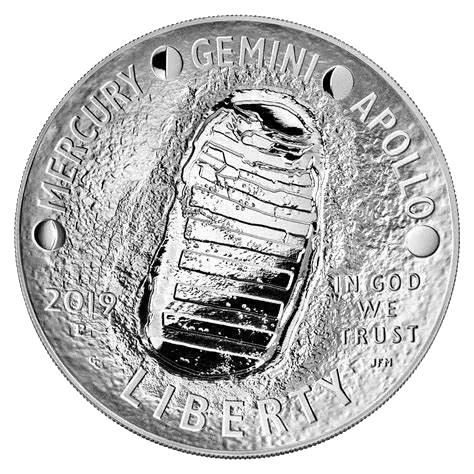
What background helps identify the object?
How does the curved design tell the moon-landing story?
The program marked fifty years since the July 1969 Apollo 11 landing. Gary Cooper’s footprint concept won the obverse design competition and was sculpted by Joseph Menna. The concave side combines a boot print with the names of Mercury, Gemini and Apollo, connecting the landing with the earlier U.S. crewed-spaceflight programs.
The convex reverse, by Phebe Hemphill, uses the reflection in Buzz Aldrin’s visor: Neil Armstrong, the flag and the lunar lander appear in the scene. A boot print on one side and a helmet reflection on the other are intended imagery, not damage or an accidental design mismatch. The curved form is likewise intentional.
How do the issues and evidence compare?
| Coin type | Metal category | Basic finishes | Mint / mark | Key comparison |
|---|---|---|---|---|
| $5 gold | 90% gold | Proof; Uncirculated | West Point · W | Two gold versions; not a silver dollar |
| Standard $1 silver | 99.9% silver; 26.73 g | Proof; Uncirculated | Philadelphia · P | Two standard-size versions |
| Five-ounce $1 silver | 99.9% silver; five troy ounces | Proof only | Philadelphia · P | One large version; denomination still $1 |
| Half dollar | Copper-nickel clad | Proof; Uncirculated | San Francisco S Proof; Denver D Uncirculated | Two clad versions, not silver halves |
Is the five-ounce coin just a bigger face-value dollar?
The five-ounce coin has the same dollar denomination as the smaller silver issue but substantially more silver and a larger format. Denomination does not specify metal weight. Read the actual product and size before matching an auction listing; a standard-size dollar result cannot price the five-ounce Proof merely because both show $1.
Does a seven-version checklist mean every product package?
No. The seven entries are the basic coin-type and finish combinations: two gold, two standard silver, one five-ounce Proof and two clad. Packaging bundles and special sets can contain coins from those categories and sometimes another coin. A two-coin product is not necessarily a complete Apollo program collection. Record a package’s actual contents rather than counting the box title as another denomination.
How are these different from Eisenhower dollars?
The Eisenhower dollar uses an Apollo-related eagle reverse on ordinary dollar issues from a different era. It is not part of the 2019 curved commemorative program. Likewise, a privately issued space medal or a plated souvenir is not automatically a U.S. Mint Apollo coin. Confirm the issuer, date, denomination and specifications together.
How should I compare value without mixing versions?
| Comparison object | Condition / manufacture | Price basis to use | Date requirement | Avoid |
|---|---|---|---|---|
| Standard silver dollar | Proof or Uncirculated; exact grade | Same version’s completed transactions | Retain sale date and fees | A five-ounce price |
| Five-ounce silver dollar | Proof; surfaces and packaging | Matching large-format sales | Check current metal and collector conditions | Treating $1 as one ounce |
| Gold $5 | Proof or Uncirculated | Exact gold version and grade | Separate metal baseline from premium | A gold-colored medal price |
| Clad half dollar | D Uncirculated or S Proof | Same coin and finish | Compare complete versus loose products | Calling every half silver |
No newly verified current market range is quoted here. Original issue prices, metal-content calculations and current resale transactions answer different questions. A graded 70, a raw Proof with hairlines and a worn loose coin should not share a single row. Keep certificates and packaging with the appropriate issue, without treating a certificate as proof that another loose coin belongs in that box.
For broader commemorative collecting categories, see the commemorative half-dollar guide. A complete record of the version is more useful than a generic “moon coin” label.
What should I check in three steps?
- 01Confirm 2019, the legal denomination and the footprint / visor designs. Separate official coins from medals and souvenirs.
- 02Identify gold, standard silver, five-ounce silver or clad, then the correct mint and Proof / Uncirculated manufacture.
- 03Use the same version, grade and package contents in dated transaction comparisons. Preserve curved surfaces without rubbing them.
What should I remember?
Start with four types and seven basic finish versions, not seven denominations. The five-ounce dollar and the standard dollar share a face value but are different products. Curvature, footprint and helmet imagery are intentional; price the exact metal and manufacture.
What else do collectors ask?
How many basic Apollo 11 coin versions are there?
Four types yield seven basic finish versions: two gold, two standard silver, one five-ounce Proof and two clad half dollars.
Are all 2019 Apollo coins silver?
No. The program includes gold, standard silver, five-ounce silver and clad half-dollar issues.
Is the curved shape an error?
No. The concave footprint and convex visor designs are intended features of the program.
Who appears in the visor reflection?
The design shows Neil Armstrong, the U.S. flag and the lunar lander reflected in Buzz Aldrin’s visor.
Is the five-ounce dollar the same as the standard dollar?
No. They share a one-dollar denomination but differ in size, silver weight and available manufacture.
Is an Eisenhower dollar part of this program?
No. Its Apollo-related eagle is a separate earlier design and does not make it a 2019 curved commemorative.
Which references support this guide?
References and further readingExpand
- U.S. Mint: Apollo $5 goldGold type and common program scope.
- U.S. Mint: standard Apollo silver dollarDesign credits, imagery and standard silver specifications.
- U.S. Mint: Apollo clad half dollarClad composition and manufacture distinction.
- U.S. Mint: 2019 annual reportFour-type curved commemorative program and five-ounce Proof.