

 App Store

COIN VALUE GUIDES · QUARTERS
1999 Quarters:First Five States, Historical Dates and Value
Identify the five first-year State quarters, distinguish statehood and historical dates from 1999, and separate ordinary clad coins from Proofs and claimed errors.
 HeriBase TeamPublished
In this article
Quick answer
The five 1999 State quarters are Delaware, Pennsylvania, New Jersey, Georgia and Connecticut, in that release order. An ordinary worn P or D example is copper-nickel clad and has a 25-cent face-value baseline. Statehood dates and New Jersey’s 1776 are normal design inscriptions, not the coins’ issue dates.
The PCGS guide checked October 26, 2026 lists 1999-P Pennsylvania regular strikes at $4 in MS63, $5 in MS65 and $12 in MS66; New Jersey’s P entry is $5 at MS65 and $16 at MS66. These are specific uncirculated references. Clad and 90% silver S Proofs are separate products.
Coin photos
Basics & coin story
The 50 State Quarters program began in 1999 and issued five state designs each year through 2008. Its order followed ratification of the Constitution or admission to the Union, rather than alphabetical order. The first five designs therefore form the program’s opening chapter.
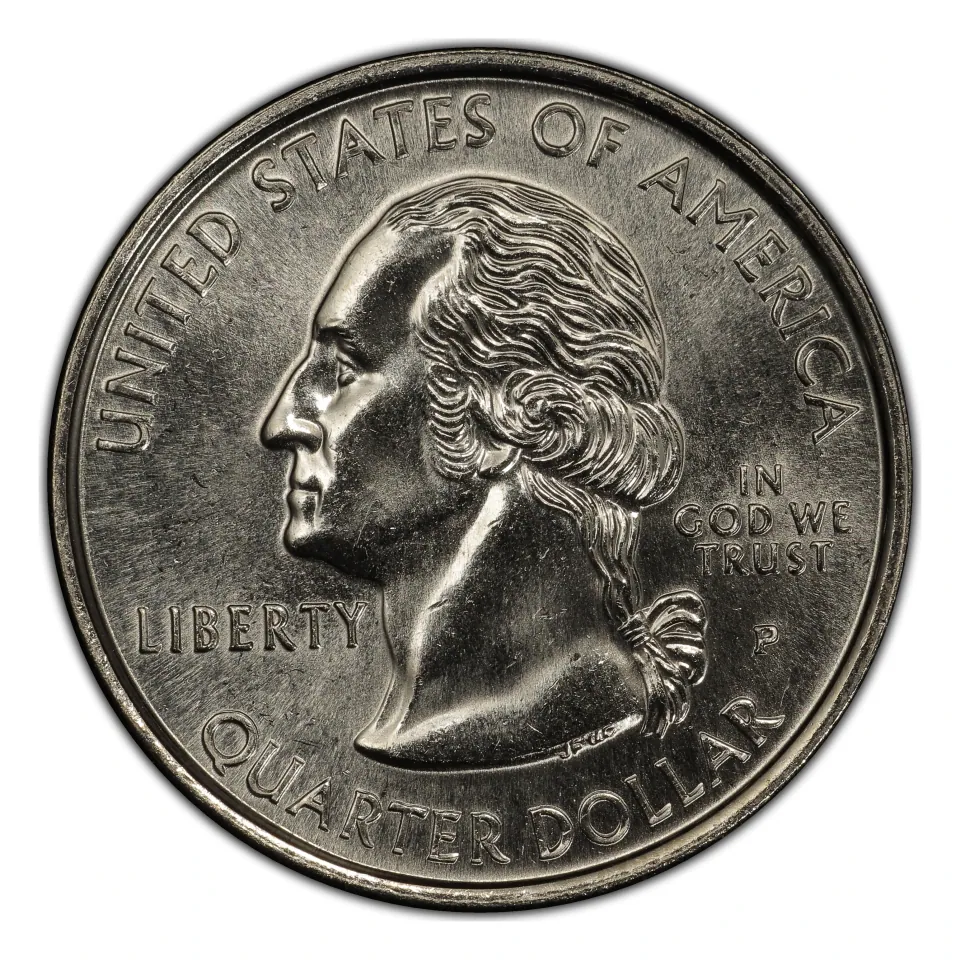
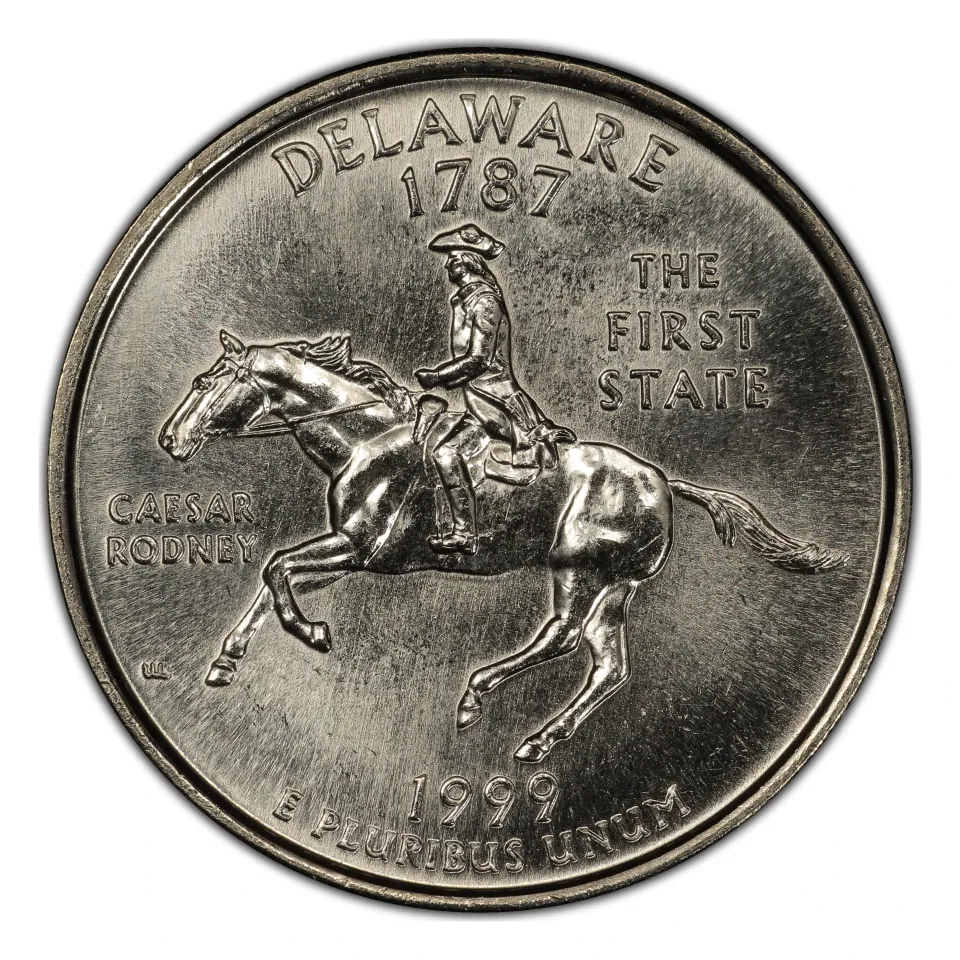
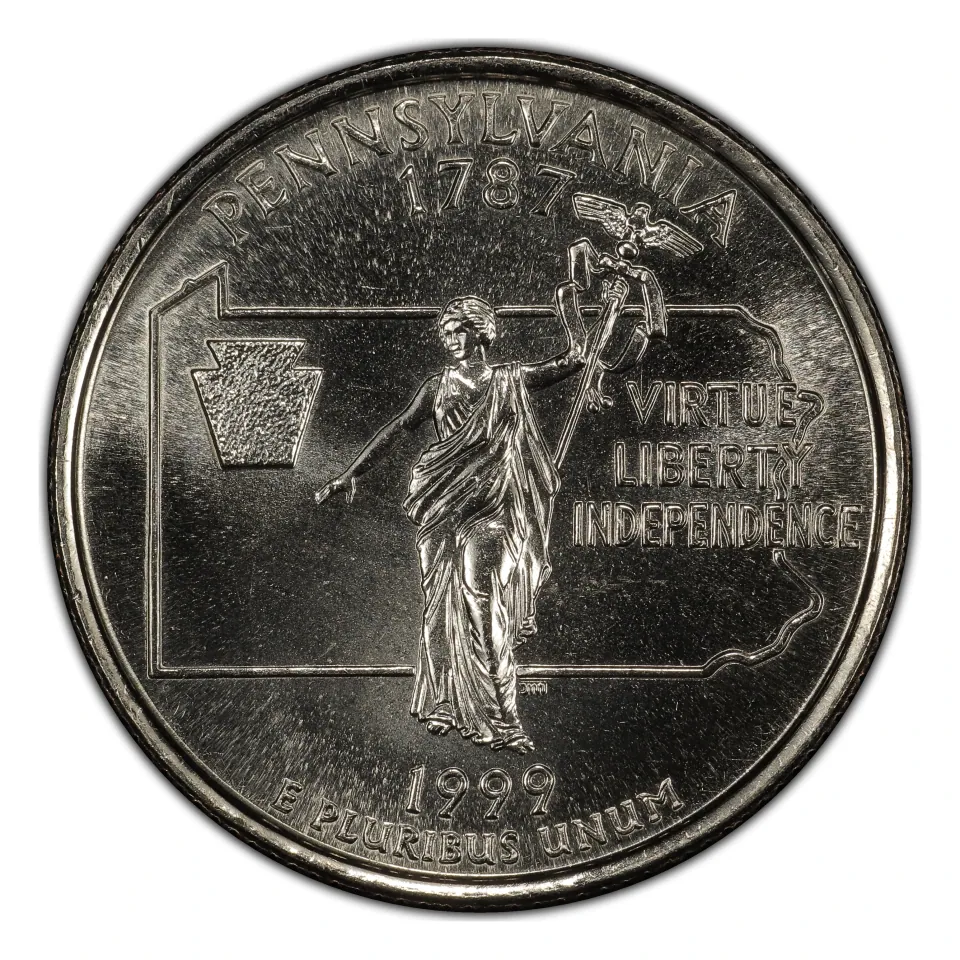
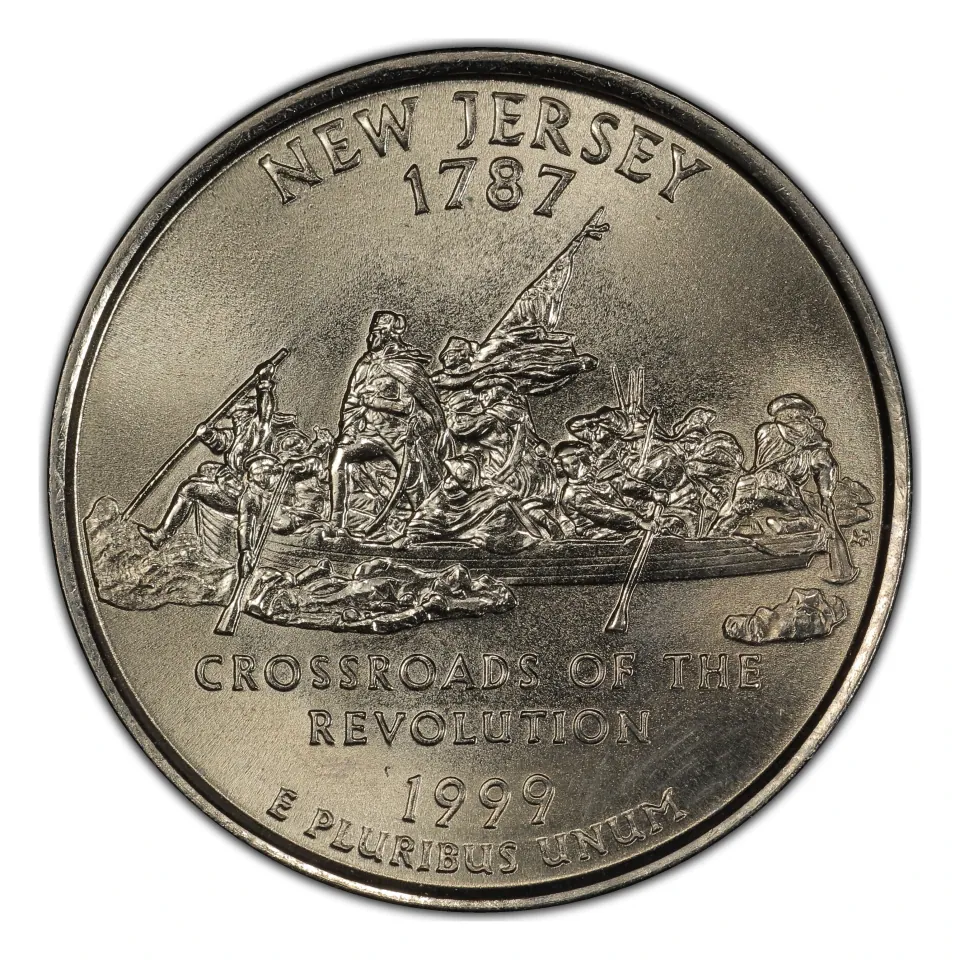
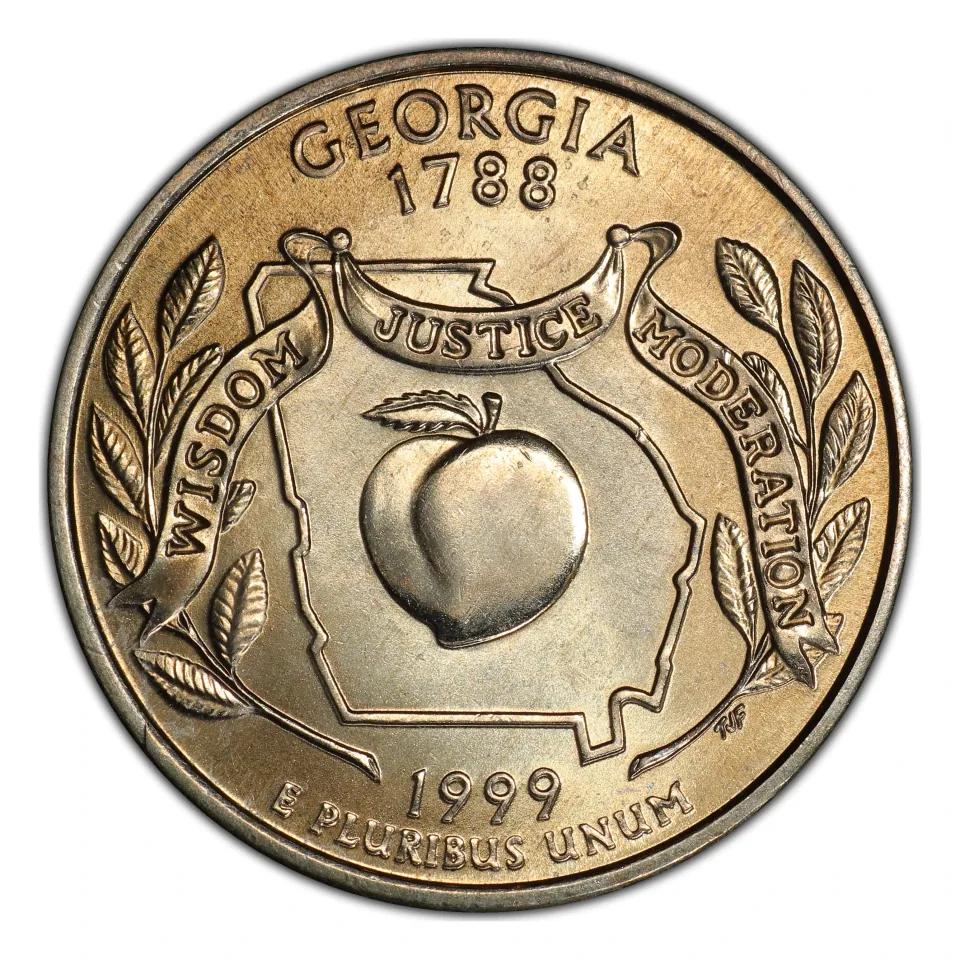
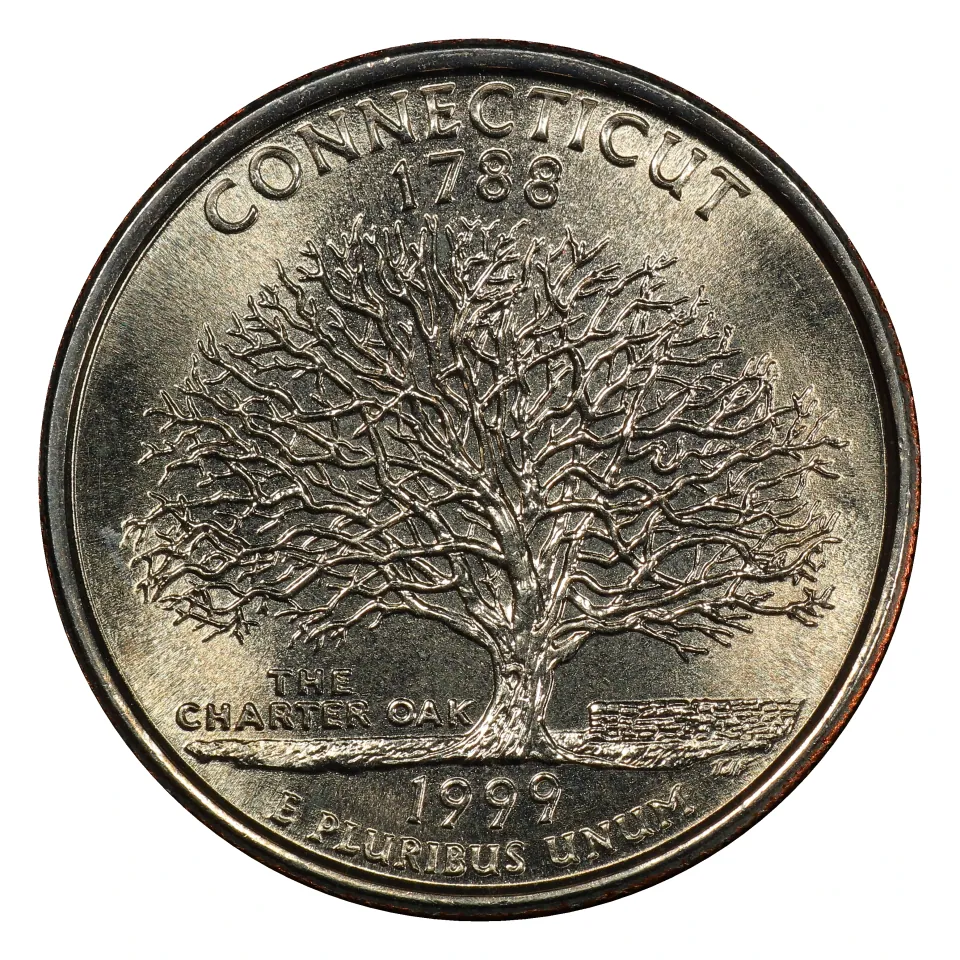
Delaware depicts Caesar Rodney on horseback, Pennsylvania a standing Commonwealth figure, New Jersey Washington crossing the Delaware, Georgia a peach within the state outline, and Connecticut the Charter Oak. Each reverses the usual habit of identifying a coin only from its portrait: the shared Washington obverse cannot tell you which state design you have.
New Jersey’s historic crossing scene is distinct from the later 2021 Crossing the Delaware quarter. Similar subject matter does not make the two dates the same issue. The Wyoming guide illustrates a later State-quarter design, while this article remains a complete first-year checklist.
| Feature | What to check |
|---|---|
| Denomination | 25 cents |
| Ordinary construction | Copper-nickel outer layers over a pure copper core |
| Ordinary nominal weight / diameter | 5.67 g / 24.26 mm |
| Edge | Reeded |
| Regular mint-mark location | Obverse beside Washington |
| Issue date | Read the modern year on the reverse; historical dates can also appear |
| Annual group | Delaware, Pennsylvania, New Jersey, Georgia, Connecticut |
| Regular issues | P: Philadelphia; D: Denver |
| Collector Proofs | S clad and S 90% silver, separate entries |
| Normal historical inscriptions | Statehood years; New Jersey crossing date 1776 |
Identification
Use the five-design checklist
| State / statehood inscription | Reverse identification |
|---|---|
| Delaware / 1787 | Caesar Rodney riding a horse; THE FIRST STATE |
| Pennsylvania / 1787 | Commonwealth figure and state outline; VIRTUE LIBERTY INDEPENDENCE |
| New Jersey / 1787 | Boat crossing the river; CROSSROADS OF THE REVOLUTION; 1776 |
| Georgia / 1788 | Peach and state outline; WISDOM JUSTICE MODERATION |
| Connecticut / 1788 | Charter Oak tree |
Find the actual 1999 issue year
The statehood year appears near the state name. New Jersey also includes 1776 for the crossing. Read the separate 1999 issue date before describing the coin as an eighteenth-century quarter or a wrong-date error.
Identify mint and metal before an error claim
P and D regular issues are clad; San Francisco made separate clad and silver Proofs. Gold-colored plating, copper-colored exposure or a line near an animal or tree cannot establish an experimental planchet or a valuable die feature. Such claims require the specific weight, edge and attribution evidence.
Condition & value
Amounts are in U.S. dollars. The listed PCGS grade examples were checked October 26, 2026. Ordinary face-value baselines and distinct collector products are separated below. They are not guaranteed purchase offers; current market conditions and selling costs can change the amount received.
| Issue | Grade / condition | Value or reference | Basis | Important condition |
|---|---|---|---|---|
| Ordinary worn P or D | Circulated | 25¢ face-value baseline | Denomination | Any of the five normal designs |
| 1999-P Pennsylvania, regular | MS63 | $4 | PCGS retail guide | Uncirculated |
| 1999-P Pennsylvania, regular | MS65 | $5 | PCGS retail guide | Correct design and grade |
| 1999-P Pennsylvania, regular | MS66 | $12 | PCGS retail guide | Original surfaces |
| 1999-P New Jersey, regular | MS66 | $16 | PCGS retail guide | Different design, separate entry |
| Other design / S Proof / authenticated error | Exact entry | Compare separately | Different issues | No universal 1999 price |
An annual set can mean five designs, ten P/D coins or a collector Proof product. State which scope is being priced. A seller’s five-coin package or complete Proof set cannot supply a single-coin realized value without accounting for what was actually sold.
Named claims such as a Delaware spitting-horse feature or an unusual Connecticut die mark need more than a nickname in an online listing. The photographed ordinary coins are design examples and are not presented as error diagnostics. For an unusual-metal claim, retain edge photographs and a reliable weight before paying an error premium.
The standard clad specification does not include silver, and surface color alone is not a metal test. Proofs need the correct manufacture, alloy and contrast designation; ordinary P/D coins need an honest wear assessment. Compare completed sales of the same design, mint and condition, using the grading guide for general terminology.
Summary
Recognize the first five state designs and separate their historical inscriptions from the 1999 issue year. Ordinary P/D coins are clad; S Proofs and authenticated errors need their own evidence and comparisons.
FAQ
What are the five 1999 State quarters?
Delaware, Pennsylvania, New Jersey, Georgia and Connecticut, in that release order.
Why does a 1999 New Jersey quarter say 1776?
1776 is the historical river-crossing date depicted by the design. The statehood inscription is 1787 and the coin’s issue date is 1999.
Are 1999 quarters silver?
Ordinary P and D regular strikes are clad. Separate S 90% silver Proofs exist alongside S clad Proofs.
Does a gold-colored 1999 quarter prove an experimental planchet?
No. Plating, alteration and lighting can change apparent color. An unusual-planchet claim needs weight, edge and authentication evidence.
References
References and further reading
- PCGS CoinFacts: exact issue, specifications and available guide evidence
- U.S. Mint: State-quarter program and first-year order
- U.S. Mint: Delaware design
- U.S. Mint: New Jersey historical inscriptions
- U.S. Mint: 1999 90% silver Proof versions
- PCGS: Pennsylvania ordinary P entry
- PCGS: New Jersey ordinary P entry
Sources and quoted guide evidence checked October 26, 2026. Guide estimates, historical sales, face value and metal-content calculations are identified separately.