

 App Store

COIN VALUE GUIDES · QUARTERS
1979 Quarter Value:No Mint Mark, D and S Proof Types
Most worn 1979 quarters are worth 25 cents. Compare Mint State prices, identify S Proof types and check claims about silver or errors.
 HeriBase TeamPublished
In this article
How much is a 1979 quarter worth?
Most worn 1979 quarters with no mint mark or a D are ordinary 25-cent coins. They are copper-nickel clad, not silver. No mint mark is normal for Philadelphia in 1979; it is not a missing-mark error.
Preservation and version create collector premiums. PCGS retail estimates checked October 20, 2026 list a no-mark MS65 at $16 and a D MS65 at $20. San Francisco S coins are collector Proofs with Type 1 “filled S” and Type 2 “clear S” varieties. These require Proof-specific comparisons; neither an S nor a shiny surface guarantees a large value.
1979 Washington quarter: real coin photos
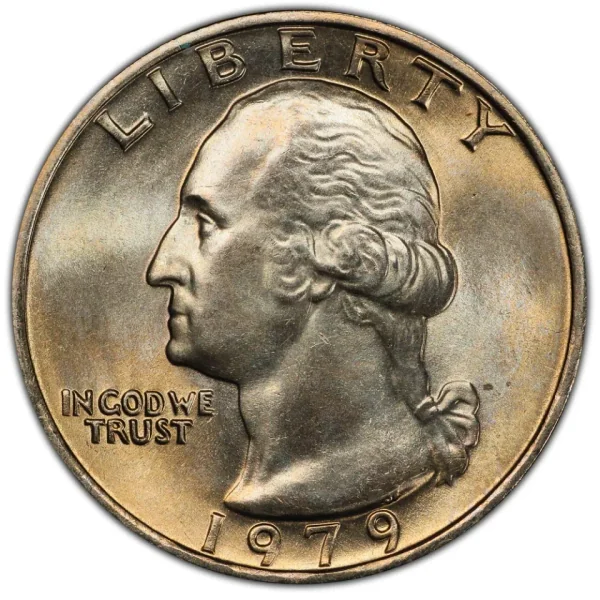
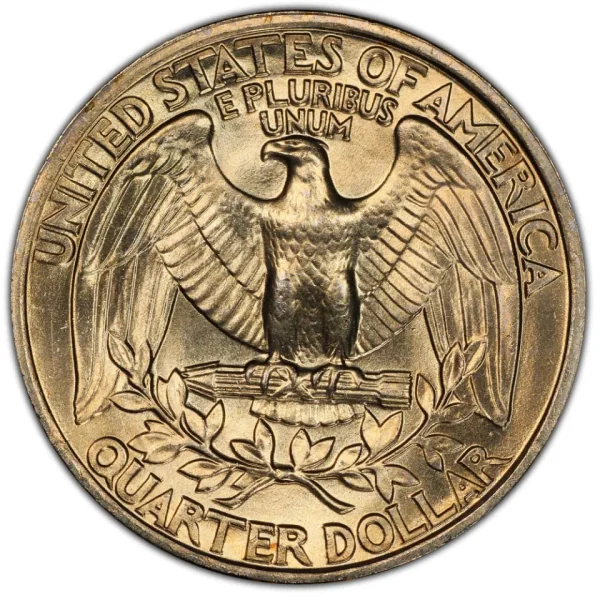
The story: the last year before a P appeared
| Feature | What to check |
|---|---|
| Designer | John Flanagan |
| Original standard | 5.67 g; 24.3 mm; reeded edge |
| Composition | Copper-nickel outer layers bonded to a pure copper core |
| Regular-strike mintage | Philadelphia 515,708,000; Denver 489,789,780 |
| Proof production | San Francisco; 3,677,175 total Proof quarters, not a separate count for each S type |
The quiet historical detail on a 1979 Philadelphia quarter is what is missing. Philadelphia quarters had no mint letter through that year; P appeared on the denomination in 1980. A perfectly ordinary 1979 coin therefore becomes a useful reference for understanding why the absence of a mint mark can be correct.
The date also belongs to the long copper-nickel clad era. Do not transfer the silver content of a 1964 quarter to this later coin. The 1965 transition guide explains the earlier change of circulating metal.
San Francisco’s two S forms add a separate collecting task. They distinguish mint-mark styles on Proofs, rather than two metals or a circulation-strike error. Keep the coin’s production method attached to its variety name.
Identify the mint, finish and S type
| Issue | Visible clue | Correct comparison |
|---|---|---|
| Philadelphia | No mint mark on the obverse | Ordinary circulation strike |
| Denver | D on the obverse near the portrait | Ordinary circulation strike |
| S Type 1 Proof | S appears filled or less open | Type 1 Proof, same grade and contrast designation |
| S Type 2 Proof | S has a clearer, more open form | Type 2 Proof, same grade and contrast designation |
Check the date before examining the mark. The photographed example above is a regular Philadelphia quarter, not a reference for the S varieties. For an S coin, take a focused close-up with lighting that does not flood the openings. A reflection, dirt or wear can obscure the shape.
Proof does not mean perfect
Proof describes how a collector coin was made. Fingerprints, haze, scratches and handling can affect its condition. Deep Cameo (DCAM) is a contrast designation, not a metal composition. A mirrorlike regular coin or a polished coin should not be priced as a certified Proof.
Is a silver-colored 1979 quarter silver?
Normal 1979 coins, including the Proofs discussed here, are clad. Their silvery outer layers are expected; the edge often reveals the copper core. If the measured weight or other features are unusual, document them before making an off-metal claim. Color alone is insufficient.
1979 quarter prices: ordinary coins and Proofs
PCGS retail guide estimates in US dollars, checked October 20, 2026. These are references for genuine, problem-free coins in the stated grade, not auction results or guaranteed offers. Cleaned, damaged and incorrectly graded coins need different comparisons.
MS means Mint State, with no circulation wear. PR means Proof. The regular-strike figures below are not the value of typical worn pocket change.
| Mint | MS60 | MS63 | MS65 | MS67 |
|---|---|---|---|---|
| No mark | $1 | $2 | $16 | $200 |
| D | $1 | $12 | $20 | $360 |
| Variety | PR65 DCAM | PR67 DCAM | PR69 DCAM |
|---|---|---|---|
| Type 1 | $7 | $10 | $18 |
| Type 2 | $5 | $6 | $16 |
Do not assume Type 2 must be more expensive in every grade. The dated guide values above are the actual selected comparisons; asking prices and older claims can differ. For a raw Proof, identify the type and condition before using a slabbed-coin reference.
What about 1979 quarter errors?
A mint error requires evidence of a production mistake. Scratches, flattened rims, missing detail from wear and plating added after minting do not establish one. Photograph both sides, the edge and the suspected feature. A verified off-center strike or wrong-planchet coin needs its own description and comparable sales, not the ordinary table.
For most worn examples, grading costs would exceed the likely premium. Use the grading guide and appraisal checklist when exceptional preservation or a specific error has a reasonable basis.
What to keep in mind about a 1979 quarter
A normal worn example is usually worth 25 cents. No mark and D identify regular issues; S identifies a Proof whose filled or clear mint-mark style needs checking. Higher values depend on verified preservation or a genuine error. Normal examples contain no silver, and the absence of P is historically correct.
Frequently asked questions
Is a 1979 quarter with no mint mark rare?
No. Philadelphia made 515,708,000 regular quarters in 1979 without a P. The missing letter is normal.
Does a 1979 quarter contain silver?
Normal circulation strikes and the S Proofs discussed here are copper-nickel clad over a copper core. They do not have the 90% silver composition of 1964 quarters.
What is the difference between Type 1 and Type 2?
On 1979-S Proof quarters, Type 1 has the filled-looking S and Type 2 has the clearer S. They are mint-mark varieties, not different metals.
Is a 1979-D quarter worth grading?
A typical worn example usually has little collector premium. Consider grading only after identifying exceptional preservation or a credible error and comparing expected value with all costs.
References
Sources
Research checked October 20, 2026. Any price example retains its stated source date and scope.
- PCGS CoinFacts: 1979 PhiladelphiaIssue specifications, grade-specific estimates and collecting history.
- PCGS CoinFacts: 1979DIssue specifications, grade-specific estimates and collecting history.
- PCGS CoinFacts: 1979T1Issue specifications, grade-specific estimates and collecting history.
- PCGS CoinFacts: 1979T2Issue specifications, grade-specific estimates and collecting history.
- PCGS: Washington quarter identificationPhiladelphia mint-mark history.