

 App Store
COIN VALUE GUIDES · PENNIES
1969 Penny Errors & Value: Doubled Die, No Mint Mark, D and S
Compare ordinary 1969 penny values with the rare 1969-S doubled die, using mint marks, real photos and dated red-grade prices.
 HeriBase TeamPublished Updated
In this article
How much is a 1969 penny worth?
Most worn 1969 pennies are common one-cent coins with little collector premium. No mint mark, D and ordinary S issues all exist. The PCGS guide checked October 20, 2026 lists red MS65 regular strikes from each mint at $20; those estimates apply to graded uncirculated coins, not typical brown pocket change.
The famous exception is the authenticated 1969-S Doubled Die Obverse. It has conspicuous doubling on the date, LIBERTY and IN GOD WE TRUST. It is not the same as an ordinary S penny or common flat machine doubling. Match the specific variety before using a rare-coin price; color, an S mark or a blurry doubled edge alone is insufficient.
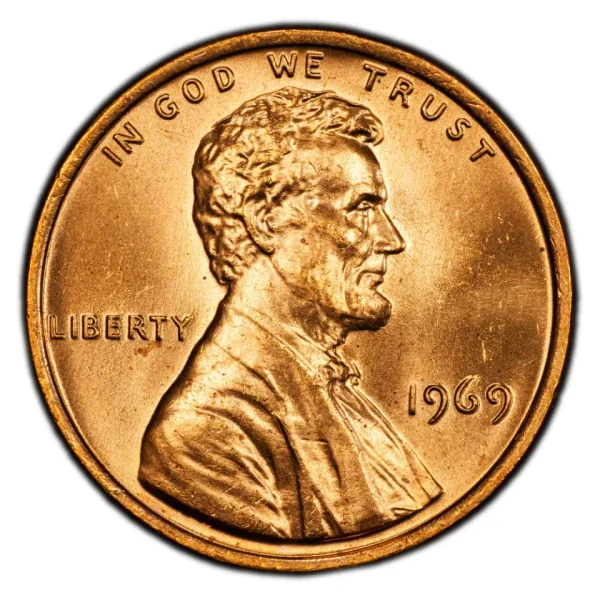
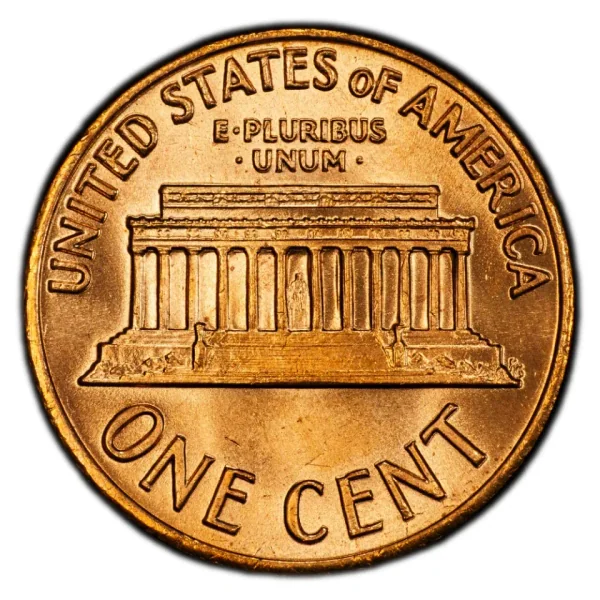
Ordinary 1969 penny: both sides
The story behind a famous roll-search discovery
| Feature | What to check |
|---|---|
| Design | Lincoln portrait; Lincoln Memorial reverse |
| Original standard | 3.11 g; about 19 mm; plain edge |
| Metal | 95% copper, 5% zinc |
| Regular-strike mintage | Philadelphia 1,136,910,000; Denver 4,002,832,200; San Francisco 544,375,000 |
The 1969-S doubled die is famous partly because it was discovered by people examining ordinary-looking rolls. PCGS reported Michael Tremonti’s 2007 discovery of a strongly doubled example from an unsearched roll. It graded MS64 Red and sold at auction in January 2008 for $126,500. The story demonstrates the value of identifying a specific die variety—not a promise that any old roll contains a fortune.
Keep the ordinary issue and the discovery story separate. Billions of 1969 cents were struck across the three mints. A common coin can still be a useful date-and-mint example for a collection, even when there is no profitable grading opportunity.
No mint mark, D, S or Proof?
| Mark or feature | Meaning | Correct comparison |
|---|---|---|
| No mint mark | Philadelphia regular strike | Ordinary 1969 cent, then grade and color |
| D below the date | Denver regular strike | 1969-D regular issue or separately attributed variety |
| S below the date | San Francisco; regular strikes and Proofs exist | Identify production finish before choosing values |
| Strong obverse doubling | Possible variety; must match the exact diagnostics | Authenticated 1969-S Doubled Die Obverse, not the ordinary S row |
Look below the date on the portrait side for the mint mark. On an S coin, establish whether it is a circulation strike or a collector Proof. Mirrorlike areas in a photograph alone are insufficient: polished or strongly lit surfaces can be misleading.
A 1969-D does not become the famous 1969-S variety because some lettering looks doubled. Preserve the mint identification throughout your search, and match any suspected D variety to its own reference.
1969-S doubled die versus machine doubling
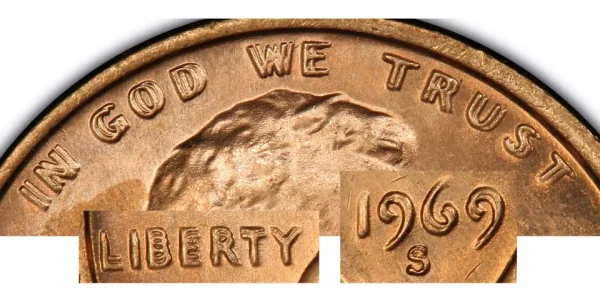
On the recognized 1969-S doubled die, the major obverse inscriptions and date show strong, distinct doubling. PCGS explains that the S was punched into the die separately, so the famous doubled-die effect does not itself double the mint mark. Flat, shelf-like strike doubling is a different phenomenon and should not inherit this variety’s price.
| Observation | Interpretation |
|---|---|
| Distinct doubled date and lettering matching the reference | Worth documenting for specialist attribution |
| Thin flat ledge or reduced-looking letter edge | Often associated with machine doubling; not sufficient for a DDO claim |
| Doubling visible only in one blurred photograph | Retake focused images before drawing a conclusion |
| S mint mark with otherwise ordinary lettering | An ordinary S issue unless another feature is independently verified |
Photograph the whole obverse first, then the date, LIBERTY and motto separately. Keep the same orientation and soft lighting. For another kind of doubled-die comparison, the 1983 penny guide examines reverse doubling; it is a different variety on a different year.
Ordinary 1969 penny value chart
PCGS retail guide estimates in US dollars, checked October 20, 2026. These are references for genuine, problem-free coins in the stated grade, not auction results or guaranteed offers. Cleaned, damaged and incorrectly graded coins need different comparisons.
| Mint | MS63 RD | MS65 RD | MS67 RD |
|---|---|---|---|
| No mark | $6 | $20 | $575 |
| D | $5 | $20 | $325 |
| S, ordinary | $8 | $20 | $350 |
The top-grade column shows why tiny marks, spots and original color matter to specialist collectors. It does not imply that a raw, shiny penny will receive that grade. RD is a grading designation; RB and BN coins require their own comparisons. A chemically brightened surface is not preserved original red.
Use an auction result only for the same variety and condition
The 2008 discovery sale above is historical evidence for a specific MS64 Red doubled die. It is not a current valuation of every doubled die, much less every 1969-S. A suspected example needs attribution and condition assessment before an appropriate recent-sale comparison can be chosen.
Avoid spending more to grade than a common coin is worth
A modest guide figure can be smaller than grading and shipping costs. First decide whether the coin has exceptional preservation or a documented variety. For a typical worn coin, recording the date, mint and condition is often the useful next step.
Use the grading terminology guide and appraisal checklist to prepare clear information. Do not clean a coin to reveal suspected doubling.
The Top 10 U.S. error coin comparison places the 1969-S doubled die beside wrong-planchet strikes, mules and other attributed varieties.
What to remember about a 1969 penny
Ordinary pennies and the 1969-S doubled die are different comparisons. Identify the mint and production finish, judge condition and original color, then inspect any suspected doubling against the correct reference. Most worn coins have little premium; an exceptional variety needs authentication before a high value is assigned.
Frequently asked questions
Is a 1969 penny with no mint mark rare?
No. It is the normal Philadelphia issue, with more than one billion regular strikes recorded. Exceptional preservation or a verified variety must be evaluated separately.
Is every 1969-S penny valuable?
No. Ordinary S circulation strikes and collector Proofs exist. The famous Doubled Die Obverse is a specific rare variety, not a feature of every S coin.
What should I check on a possible 1969-S doubled die?
Compare strong doubling on the date, LIBERTY and IN GOD WE TRUST with a reliable reference. The S was added separately to the die, so the major doubled-die effect does not itself double that mint mark.
How much does a normal 1969 penny weigh?
The original copper-alloy standard is 3.11 grams. A weight measurement helps identify the basic type but cannot establish a doubled die or a numerical grade.
Is doubling visible only on the mint mark enough to identify the major 1969-S doubled die?
No. Establish the mint and compare the required date and lettering diagnostics with the attributed variety. An isolated mint-mark feature or shelf-like outline does not substitute for the obverse diagnostics.
Should Brown, Red-Brown and Red examples share one price?
No. Copper color and surface preservation are separate comparison conditions. Match the same attribution, numerical grade and color designation before using a published guide or completed sale.
References
Sources
Research checked October 20, 2026. Any price example retains its stated source date and scope.
- PCGS CoinFacts: 1969 (Philadelphia)Issue specifications, grade-specific guide estimates and historical context.
- PCGS CoinFacts: 1969-DIssue specifications, grade-specific guide estimates and historical context.
- PCGS CoinFacts: 1969-SIssue specifications, grade-specific guide estimates and historical context.
- PCGS: 1969-S Doubled Die ObverseSpecific variety diagnostics and the distinction from machine doubling.
- PCGS: a 1969-S doubled die discoveryThe 2007 roll-search discovery and certification context.
Watch the identification example
Watch on Facebook ↗ · Promotional illustration. The $126,500 result concerns a specific graded specimen, not every 1969-S cent.