

 App Store

COIN VALUE GUIDES · SILVER QUARTERS
1946 Quarter Value:No Mint Mark, D, S and Silver
Identify a 1946 Washington silver quarter, find its reverse mint mark and separate melt calculations, circulated values and high-grade collector comparisons.
 HeriBase TeamPublished
In this article
Quick answer
A standard 1946 Washington quarter is 90% silver, weighs 6.25 grams and contains approximately 0.18084 troy ounce of fine silver. No mint mark means Philadelphia; D and S appear on the reverse. It is not an ordinary modern clad quarter.
For a specifically identified circulated reference, NGC’s October 2026 1946-S listing gives $11–$13.50 across circulated condition. That is a San Francisco guide range, not a valuation of every 1946 quarter or a live silver quotation.
Coin photos
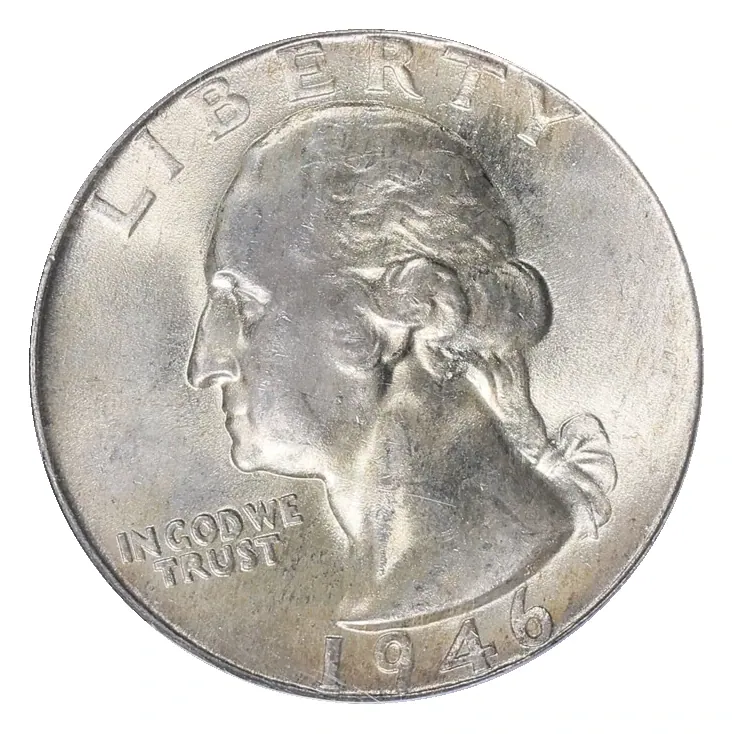
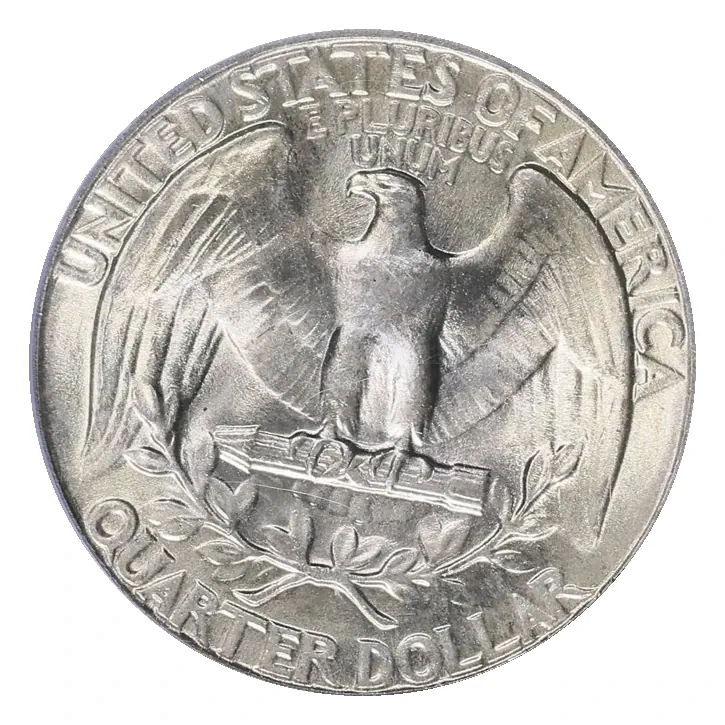
Basics & coin story
The Washington portrait first appeared in 1932. By 1946 the design was a familiar circulating silver quarter, with John Flanagan’s Washington portrait on the front and an eagle on the back. Postwar coin production continued at Philadelphia, Denver and San Francisco.
Philadelphia struck 53,436,000 quarters in 1946, Denver 9,072,800 and San Francisco 4,204,000. These figures identify production, not today’s surviving population at each grade. The smaller S mintage alone does not prove that a worn example has a dramatic premium.
No regular U.S. Proof sets were issued in 1946 during the wartime and postwar interruption. A mirrorlike or polished 1946 quarter should not be called a standard 1946 Proof. For the broader alloy change, the Washington quarter guide distinguishes silver issues from later clad coins.
| Feature | What to check |
|---|---|
| Date / denomination | 1946 / 25 cents |
| Designer | John Flanagan |
| Alloy | 90% silver, 10% copper |
| Nominal mass / diameter | 6.25 g / about 24.3 mm |
| Fine silver | Approximately 0.18084 troy ounce |
| Mint marks | No mark Philadelphia; D Denver; S San Francisco |
| Mark location | Reverse below the eagle’s wreath, above QUARTER DOLLAR |
| Normal Proof issue | None for 1946 |
Identification
Look on the reverse for the mint mark
The 1946 mint mark is below the eagle, not beside Washington’s portrait in the position familiar on later quarters. An empty space there is normal for Philadelphia. Do not identify a 1946 coin using only the mint-mark location of a 1998 quarter.
Photograph the date and reverse letter clearly. A small S can be obscured by wear or deposits. If the mark cannot be read reliably, describe it as uncertain rather than choosing whichever mint has the highest guide value.
Use silver content as a calculation, not a fixed price
Multiply 0.18084 by a verified silver spot price per troy ounce to calculate the nominal contained-silver reference. Record the date and currency of the quote. Dealer spreads, transaction costs and wear can affect an actual offer.
A silvery edge is one supporting observation. Authenticity and issue identification still come first. The date already places a normal 1946 quarter in the silver series, while the 1965 quarter guide addresses the later clad transition and alleged wrong-metal pieces.
Separate ordinary wear from a high-grade claim
Inspect Washington’s hair above the ear and other raised areas for friction, then look at the eagle and the fields. Marks can be present even without circulation wear. A numerical Mint State grade concerns preservation of the complete coin.
The pictured Philadelphia example was cataloged as PCGS MS66. It is a design illustration, not the coin priced by the circulated 1946-S range. A high-resolution photograph can show features to examine but cannot transfer certification to a different specimen.
Condition & value
USD NGC 1946-S circulated guide snapshot as of October 2026, consulted October 27. The S range does not value the photographed Philadelphia MS66 example. Silver calculations require a separately dated spot quote.
| Issue | Grade / condition | Value or reference | Basis | Important condition |
|---|---|---|---|---|
| 1946-S | Circulated condition | $11–$13.50 | NGC guide, October 2026 | S mint only; grade within the range matters |
| 1946 Philadelphia, no mint mark | Exact circulated grade | Use a Philadelphia listing | Issue-specific comparison | Do not substitute the S range |
| 1946-D | Exact circulated grade | Use a Denver listing | Issue-specific comparison | D is on the reverse |
| Any 1946 mint, Mint State | Exact certified grade | Use matching graded sales | Condition market | Not represented by a circulated range |
| Nominal contained silver | 0.18084 troy oz | 0.18084 × silver spot per troy oz | Metal calculation | Spot date and selling spread must be separate |
The NGC range is useful because its mint and time basis are explicit. It does not establish that every circulated S coin will bring the top figure or that all P and D coins are worth the same amount. Cleaning, rim damage and other problems require separate comparisons.
Use a fresh spot quote for a metal calculation at the time of a transaction. For a collector premium, compare completed lots with the exact date, mint, grade and surface status. A top-population result is not an ordinary circulated-quarter benchmark.
Keep the coin unpolished. The cleaning guide explains hairlines and altered surfaces, while the grading scale helps narrow the condition category before seeking an offer.
Summary
Read the reverse mint mark and confirm the silver-series identity. Keep the 1946-S circulated reference, a fresh silver calculation and any high-grade sale in separate comparisons. Preserve the surfaces before researching a premium.
FAQ
How much silver is in a 1946 quarter?
A standard 1946 quarter is 90% silver and contains approximately 0.18084 troy ounce of fine silver at its nominal 6.25-gram mass.
Is a 1946 quarter with no mint mark an error?
No. Philadelphia normally issued 1946 quarters without a mint mark.
Where is the 1946 quarter mint mark?
On the reverse below the eagle’s wreath, above QUARTER DOLLAR. D identifies Denver and S San Francisco.
Is a shiny 1946 quarter a Proof?
Not merely because it is shiny. There is no regular 1946 U.S. Proof issue; polished surfaces and normal reflective areas must not be confused with Proof manufacture.
References
References and further reading
- NGC: 1946-S Washington quarter values
- PCGS: 1946 Philadelphia quarter
- GreatCollections: photographed 1946 PCGS MS66
References consulted October 27, 2026. Price tables retain the update dates stated in the text; guide estimates, face values and completed transactions are different forms of evidence.