

 App Store

COIN VALUE GUIDES · TRADE DOLLARS
Trade Dollar Value:Silver, Chop Marks and Authentication
Identify U.S. Trade dollars, read 420 GRAINS 900 FINE, locate S and CC mint marks and compare condition without confusing chop marks with Mint errors.
 HeriBase TeamPublished
In this article
Quick answer
The U.S. Trade dollar is a 90% silver coin with a nominal weight of 420 grains, about 27.22 grams, and approximately 0.7874 troy ounce of fine silver. Regular strikes date from 1873–1878; later dated issues through 1885 are Proof-only.
As a defined reference, NumisMedia’s October 24, 2026 guide lists 1877-S at $540 in AU50, $630 in AU55 and $1,170 in MS60. Authenticity, wear, cleaning and chop marks must be evaluated before applying a problem-free guide row.
Coin photos
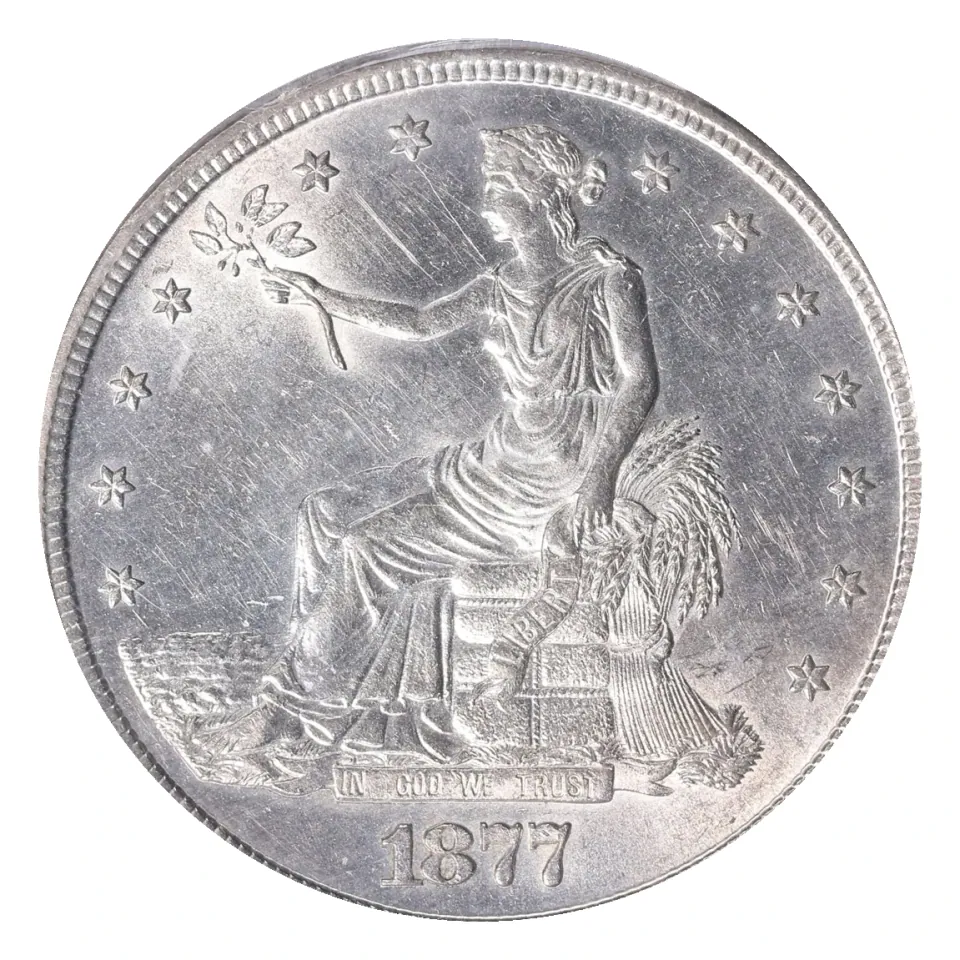
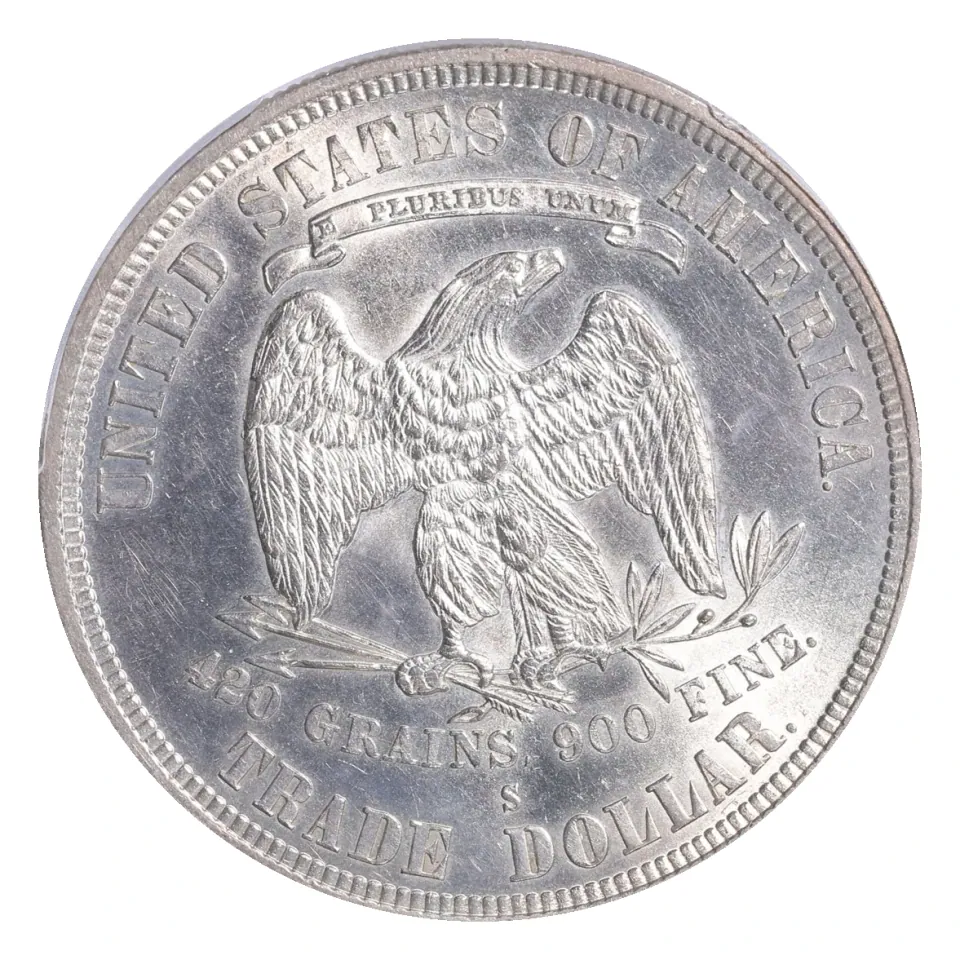
Basics & coin story
The Trade dollar was created for overseas commerce, particularly Asian trade where silver weight and fineness mattered. William Barber’s seated Liberty faces left, extending an olive branch. The reverse eagle appears above the weight and fineness inscription and the denomination TRADE DOLLAR.
The coin is heavier than a standard Morgan silver dollar and belongs to a different series. A similar age or silver color does not make the two interchangeable. The Morgan dollar guide explains the later domestic dollar design.
Philadelphia, Carson City and San Francisco produced regular Trade dollars in different years. After regular production ended in 1878, Proof issues continued. The very rare later Proof dates should not be treated as ordinary pocket-change discoveries merely because a piece bears the correct numbers.
| Feature | What to check |
|---|---|
| Regular-strike years | 1873–1878 |
| Later dates | 1879–1885, Proof-only issues |
| Designer | William Barber |
| Normal alloy | 90% silver, 10% copper |
| Nominal mass / diameter | 420 grains, about 27.22 g / 38.1 mm |
| Fine silver | Approximately 0.7874 troy ounce |
| Reverse inscription | 420 GRAINS 900 FINE / TRADE DOLLAR |
| Mint marks | No mark, S or CC where issued; reverse below the eagle |
Identification
Read the weight inscription and mint mark
Look for 420 GRAINS 900 FINE on the reverse. This states the original nominal gross weight and fineness; it does not mean 420 grains of pure silver. The coin’s fine-silver content is about 0.7874 troy ounce.
Find the S or CC below the eagle, near the reverse inscriptions; no mark identifies Philadelphia where issued. A scratch, merchant stamp or seller’s annotation is not a mint mark. Verify that the date and mint form a real issued combination.
Understand chop marks as a separate collecting category
Merchants sometimes punched marks into coins during overseas circulation to test or identify accepted silver. These chop marks are evidence to research, not original Mint design elements. They can be collected on their own terms, but do not automatically make a coin worth more.
Compare a chopped coin with similarly attributed chopped examples. A generic unmarked AU price may not describe that market. Modern added marks, damage and counterfeit pieces also exist, so the presence of a punch does not establish an authentic nineteenth-century trade history.
Weight and a magnet are screening tools
A precise scale and diameter measurement can flag a discrepancy, but a correct weight does not prove authenticity. A nonmagnetic counterfeit can still use a plausible alloy and dimensions. Design details, edge, surfaces and specialist examination remain important.
If a coin may be valuable, retain it uncleaned and compare both sides with a certified example. A holder certification should be checked against the grading service’s records and images. The coin identification guide explains what to photograph before review.
Condition & value
USD NumisMedia collector FMV guide, updated October 24, 2026. Rows are ordinary issue-and-grade references, not estimates for chopped, damaged or counterfeit pieces.
| Issue | Grade / condition | Value or reference | Basis | Important condition |
|---|---|---|---|---|
| 1877-S, ordinary unchopped issue | AU50 | $540 | NumisMedia FMV, Oct 24, 2026 | Authenticated, no major surface problem |
| 1877-S, ordinary unchopped issue | AU53 / AU55 | $600 / $630 | Same dated guide | Correct amount of remaining wear |
| 1877-S, ordinary unchopped issue | AU58 / MS60 | $920 / $1,170 | Same dated guide | AU and Mint State are distinct |
| Contained silver | 0.7874 troy oz | 0.7874 × silver spot per troy oz | Metal-content reference | Does not establish authenticity or full value |
| Chopped, cleaned or later Proof issue | Exact attributed identity | Use matching evidence | Separate comparison | Do not transfer the ordinary 1877-S rows |
The photographed 1877-S is a certified MS62 example, while the numerical references above stop at MS60. It supplies a design comparison without silently assigning a lower grade’s value to a different coin.
Trade dollars can have collector value well above their silver component, but authenticity comes before a premium calculation. A proposed bargain with a scarce date, unusually uniform wear or copied certification needs a closer look rather than an immediate retail-price estimate.
For completed sales, record the mint, grade, surface designation, chop-mark status, sale date and buyer’s fees. Those details explain more than one spectacular result from another date. The appraisal guide can help organize the information for a specialist.
Summary
Confirm the Trade dollar design, 420-grain inscription, date and mint before comparing values. Check authenticity and surface status, and research chop-marked coins separately from ordinary unmarked examples.
FAQ
How much silver is in a Trade dollar?
A standard U.S. Trade dollar is 90% silver at a nominal 420-grain gross weight, containing approximately 0.7874 troy ounce of fine silver.
Are Trade dollar chop marks Mint errors?
No. Merchant chop marks were applied after minting. Their historical attribution and collector market require separate evidence.
Is a correct weight enough to prove a Trade dollar is real?
No. Weight and diameter are useful screening checks, but plausible counterfeits exist. Design, edge, surfaces and expert examination still matter.
Were 1879 Trade dollars regular circulation strikes?
No. Regular-strike production ended in 1878. Later dated Trade dollars through 1885 are Proof-only issues.
References
References and further reading
- PCGS: 1877-S Trade dollar
- NumisMedia: Trade dollar grade comparisons
- GreatCollections: photographed 1877-S PCGS MS62
References consulted October 27, 2026. Price tables retain the update dates stated in the text; guide estimates, face values and completed transactions are different forms of evidence.