

 App Store

COIN ERRORS & VARIETIES
Struck-Through Coin Errors:Grease, Missing Letters and Damage
Compare grease-filled die details, foreign-object impressions, worn letters and scratches. Use the whole coin before assigning a mint error.
 HeriBase Editorial TeamPublished
In this article
Quick answer
A struck-through error occurs when material interferes with the transfer of the design during the strike. Grease or compacted debris in a die recess can leave letters weak or absent. A solid object can leave a distinct recessed outline or texture.
A missing letter alone is not enough. Compare nearby lettering, the surface where the design is weak and the corresponding area on the other face. Keep wear, a weak strike and post-mint damage in the comparison.
Specimen photos
How it happens
The dies carry recessed design elements that become raised on the coin. When grease and debris occupy some of those recesses, the planchet may receive less of the intended design at that point. Solid material between a die and the blank can interfere more locally and leave a visibly different impression.
The same worn-looking letter can have several causes. Normal circulation wear often affects neighboring high points, while a scratch may cut across relief and leave displaced metal. Old strike-throughs can also be worn, so inspect the affected area in context.
| Type | Location or shape | What to check | Comparison |
|---|---|---|---|
| Grease or compacted die fill | One or more design elements fade locally | Compare their shape with surrounding relief and surface texture | An isolated missing letter needs other evidence |
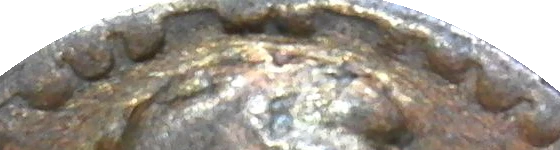
| Solid material struck through | A recessed impression or texture interrupts the design | Look at its outline under light from different directions | A dent can make a recess too |
| Wear or weak strike | More than one high point may be soft | Check surrounding details and the opposite face | Distinguish wear from original strike softness |
| Post-mint scratch or impact | A groove, rough recess or displaced lip can interrupt lettering | Look for cut metal crossing already raised design | Damage may still be present on a genuine error coin |
Identification
Map the weak area
Identify which part of the lettering or design is missing. Compare the same area on a normal example from the same series and issue.
Use angled light on both faces
Look for raised edges, gouges and scraping. Preserve several photographs from different angles instead of choosing the one that makes the anomaly look strongest.
Identify the mechanism before pricing
A recognizable retained object, broad grease fill and minor single-letter weakness are different comparisons. Leave possible retained material in place and seek attribution if the error is substantial.
Documented cases and value
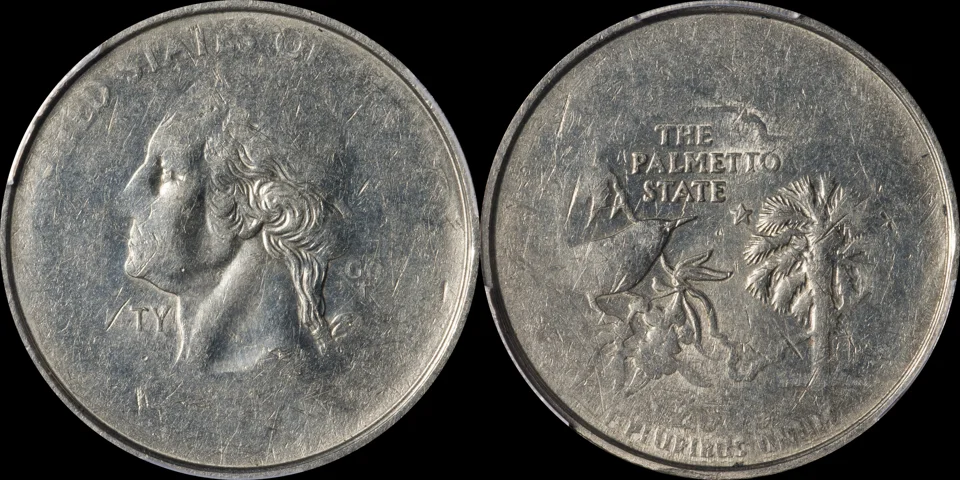
Heritage lot 52239 records the 2000-P South Carolina quarter graded ANACS MS63 and sold for $53 on March 20, 2023. This was a specific attributed grease strike. The state quarter comparison records that case alongside other distinct errors. A different coin with a weak letter needs its own assessment.
For wider edge damage and rolled rims, see the penny rim photo guide. Compare the visible surface and strike first, then use sales of an equivalent attributed error.
Summary
Use a normal control, angled photos and the rest of the design to tell die fill from damage. Compare prices only once the error mechanism and approximate extent match.
Frequently asked questions
Is an “In God We Rust” quarter always a grease error?
A weak or missing T can fit die fill. Check the surrounding surface and lettering because wear and damage can produce a similar appearance.
Can a grease strike affect a mint mark?
Die fill can weaken individual features. Compare the expected mint mark for the issue and rule out other explanations before making an attribution.
Is every recessed mark a struck-through error?
No. Impacts and cuts also leave recessed marks. Look for displaced metal, shape, texture and other strike evidence.
Should I clean an apparent retained object?
Leave the surface as found. Removing material can destroy diagnostic evidence or damage the coin.