

 App Store

COIN VALUE GUIDES · SHIELD NICKELS
Shield Nickel Value:With Rays, No Rays and Condition
Identify 1866–1883 Shield nickels, separate the two 1867 reverses and compare ordinary circulated prices without mistaking corrosion or die cracks for rarity.
 HeriBase TeamPublished
In this article
Quick answer
A Shield nickel is a five-cent copper-nickel coin dated 1866–1883, not a silver half dime. Its shield front and large 5 reverse identify the design. The 1867 date comes both With Rays and No Rays, so turn the coin over before pricing.
NumisMedia’s October 24, 2026 circulated guide lists 1867 No Rays at $24 in G4, $34 in F12 and $72 in XF40. With Rays is a separate issue. Corroded, damaged or cleaned coins do not automatically qualify for problem-free guide values.
Coin photos
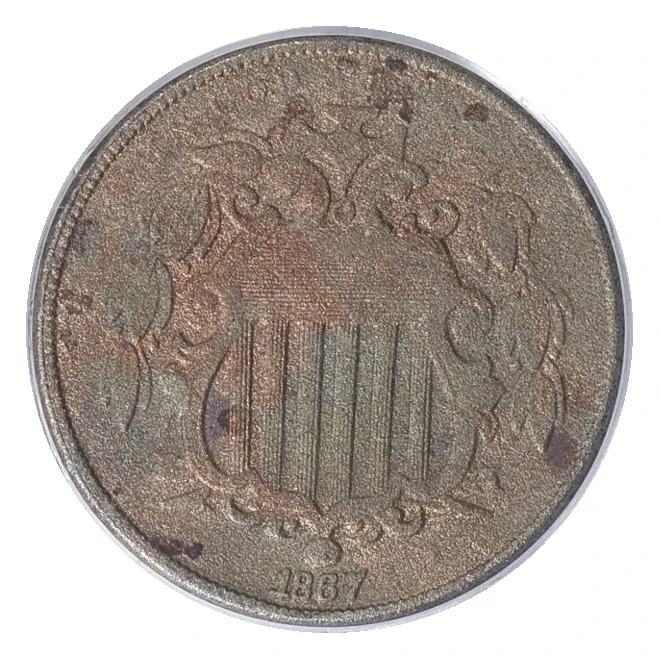
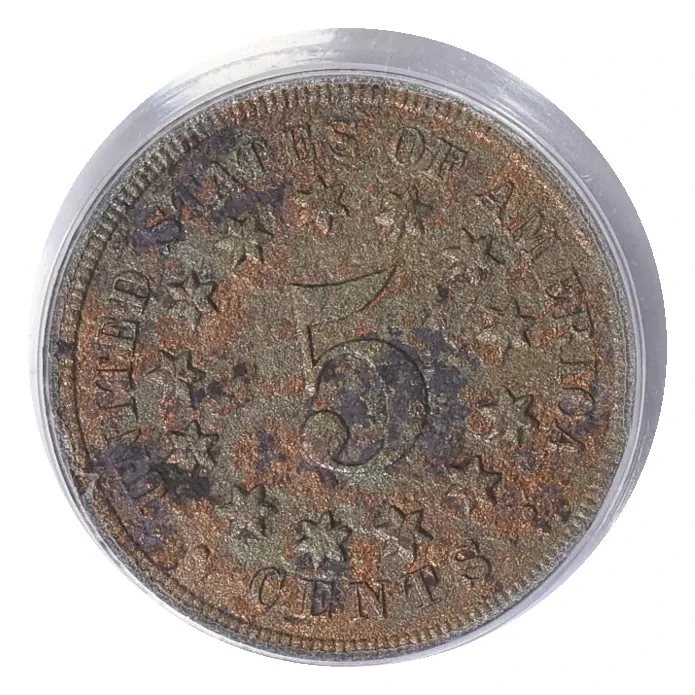
Basics & coin story
The Civil War disrupted familiar small-change supplies. The five-cent nickel authorized in 1866 used a larger base-metal format alongside the existing silver half dime. James B. Longacre placed a national shield beneath IN GOD WE TRUST, with branches, arrows and the date around it.
The original reverse surrounded a large 5 with stars and rays. The rays were removed in 1867 after difficulties producing satisfactory coins and durable dies. Both reverses belong to that year, while 1866 uses rays and later regular dates use the No Rays design.
Shield nickels continued through 1883, when the Liberty Head nickel also began. The Liberty nickel guide covers the following design, while the half-dime guide explains the smaller silver denomination that overlapped part of the Shield era.
| Feature | What to check |
|---|---|
| Series / value | 1866–1883 / five cents |
| Designer | James B. Longacre |
| Normal alloy | 75% copper, 25% nickel; no silver |
| Nominal weight / diameter | 5.00 g / about 20.5 mm |
| Obverse | Shield, motto and date |
| Reverse | Large 5 surrounded by stars; With Rays or No Rays |
| Mint identity | Philadelphia; no mint mark |
| Manufacture | Regular strikes and Proofs; 1877 and 1878 are Proof-only dates |
Identification
Check 1867 on the reverse
With Rays has short lines between the surrounding stars. No Rays omits those lines. Do not infer the reverse from the date alone. The photographed 1867 coin is No Rays and has significant surface problems; it is an identification example, not a model for the price table.
Dirt or corrosion can obscure small features. Examine the complete star ring with angled light and compare a verified photograph. Do not scrape the surface to expose a possible ray.
Distinguish die cracks from valuable varieties
The hard copper-nickel alloy was challenging for nineteenth-century dies, and cracks or uneven strikes can appear. A raised line produced by a cracked die is different from a cut into the coin after striking. Neither automatically establishes a large premium.
A recognized doubled die or repunched date requires matching diagnostic locations, not simply a thick or blurred numeral. Record what you can actually see and check a specialist attribution before attaching a variety price.
Check the surface before calling the coin high grade
The shield’s horizontal and vertical lines help compare remaining detail. Flat areas can reflect wear or an incomplete strike. Look separately for circulation friction, heavy scratches, porous corrosion and unnatural polishing.
An old nickel with readable detail may receive a problem notation rather than an ordinary numerical grade. Our grading guide distinguishes the preservation scale from those surface problems. A genuine designation alone is not an MS grade.
Condition & value
USD NumisMedia collector FMV references updated October 24, 2026. These are problem-free issue-and-grade comparisons. The pictured PCGS Genuine coin has surface problems and is not valued by these rows.
| Issue | Grade / condition | Value or reference | Basis | Important condition |
|---|---|---|---|---|
| 1867 No Rays | G4 / F12 | $24 / $34 | NumisMedia FMV, Oct 24, 2026 | Problem-free circulated comparisons |
| 1867 No Rays | XF40 | $72 | Same dated guide | Check shield detail and surfaces |
| 1867 With Rays | G4 / F12 | $32 / $72 | Same dated guide | Different reverse from the photographed coin |
| 1867 With Rays | XF40 | $222 | Same dated guide | Do not apply to No Rays |
| 1877 or 1878 | Proof issue | Use a matching Proof guide | Manufacture-specific | Not an ordinary circulation issue |
The two 1867 reverse rows show why an exact identification matters even before grade is considered. They do not mean that every 1867 coin falls between the lowest and highest numbers shown. A damaged example requires separate sold-coin evidence.
There is no silver-melt calculation for a standard Shield nickel. Its nominal five-gram copper-nickel composition is useful for identification but does not explain its collector price. Date, survival in an acceptable grade, attribution and demand matter.
Keep a questionable date or unusual feature unaltered. Photograph both sides, the edge and a close view of the area in question. Professional review is especially useful for a costly scarce date or a proposed Proof that has lost its original appearance.
Summary
Identify the Shield design, reverse type and exact date, then evaluate the surface. The 1867 With Rays and No Rays issues have separate values. Die cracks, corrosion and shine alone do not establish rarity.
FAQ
Do Shield nickels contain silver?
No. Standard Shield nickels are 75% copper and 25% nickel, unlike the separate silver half-dime denomination.
What is the difference between 1867 With Rays and No Rays?
With Rays has lines between the reverse stars. No Rays omits those lines. Both designs exist with the 1867 date.
Where is the Shield nickel mint mark?
Normal Shield nickels were made at Philadelphia and do not carry a mint mark.
Were 1877 and 1878 Shield nickels made for circulation?
No. Those are Proof-only dates in the Shield nickel series and need Proof-specific comparisons.
References
References and further reading
- NumisMedia: Shield nickel circulated values
- PCGS: 1867 No Rays specifications
- PCGS: With Rays history
- NGC: Proof-only dates and Shield grading
- GreatCollections: pictured 1867 No Rays genuine coin
References consulted October 27, 2026. Price tables retain the update dates stated in the text; guide estimates, face values and completed transactions are different forms of evidence.