

 App Store

COIN VALUE GUIDES · DOLLAR COINS
Martin Van Buren Dollar Coin:2008 Date, Edge Lettering and Value
Find the actual date and mint mark on a Martin Van Buren dollar, distinguish normal lettering orientations from missing-edge errors, and compare regular, satin and Proof coins.
 HeriBase TeamPublished
In this article
Quick answer
The Martin Van Buren dollar is a 2008 Presidential $1 coin, not a coin minted in 1837 or 1841. The dates below his portrait describe his presidency; the actual 2008 date and mint mark are on the edge. An ordinary circulated coin has a $1 face-value baseline and contains no gold despite its golden color.
For a regular 2008-P Position A coin, the PCGS guide checked October 21, 2026 lists $5 in Mint State 63, $7 in Mint State 65 and $12 in Mint State 66. Satin-finish set coins, S Proofs and authenticated edge errors require separate entries. Upside-down edge lettering relative to the portrait is a normal orientation, not automatically an error.
Coin photos
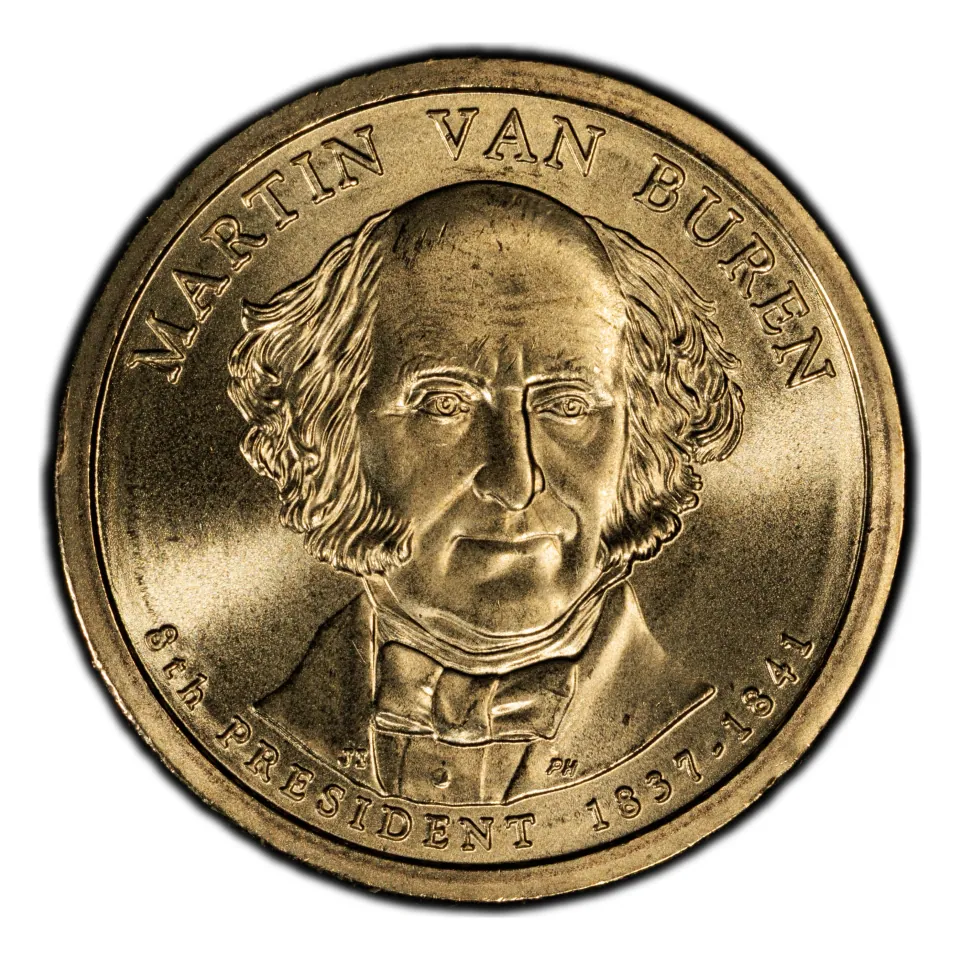
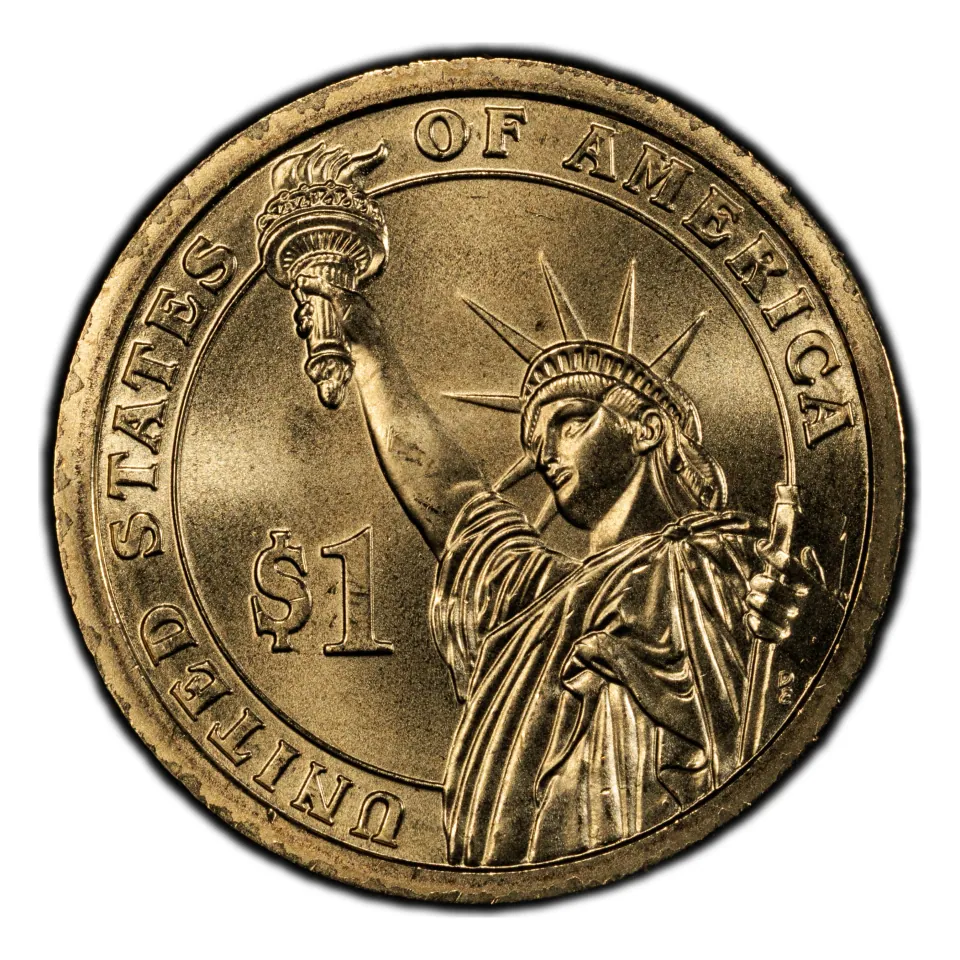
Basics & coin story
The Van Buren dollar was released on November 13, 2008, as the eighth design in the Presidential $1 Coin Program. The obverse portrait was designed by Joel Iskowitz and sculpted by Phebe Hemphill; Don Everhart created the shared Statue of Liberty reverse.
Van Buren served after Andrew Jackson, during a presidency associated with economic crisis and debates about federal finances. The coin’s presidential dates explain that sequence rather than the coin’s age. For nearby issues, compare Andrew Jackson’s dollar and John Quincy Adams’s dollar.
| Feature | What to check |
|---|---|
| Actual issue date | 2008; released November 13 |
| Denomination | $1 |
| Presidential inscription | 8TH PRESIDENT 1837–1841 |
| Nominal weight / diameter | 8.10 g / 26.50 mm |
| Overall composition | 88.5% copper, 6% zinc, 3.5% manganese, 2% nickel |
| Edge information | 2008, mint letter, E PLURIBUS UNUM and IN GOD WE TRUST |
| Regular / collector issues | P and D regular and satin issues; S Proof |
Identification
Read the edge all the way around
Hold the coin by its edges and rotate it under good light. Locate 2008 and P, D or S rather than using the presidential dates. The 2008 design places IN GOD WE TRUST on the edge; looking only at the faces can create a mistaken missing-motto claim.
Position A and Position B are normal
On regular strikes, edge lettering was applied in a separate manufacturing step. Position A reads upside-down with the presidential portrait facing up; Position B reads the other way. Neither orientation alone proves an error. Do not pay a missing-letter premium simply because the text is inconvenient to read.
Separate weak, missing and damaged lettering
A completely missing-edge attribution requires more than a faint photograph. Wear, edge knocks and incomplete lighting can hide characters. An expert should examine the whole edge and the coin’s surfaces before an error designation is assigned. Satin-finish set coins and Proofs also have different reference entries, even when the portraits are alike.
Condition & value
Amounts are in U.S. dollars. PCGS retail-guide examples were checked October 21, 2026 and apply only to the stated issue, grade and designation. They are not guaranteed purchase offers; current market conditions and selling costs can change the amount received.
| Issue | Grade / condition | Value or reference | Basis | Important condition |
|---|---|---|---|---|
| Ordinary circulated coin | Worn | $1 baseline | Face value | Golden color does not mean gold |
| 2008-P Position A, regular | MS63 | $5 | PCGS retail guide | Exact issue and orientation entry |
| 2008-P Position A, regular | MS65 | $7 | PCGS retail guide | Not a satin-finish set coin |
| 2008-P Position A, regular | MS66 | $12 | PCGS retail guide | Problem-free graded coin |
| Satin / Proof / attributed edge error | Issue-specific | Use matching entry | Separate market | Orientation alone is not an error |
The ordinary dollar is a base-metal coin; its color should not be confused with a gold bullion value. The gold-dollar identification guide explains the difference between golden $1 coins and actual gold issues.
For a collector example, record mint, finish and condition. The Position A table is not a universal price for every Van Buren dollar. Grading costs may exceed the premium on a modest uncirculated coin. Keep original packaging with satin or Proof examples, and photograph the complete edge if an error is suspected.
Summary
Find 2008 on the edge, identify the mint and finish, and treat the presidential dates as historical context. An ordinary worn coin starts at $1. Normal edge orientation does not create an error; preserve the coin and seek attribution only when the physical lettering provides a real reason.
FAQ
Is the Martin Van Buren dollar from 1837?
No. The coin was issued in 2008. The 1837–1841 inscription gives Van Buren’s presidential term; the actual date is on the edge.
Is a Martin Van Buren dollar made of gold?
No. It is a golden-colored base-metal Presidential dollar, with an overall composition dominated by copper.
Is upside-down edge lettering an error?
Not by itself. Position A and Position B are normal orientations on regular Presidential dollars.
Where is IN GOD WE TRUST on the 2008 Van Buren dollar?
It is on the edge, along with the date, mint mark and E PLURIBUS UNUM. Inspect the complete edge before alleging missing lettering.
References
References and further reading
- PCGS CoinFacts: exact issue, specifications and available guide evidence
- U.S. Mint: Van Buren portrait, history and edge inscriptions
Sources and quoted guide evidence checked October 21, 2026. Guide estimates, historical sales, face value and metal-content calculations are identified separately.