

 App Store

COIN ERRORS & VARIETIES · DIME
1990 Dime Errors: P, D, Off-Center Strikes and Collar Checks
Compare documented Philadelphia and Denver mint errors, then separate a 1990 dime from a later coin struck over it.
 HeriBase TeamPublished
In this article
What should you know first?
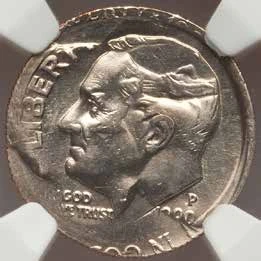
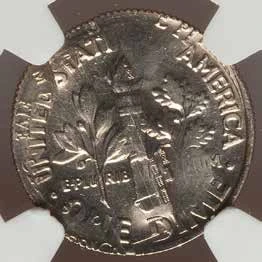
1990 dime errors must be separated by mint, mechanism and specimen. GreatCollections records a 1990-D dime struck 50% off center and a 1990-P partial-collar strike. These are different errors. Another published case is a 1991-P nickel overstruck on a 1990-P dime;it is not a 1990-dated nickel or an ordinary doubled die.
What do the real coins show?
What is normal for this issue?
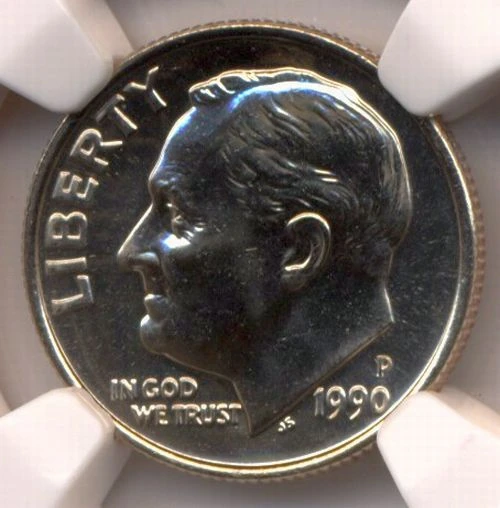
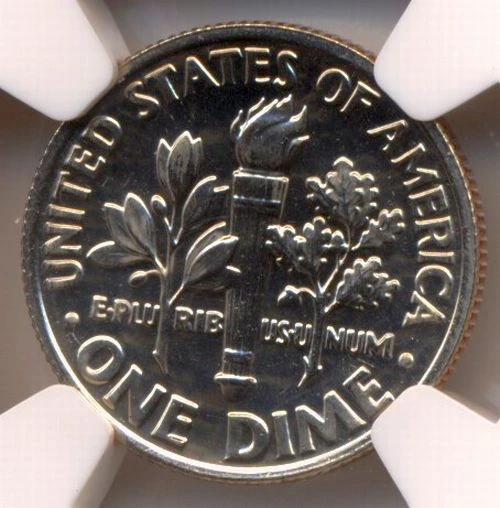
The Roosevelt portrait and the torch reverse belong on an ordinary 1990 dime. Philadelphia and Denver circulation issues have P or D mint letters on the obverse. A weakly visible letter needs examination for strike quality, wear or damage before it is called missing.
This date is useful for learning why the visible date, underlying coin and final strike must be distinguished. A dime can become the undercoin in a double-denomination error. The overstriking dies then belong to another denomination and can carry a later date. A cataloged 1991-over-1990 combination should retain both dates in the description.
For the broader mechanisms and other dates,compare the dime error guide. A year-specific attribution still needs the exact diagnostics described below.
How do normal coins and errors compare?
| Coin or observation | Where to look | Meaning | How to confirm | Value context |
|---|---|---|---|---|
| Regular 1990-P or D | Roosevelt, torch and expected mint letter | Normal dime issue | Separate circulation and S Proof manufacture | Worn ordinary coin:10¢ face value |
| 1990-D 50% off center | Large unstruck area and displaced design | NGC MS 64 example documented by GreatCollections | Match actual date, mint and error | Result hidden behind login;not quoted |
| 1990-P partial collar | Partial engagement of the edge-forming collar | ICG MS 63 example documented by GreatCollections | Edge views and collar step, not rim width alone | Result hidden behind login;not quoted |
| 1991-P nickel on 1990-P dime | Two denominations and two date contexts | Published double-denomination error | Preserve final-strike and undercoin identity | Do not price an ordinary dime from this record |
Which diagnostics identify the actual cases?
What proves an off-center 1990-D dime?
GreatCollections item 749833 identifies a 1990-D dime struck 50% off center, NGC MS 64, certification 4675160-008. An off-center error concerns displacement of the blank relative to the dies and actual loss of design. The ordinary 1990-P photographs here are baseline references;they do not depict that Denver specimen.
How is a partial collar different?
GreatCollections item 2023000 records a 1990-P CONECA partial-collar strike, ICG MS 63, certification 5029760601, ended January 4, 2026. The collar forms the coin’s edge. Partial engagement can leave a stepped edge, so edge photographs matter more than an unusually broad-looking rim in a face-on image. A collar clash is a separate event in which the die contacts the collar and acquires transferred marks.
Why does the pictured error show Jefferson?
The published case is a 1991-P nickel overstruck on a 1990-P dime. Jefferson belongs to the later nickel strike. Surviving dime design under that strike supplies the second-denomination evidence. It is not a 1990 Roosevelt dime with a standard portrait variety, and the second date is not an extra digit from a doubled die.
Could the feature be damage?
Can a worn smooth edge be a partial-collar error?
Loss of reeding through wear, damage or alteration can imitate an unusual edge. Compare the entire circumference and look for a coherent as-struck collar relationship. A smooth patch alone does not establish the mechanism.
Are thick letters or doubled rims sufficient?
No. Die wear, machine doubling, alignment differences and damage can make letters or rims look doubled. A doubled die requires a repeatable die-made diagnostic;a second strike requires evidence of a separate impression.
What do the price records establish?
| Coin or category | Grade or attribution | Amount | Source and date | Basis and limitation |
|---|---|---|---|---|
| Ordinary worn 1990-P or D | Normal circulation dime | 10¢ | Face denomination | No error premium |
| 1990-D,50% off center | NGC MS 64;GC 749833 | Not quoted | GreatCollections archive accessed November 16, 2026 | No publicly visible sale amount verified |
| 1990-P partial collar | ICG MS 63;GC 2023000 | Not quoted | Auction ended January 4, 2026 | No publicly visible sale amount verified |
| 1991-P nickel over 1990-P dime | NGC MS 64 | $4,600 | Mint Error News,2010 Boston ANA Heritage results, page 107 | Published historical result;fee basis not separately established |
Use the $4,600 figure only as the publication’s historical result for the identified double-denomination coin. It is not a current value for ordinary 1990 dimes, partial-collar pieces or a different off-center strike. The publication’s caption and actual photographs should be read together.
An archive entry can verify that a specimen and an attribution exist even when its sale amount is not publicly visible. In that situation, it is better to omit a price than to invent one from auction bidding activity or a similar-looking listing. Shipping, taxes, commissions and a seller’s asking price should also not be presented as interchangeable with a completed result.
How should you check your coin?
1.Read all visible dates
Confirm 1990 and P or D on a suspected dime. If a second denomination is visible, record it rather than forcing the coin into an ordinary dime category.
2.Photograph the edge as well as both faces
For a collar claim, include several edge angles. For an off-center claim, show the complete blank and the missing design.
3.Compare the same mechanism
Keep off-center, partial-collar, collar-clash and double-denomination records separate. Use an attributed specimen and a verified sale basis.
Keep the original photographs and measurements together. HeriBase can help with an initial photo-based identification; a coin-specific error attribution or certified grade still requires the appropriate evidence.
What is the key takeaway?
Identify the mint and the physical error before comparing prices. The P partial-collar and D off-center records establish different cases;the photographed 1991-over-1990 coin adds a second denomination and must not be mislabeled as an ordinary 1990 dime.
What else do collectors ask?
Are 1990-P and 1990-D dime errors the same?
No. P and D identify different mints, and any error must also be described by its mechanism and extent.
Is a partial collar the same as a collar clash?
No. A partial-collar strike involves incomplete engagement with the coin blank. A collar clash concerns contact between a die and the collar.
Why does the photographed 1990-dime case show Jefferson?
It is a 1991-P nickel overstruck on a 1990-P dime. The final strike supplies the Jefferson design.
Is the $4,600 result a 1990 dime price guide?
No. It is a historical published result for the specific double-denomination specimen.
Does a missing-looking P prove an error?
Not on appearance alone. Examine strike quality, wear, damage and the intended issue before considering a missing-letter claim.
Can a normal high-grade dime be valuable without an error?
Yes. Grade and strike designations can affect collector demand, but they should not be described as mint errors. Compare them separately.
Where can you verify the evidence?
References and further reading
- GreatCollections:1990-D 50% off-center dime, NGC MS 64
- GreatCollections:1990-P partial-collar strike, ICG MS 63
- Mint Error News:2010 Boston ANA results, page 107
- PCGS CoinFacts:ordinary 1990-P dime
References accessed November 16, 2026. Publication dates and historical sale dates are retained separately. A catalog attribution is not itself a sale or a current buying offer.