

 App Store

COIN VALUE GUIDES · PEACE DOLLARS
1922 Silver Dollar Value:No Mint Mark, D & S Prices
Check 1922 Peace dollar values for no mint mark, D and S. Compare grades and learn why a missing mint mark and TRVST are normal features.
 HeriBase TeamPublished Updated
In this article
What is a 1922 silver dollar worth with no mint mark, D or S?
A standard circulated 1922 Peace dollar has a dated NGC retail guide range of about $53–$61, from the October 14, 2026 snapshot used here. No mint mark means Philadelphia; D and S identify Denver and San Francisco. No mark is normal, not a missing-letter error, and all three standard issues are 90% silver.
At Mint State 63 (MS63), that same guide lists $115 for no mint mark, $125 for D and $135 for S. These are separate grade-specific comparisons, not values assigned from age or appearance. Cleaning, damage, a different grade or a verified rare attribution changes the comparison. TRVST is normal design lettering.
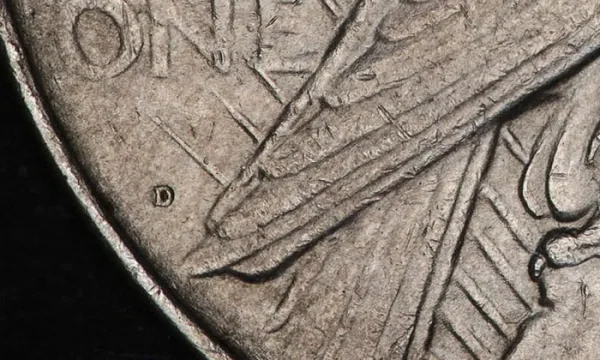
Check the reverse beside the eagle’s tail, then match your condition to the no-mark, D or S value row. Our photographs show a D example to illustrate the area, not a Philadelphia coin. The guide prices are historical retail references; compare matching recent sales before estimating what a buyer might pay.
A real 1922-D Peace dollar: both sides
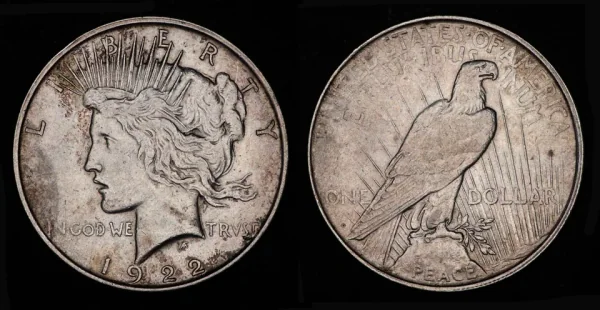
Check the year on the portrait side and the mint mark on the eagle side. Keep photographs of both together: the reverse identifies the mint, while the obverse confirms that the coin is dated 1922.
The story behind the 1922 Peace silver dollar
A dollar for a new peace
The Peace dollar replaced the Morgan dollar late in 1921, commemorating peace between the United States and Germany after World War I. Anthony de Francisci’s design gives Liberty a crown of rays. On the other side, an eagle rests with an olive branch above the word PEACE, facing the light of a new day.
That imagery connects the two sides: Liberty’s rays and the rising light around the eagle make an ordinary circulating coin a statement about the future. A well-worn example still carries that story, even when it has no exceptional collector premium.
Why 1922 looks different from 1921
The original high-relief design was difficult to manufacture and put stress on the dies. In 1922, relief was lowered for large-scale production. The usual 1922 dollar is therefore the low-relief circulation issue. Rare 1922 Proofs exist in both relief styles and require specialist attribution.
For the earlier transition year, use our 1921 silver dollar guide, which separates Morgan and Peace dollars. Prices for those coins should not be transferred to a common 1922 Peace dollar.
| Feature | Specification |
|---|---|
| Denomination | United States, one dollar |
| Composition | 90% silver, 10% copper |
| Standard weight | 26.73 g |
| Diameter / edge | 38.1 mm / reeded |
| Fine silver content | Approximately 0.7734 troy ounce |
| Designer | Anthony de Francisci |
The 1924 Peace dollar guide compares Philadelphia and San Francisco prices and shows why the S premium changes sharply with grade.
Use the Peace dollar series overview to compare original silver content, design eras and the available year guides.
Identify the mint mark and normal details
No mint mark, D or S?
On a Peace dollar, the mint mark is on the reverse near the tip of the eagle’s tail. Philadelphia coins have no mint mark; D means Denver and S means San Francisco. The small designer’s monogram on the portrait side is not the mint mark.
| Mark | Mint | Reported mintage |
|---|---|---|
| None | Philadelphia | 51,737,000 |
| D | Denver | 15,063,000 |
| S | San Francisco | 17,475,000 |
Mintage is the number made, not the number surviving at a particular grade. A smaller production total alone does not tell you what your coin will sell for.
Is “IN GOD WE TRVST” an error?
No. The V-shaped letter is the intended lettering for U. It appears on normal Peace dollars and does not create a rare spelling error. Judge a claimed variety by its specific documented features, not an unfamiliar-looking letter.
Is it a rare high-relief coin or Proof?
Start with the ordinary low-relief issue unless there is evidence for a specialist attribution. A bright surface, bold photograph or seller’s label is not enough to establish Proof manufacture or a rare relief type. If a substantial premium depends on that claim, obtain an expert examination before using a rare-coin price.
No mint mark: what should a 1922 Philadelphia dollar show?
The same small area beside the eagle’s tail is blank instead of carrying the D visible in our close-up. Check that area in clear light before treating a weak or obscured letter as absent. The obverse designer’s monogram is not the mint mark. Once the issue is established, compare the no-mark, D and S value rows at the same grade.
1922 Peace dollar value by mint and grade
NGC retail guide snapshot, October 14, 2026, in US dollars. The figures below apply to standard issues in the stated grades; they exclude special varieties, Proofs, plus grades and problem coins. Retail estimates are different from a dealer’s buying offer.
| Issue | Good | Extremely Fine | AU58 | MS63 | MS65 |
|---|---|---|---|---|---|
| 1922 · no mark | $53 | $56 | $61 | $115 | $175 |
| 1922-D | $53 | $56 | $61 | $125 | $575 |
| 1922-S | $53 | $56 | $61 | $135 | $1,500 |
AU means About Uncirculated; MS means Mint State, with no circulation wear. The number specifies the grade. Use our coin grading scale guide for the distinctions rather than estimating a numerical grade from brightness.
Why condition changes the comparison
Philadelphia’s 1922 issue is widely available in uncirculated grades. San Francisco coins often show weaker striking detail and become much harder to find in gem condition. This helps explain why a small change in a high grade can matter more than the date itself.
For your own coin, examine both the high points and the open fields. Flat detail may reflect strike quality or wear; it should not be assessed in isolation. Scratches, polishing and altered surfaces also make an apparently similar coin a poor price match. Our guide to identifying cleaned coins explains those surface clues.
Silver value is a useful cross-check
A standard Peace dollar contains approximately 0.7734 troy ounce of silver. Multiply that by the current silver price per troy ounce to estimate its metal content value. For illustration only, a $60 silver price would imply about $46.40 of silver. This is a calculation, not a live quote or guaranteed cash offer; collector premiums and transaction costs are separate.
Use sold examples that actually match
Search completed auction records by date, mint mark and grade together—for example, 1922-D Peace dollar MS63. Then compare the photographs, certification, sale date and any stated surface problems. Check whether the total includes a buyer’s premium. Several recent comparable sales are more useful than one unusually expensive result or an unsold listing.
A raw coin described as “uncirculated” is not automatically equivalent to a certified gem. When the expected premium is substantial, compare the likely benefit of grading with its fees. Our coin appraisal guide covers choosing an appropriate valuation route.
Use HeriBase to organize the identification
Photograph both sides in clear, even light and use HeriBase as a starting point for identifying the coin. Check the returned date and issue against the visible D, S or blank mint-mark area. See the HeriBase user guide for the workflow. An image-based result does not establish a certified grade, rare Proof status or a guaranteed selling price.
Choose the no-mark, D or S price row
A normal 1922 silver dollar is a Peace dollar; no mint mark means Philadelphia and does not make it rare. The October 14, 2026 NGC table gives $53–$61 across circulated grades for the standard issues, while MS63 references are $115 for no mark, $125 for D and $135 for S. These are dated retail guide estimates, not guaranteed sale proceeds.
Locate the reverse mint mark, compare the same condition in the 1922 value chart, and cross-check recent matching sales. TRVST is normal lettering, and cleaning can reduce collector appeal. Use the 1921 Morgan-versus-Peace comparison only for that different date, not to price a 1922 coin.
Frequently asked questions
Is a 1922 silver dollar with no mint mark rare?
No. No mint mark identifies the Philadelphia issue, which had a reported mintage of 51,737,000. Exceptional condition or a verified specialist attribution can matter, but a blank mint-mark area alone is normal.
Is a 1922 silver dollar real silver?
The standard genuine Peace dollar is 90% silver and 10% copper, with a standard weight of 26.73 grams. Appearance alone cannot authenticate a particular coin.
Does TRVST instead of TRUST make a Peace dollar valuable?
No. The V-shaped letter is part of the normal design. It is not a spelling error and does not add a premium by itself.
Which is worth more: a 1922, 1922-D or 1922-S dollar?
Compare the same grade and surface quality. Their circulated guide values can be similar, while high-grade Denver and San Francisco coins can command larger premiums. A mint mark alone does not establish a high value.
Should I clean my 1922 Peace dollar before selling it?
Do not clean or polish it to make it look more valuable. Altered surfaces can reduce collector demand. Photograph both sides and obtain an assessment before considering any treatment.
Is a 1922 Liberty silver dollar the same as a Peace dollar?
For the standard U.S. one-dollar coin dated 1922, yes: the portrait is Liberty, and the coin belongs to the Peace dollar series. Look for her radiating crown and the perched eagle above PEACE on the reverse. It is not a Morgan dollar; compare 1922 Peace dollar prices by mint and grade, not Morgan prices.
How much is a 1922 silver dollar worth with no mint mark?
No mint mark identifies Philadelphia. The NGC guide snapshot dated October 14, 2026 lists $53 in Good, $56 in Extremely Fine, $61 at AU58, $115 at MS63 and $175 at MS65. These are grade-specific retail guide estimates for the standard issue, not current offers. Cleaning, damage and a different grade change the comparison.
References
- NGC · Peace dollar price guideStandard 1922, 1922-D and 1922-S grade rows, updated October 14, 2026. Retail estimates, not individual sale results.
- NGC · Face Value: 1922 Peace DollarMintages, mint-mark location and relief/Proof context. Its 2022 price quotations are not used in the price table.
- PCGS CoinFacts · 1922 Peace dollarComposition, size, designer and Philadelphia availability.
- NGC · 1922-S Peace dollarSan Francisco strike quality and gem-condition scarcity.
- NGC · 1922 coin specificationsFine silver content and physical specifications.
- U.S. Mint · One Hundred Years of Silver Dollar CoinageThe transition from Morgan to Peace dollars and the meaning of de Francisci’s designs.
- Atlanta Gold & Coin · TRVST letteringExplanation of the normal V-shaped letter in the motto.