

 App Store

COIN VALUE GUIDES · DOLLARS
1776–1976 Dollar Value:No Mint Mark, D & S Price Chart
Identify your Bicentennial Eisenhower dollar as clad or 40% silver. Compare no-mark, D and S issues, Type 1 and Type 2, and the right grade.
 HeriBase TeamPublished Updated
In this article
What is a 1776–1976 dollar worth: no mark, D or S?
A common worn Bicentennial Eisenhower dollar with no mint mark or D usually starts at its $1 face value. These circulation issues are copper-nickel clad, not silver. S coins need another check: San Francisco made clad Proofs, 40% silver collector strikes and 40% silver Proofs.
Uncirculated and Proof coins use different price rows. NumisMedia's guide, updated November 4, 2026 and checked November 12, lists D Type 1 at $7.20 in Mint State 63 (MS63) and $25 in MS65; D Type 2 is $6.60 and $23.75. The S silver collector strike is $22.80 at MS63. These are guide estimates, not offers for an ungraded coin.
Match metal and Type 1/Type 2 lettering, then use the regular-strike or Proof value chart. The dual date is a normal anniversary feature, and an S alone does not prove that a coin contains silver.
Recognize the Bicentennial dollar
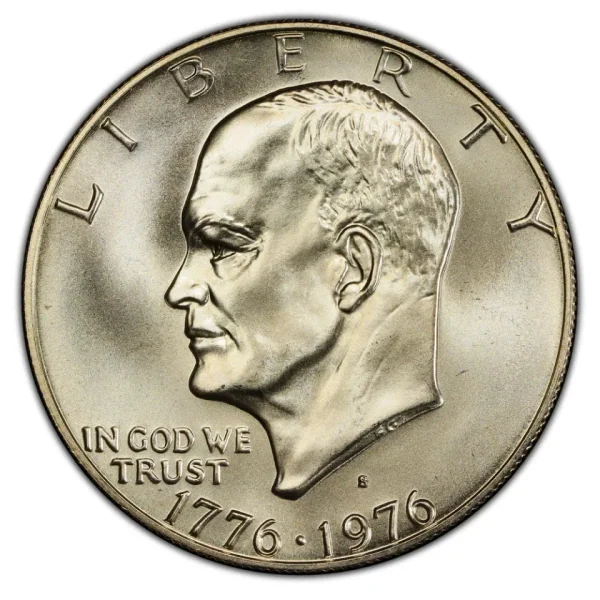
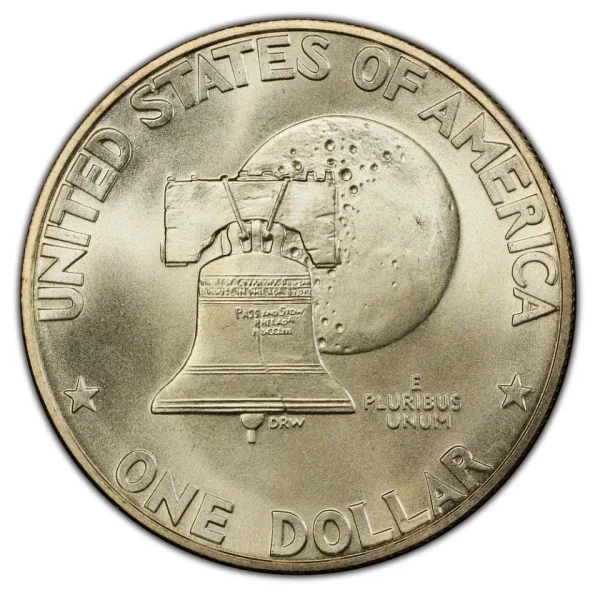
Why one date spans two production years
The dollar’s special reverse was part of the celebration of two hundred years of American independence. Dennis R. Williams designed the Liberty Bell and Moon combination, replacing the earlier eagle reverse for the Bicentennial coinage. The familiar Eisenhower portrait remained on the front.
Production occurred in 1975 and 1976, with the same 1776–1976 dual date. This is why a regular 1975-dated Eisenhower dollar is absent from a date collection. The Mint also changed the quarter and half-dollar reverses for the anniversary; the Bicentennial half-dollar guide covers the smaller Kennedy coin with Independence Hall.
| Feature | What to check |
|---|---|
| Denomination | One dollar |
| Portrait / special reverse | Eisenhower / Liberty Bell and Moon |
| Normal P and D composition | Copper-nickel clad, no silver |
| Normal S collector choices | Clad Proof; 40% silver regular strike or Proof |
| Clad / silver nominal weight | Approximately 22.7 g / 24.6 g |
| Fine silver in 40% issue | Approximately 0.3161 troy ounce |
| Edge | Reeded |
The Eisenhower series overview explains the surrounding years; the 1974 dollar guide shows the preceding eagle reverse.
Type 1 versus Type 2: read the reverse lettering
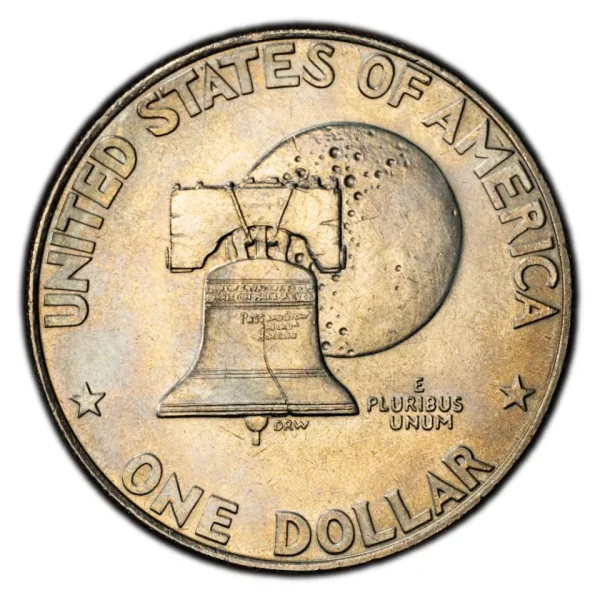
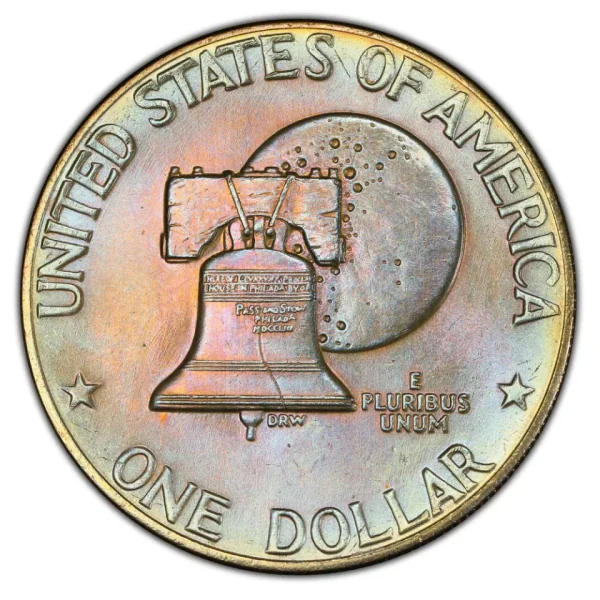
| Mint / issue | Metal | Lettering | Finish | How to compare |
|---|---|---|---|---|
| No mark or D | Clad | Type 1 or Type 2 | Regular strike | Match mint, type and grade |
| S clad collector coin | Clad | Type 1 or Type 2 | Proof | Match type, Proof grade and contrast |
| S silver collector coin | 40% silver | Type 1 for normal public issues | Regular strike or Proof | Match silver and finish |
Type 1 uses broad, block-like reverse letters; Type 2 uses finer letters with serifs. Inspect UNITED STATES OF AMERICA and ONE DOLLAR, rather than relying on a vague impression of the bell. These are intended design varieties, not errors.
Type and metal answer different questions. A Type 1 is not automatically silver, and an S is not automatically silver either. The normal silver issues sold to the public used Type 1. A claim involving an unusual presentation piece belongs to specialist authentication, not an ordinary pocket-change price comparison.
Three checks before using a price
1. Confirm the denomination and dual date. The dollar has Eisenhower and the Liberty Bell/Moon reverse. A quarter with a drummer or a half dollar with Independence Hall needs its own chart.
2. Identify mint, metal and finish. Read the mark above the date. A copper-colored edge band and a weight near the clad specification support a clad identification. Packaging or reliable certification can help separate silver regular strikes from Proofs, but the coin must match the description.
3. Read the lettering and assess condition. Use the reverse comparison above, then evaluate wear, marks and original surface quality. Do not clean the coin to make the letters more distinct. The condition guide explains the grade terms used below.
1776–1976 dollar value charts by mint and finish
Use the regular-strike table for no-mark/D clad coins or the S silver collector strike, and the Proof table for S Proofs. The following NumisMedia Fair Market Value (FMV) snapshots were checked November 12, 2026; the source states November 4, 2026 as its update date. Prices are USD guide estimates for genuine coins in the specified grade, not completed sales or guaranteed buying offers.
No mint mark, D and S silver regular strikes
| Issue | Metal | MS63 | MS64 | MS65 |
|---|---|---|---|---|
| No mark · Type 1 | Clad | $10.20 | $20.00 | $105.00 |
| No mark · Type 2 | Clad | $6.60 | $11.25 | $25.00 |
| D · Type 1 | Clad | $7.20 | $10.00 | $25.00 |
| D · Type 2 | Clad | $6.60 | $10.00 | $23.75 |
| S · silver collector strike | 40% silver | $22.80 | $23.75 | $24.06 |
MS means Mint State, with no circulation wear. An ordinary worn clad coin should not be assigned the MS63 price. Type 1 versus Type 2 is a lettering distinction, not a silver test; use the photographs above before selecting a row.
S clad and silver Proofs
| S issue | Contrast category | PR63 | PR64 | PR65 |
|---|---|---|---|---|
| Clad · Type 1 | Standard Proof | $7.20 | $9.38 | $10.00 |
| Clad · Type 2 | Standard Proof | $7.80 | $10.00 | $10.63 |
| Silver | Standard Proof | $22.80 | $23.75 | $24.38 |
| Clad · Type 1 | Deep Cameo | $9.60 | $11.25 | $12.50 |
| Clad · Type 2 | Deep Cameo | $10.80 | $11.88 | $12.50 |
| Silver | Deep Cameo | $24.00 | $25.00 | $25.63 |
PR means Proof grade. Deep Cameo describes strong frosted-design/mirrored-field contrast and must match the coin's designation; it is not another metal. These selected grades do not establish prices for PR69 or PR70, and the table does not price the separate Cameo category. A raw shiny coin cannot automatically be treated as a certified Proof.
For silver content alone, multiply approximately 0.3161 troy ounce by a dated silver price. Collector prices, metal value and selling fees are different measures; do not add the full guide price to melt value. For the surrounding years, use the Eisenhower dollar series guide.
Identify the Bicentennial version before the price
No-mark and D circulation dollars are clad; common worn examples generally start at $1. An S requires a separate clad/silver and regular-strike/Proof identification. The date 1776–1976 and Type 1/Type 2 lettering do not themselves prove silver or a mint error.
Read the mark, match the lettering and finish, then compare the same grade in the regular-strike or Proof chart. The dated MS63 references include $7.20 for D Type 1, $6.60 for D Type 2 and $22.80 for the S silver collector strike. Confirm against matching sales before selling, and do not apply a collector-grade price to worn clad change.
Frequently asked questions
Is a 1776–1976 dollar made of silver?
Most circulation coins are copper-nickel clad. Normal 40% silver collector issues bear S, but S clad Proofs also exist. Confirm the metal and finish before estimating value.
What is the difference between Type 1 and Type 2 Bicentennial dollars?
Type 1 has heavier, blockier reverse lettering. Type 2 has thinner lettering with serifs. The distinction is most easily checked in UNITED STATES OF AMERICA and ONE DOLLAR.
Why does my dollar say 1776–1976?
The dates commemorate two hundred years of American independence. The Bicentennial coins were produced in 1975 and 1976; the first date is not the coin’s production year.
What is a no-mint-mark 1976 dollar worth?
Common worn clad examples start at $1. NumisMedia's November 4, 2026 guide lists no-mark Type 1 at $10.20 in MS63 and $105 in MS65, versus $6.60 and $25 for Type 2. These are guide estimates for matching uncirculated grades, not sale guarantees.
What is a 1976-D dollar worth?
A common worn clad 1976-D dollar starts at $1. In the NumisMedia November 4, 2026 guide, Type 1 is $7.20 at MS63 and $25 at MS65; Type 2 is $6.60 and $23.75. Identify the reverse lettering and match the actual grade before using those collector references.
References
Sources
Issue references checked November 12, 2026. The value tables use the NumisMedia guide update dated November 4, 2026; they are guide estimates, not transactions.
- NumisMedia · Eisenhower dollar Collector FMV guideRegular strikes and standard/Deep Cameo Proof comparisons, source update November 4, 2026.
- U.S. Mint · Bicentennial coinageThe anniversary program and Dennis Williams reverse.
- PCGS · Type 1 and Type 2Lettering diagnostics and issue scope.
- PCGS · Philadelphia Type 1Clad regular-strike prices.
- PCGS · Philadelphia Type 2Separate type and grade comparisons.
- PCGS · 1976-S silver regular strikeSilver collector specifications and guide.
- PCGS · Denver Type 1Issue and composition identification; separate from the FMV table source.
- PCGS · Denver Type 2Issue and composition identification; separate from the FMV table source.
- PCGS · S clad Proof Type 1Issue and composition identification; separate from the FMV table source.
- PCGS · S clad Proof Type 2Issue and composition identification; separate from the FMV table source.
- PCGS · S silver ProofIssue and composition identification; separate from the FMV table source.