

 App Store

COIN VALUE GUIDES · QUARTERS
1968 Quarter Value:No Mint Mark, D and S Proof
Find the mint mark on a 1968 Washington quarter, confirm its clad composition and compare Philadelphia, Denver and San Francisco Proof values.
 HeriBase Editorial TeamUpdated
In this article
Quick answer
An ordinary worn 1968 Washington quarter is generally worth 25 cents. The standard issues are copper-nickel clad. Philadelphia and Denver made regular strikes. San Francisco issued Proofs for collectors.
PCGS lists $18 and $10 in Mint State 65 (MS65) for the Philadelphia and Denver issues respectively. Its MS66 quotes are $32 and $16. Compare coins of the same mint and grade before using either figure.
Coin photos
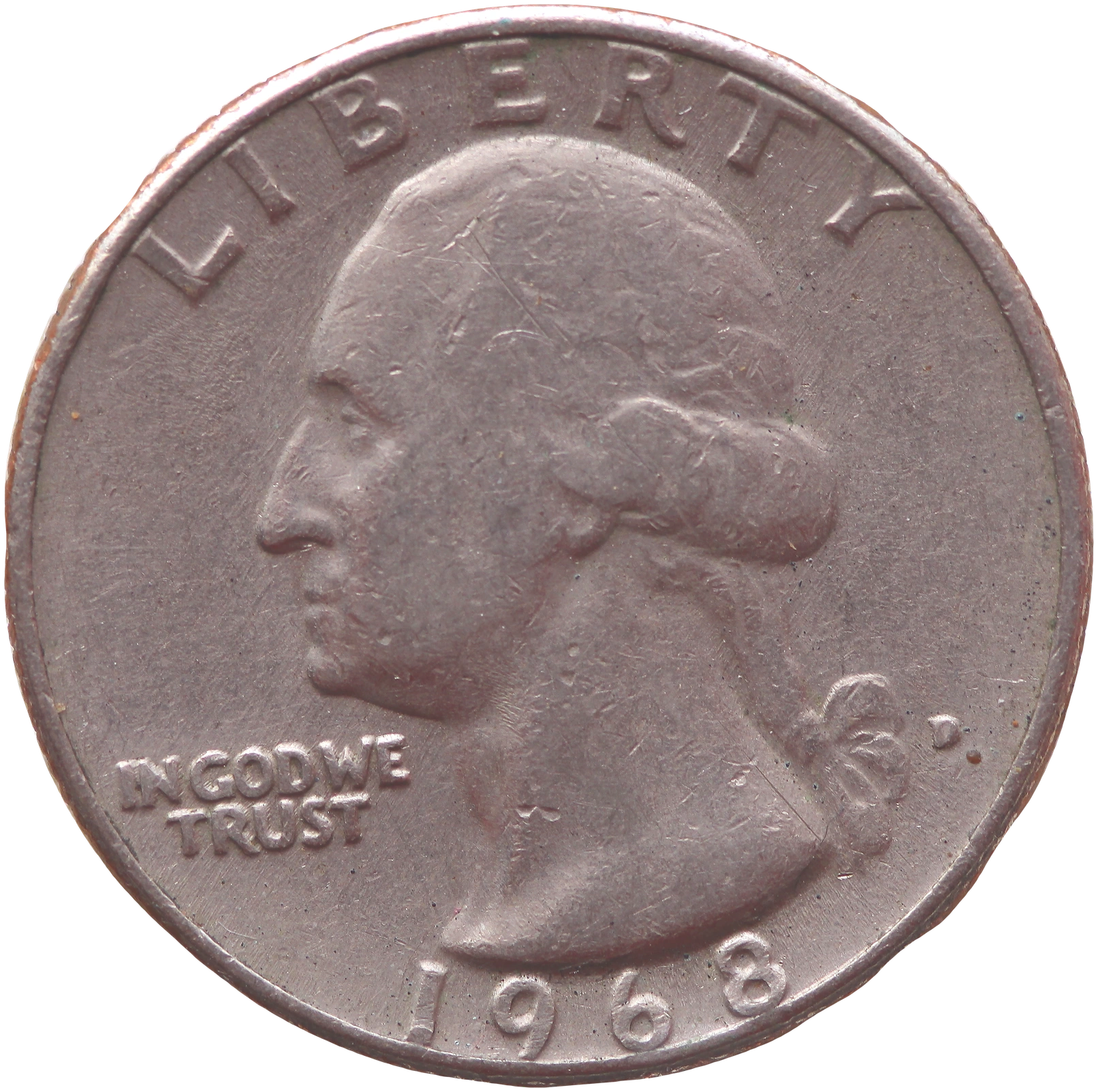
Coin photography by Mark Morgan from Trinidad (CC BY 2.0, the original). Cropped and resized.

Basics & coin story
The Mint omitted mint marks on circulating quarters dated 1965 through 1967. Denver’s D returned in 1968, at the new obverse position, while Philadelphia stayed unmarked. San Francisco produced the S Proof.
Both sides use John Flanagan’s design. The Washington quarter series guide shows the earlier reverse mint-mark position and the switch to clad coinage.
| Feature | What to check |
|---|---|
| Alloy | Copper-nickel outer layers over a copper core |
| Nominal weight / diameter | 5.67 g / 24.30 mm |
| Regular strikes | Philadelphia (No Mint Mark) and Denver (D) |
| Collector strike | San Francisco S Proof |
| Mint-mark position | Obverse, beside the hair ribbon |
Identification
Read the small field beside the ribbon
Confirm 1968 below the portrait. A D to the right of the ribbon is expected on Denver pieces, while a clear blank is expected for Philadelphia. The earlier silver quarter mint mark was on the reverse.
Check whether the high points are worn
Tilt the coin under one lamp. Compare the sheen on Washington’s cheek and temple with the protected area by the ribbon. Do the same on the eagle’s breast. Localized dullness can show circulation friction. Scratches and contact marks can also lower the grade.
Check a possible Proof or mint error
Look for the S, rim definition and finish together when checking a Proof. For a suspected off-center strike, look for a blank arc and missing design. A scraped rim or unusual shine alone offers little evidence.
Condition & value
Amounts are in U.S. dollars. Retail guide values are estimates for the stated grade, mint and designation. A dated sale is a record of one coin. Neither is a guaranteed purchase offer.
| Issue | Grade / condition | Value or reference | Basis | Important condition |
|---|---|---|---|---|
| Philadelphia or Denver | Ordinary worn | $0.25 | Face value | Normal circulation strike |
| Philadelphia | MS65 / MS66 | $18 / $32 | PCGS Price Guide, checked Nov. 24, 2026 | Certified regular strike |
| Denver | MS65 / MS66 | $10 / $16 | PCGS Price Guide, checked Nov. 24, 2026 | Certified regular strike |
| 1968-S | Proof | Compare like PR grade and contrast | Proof issue | Separate collector strike |
Summary
Identify the mint beside the ribbon. If your 1968 quarter has original luster and no wear, compare the exact mint and grade. Use a Proof or error comparison only after confirming the issue.
Frequently asked questions
Is a 1968 quarter silver?
The regular and normal Proof issues use copper-nickel clad over a copper core.
Where is the mint mark on a 1968 quarter?
Look on the portrait side just to the right of Washington’s hair ribbon.
Is a 1968 quarter without a mint mark rare?
No mint mark is standard for the Philadelphia regular strike. Evaluate the coin’s condition and any separately attributed error.
What makes a 1968 quarter worth over face value?
Uncirculated condition, an attributed mint error or a collector Proof can support a different comparison. Match the exact issue and condition.