

 App Store

COIN VALUE GUIDES · DIMES
1967 Roosevelt Dime Value:No Mint Mark, Clad, SMS and Full Bands
Learn why a 1967 Roosevelt dime has no mint mark, how to compare a circulation strike with an SMS coin, and how Full Bands affects grade-based prices.
 HeriBase Editorial TeamUpdated
In this article
Quick answer
A normal circulated 1967 Roosevelt dime is a copper-nickel clad ten-cent coin. The Mint left the mint mark off dimes dated 1965–1967, so a blank area on a 1967 dime is expected.
The PCGS regular-strike guide lists $8 in MS65 and $26 in MS65 FB. Coins attributed as Special Mint Set strikes have their own listings and use a different comparison.
Coin photos
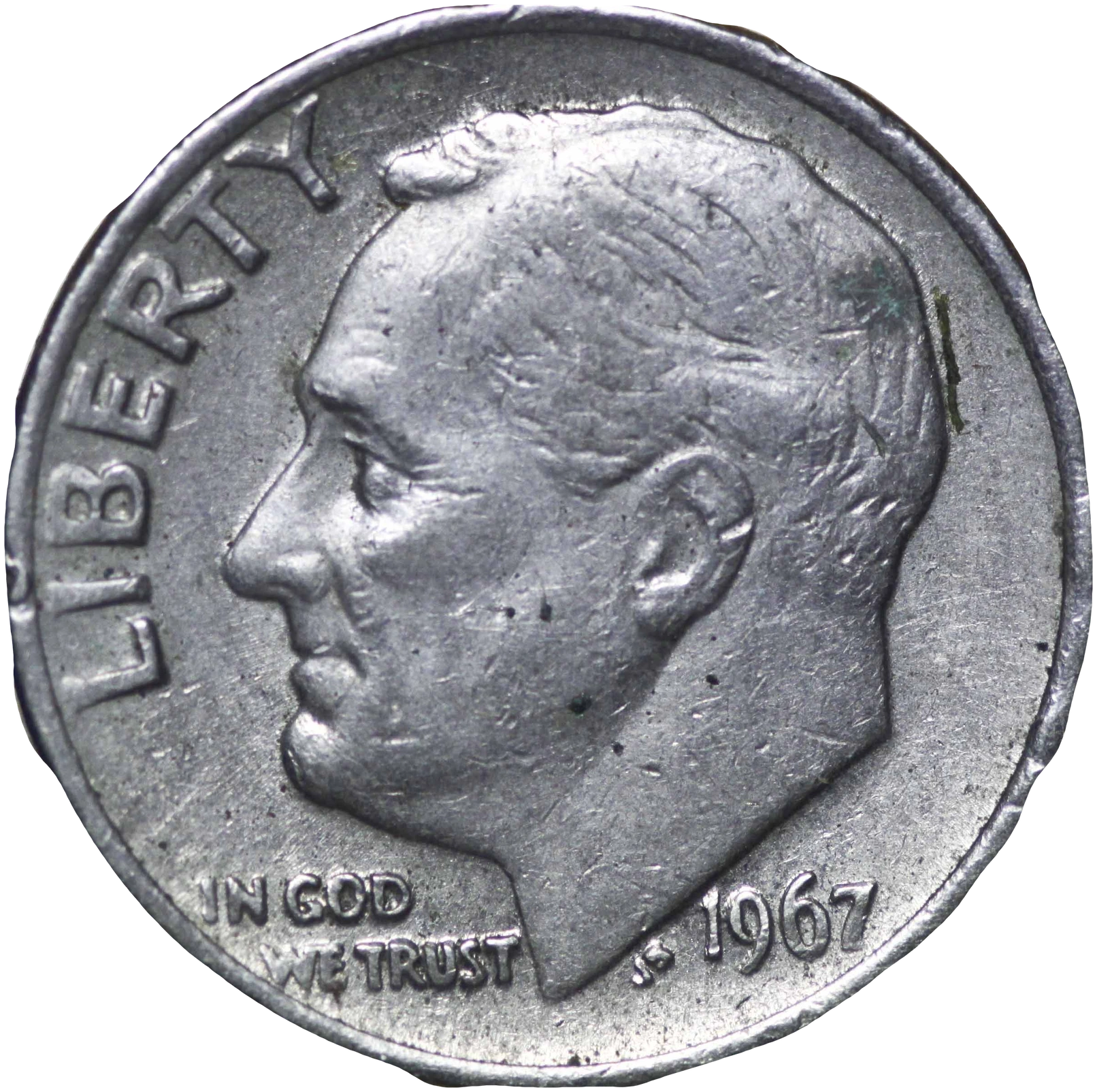
Coin photography by Mark Morgan from Trinidad (CC BY 2.0, the original). Cropped and resized.

Basics & coin story
The ordinary dime switched from silver to copper-nickel clad with the 1965 date. A 1967 dime retained the torch, olive branch and oak branch reverse of the earlier series. The familiar design can make the metal difference easy to overlook.
The Mint offered Special Mint Sets during the 1965–1967 period. An SMS dime can have different surface and strike characteristics from a circulation coin. Use the Roosevelt dime series guide for other dates.
| Feature | What to check |
|---|---|
| Composition | Copper-nickel clad over a copper core |
| Nominal weight / diameter | 2.27 g / 17.9 mm |
| Mint mark | None on standard 1967 dimes |
| Collector strike | Special Mint Set (SMS) |
| PCGS FB | Distinct separation at both sets of torch bands |
Identification
Start with the edge and weight
A warm copper stripe is typical of a clad edge. Under good light, inspect the full edge and record weight on a calibrated scale. An unusual color alone is weak evidence of a composition error.
Check a suspected mint error
A genuine off-center strike has a blank arc accompanied by missing design. If you suspect the wrong planchet, compare weight, diameter, edge and retained design together. Ring damage and coatings can change a dime’s appearance. Use attributed sales for the same error and keep them outside the regular-strike price table.
Check torch detail at both ends
Inspect the top and bottom horizontal bands of the reverse torch. Interruption from a mark or an incomplete split can affect FB attribution. NGC’s Full Torch criteria use a different designation.
Use provenance to identify an SMS dime
Original set packaging or a grading label can help separate an SMS strike from a shiny circulation coin. Look at the fields and devices under angled light before selecting the price category.
Condition & value
Amounts are in U.S. dollars. Retail guide values are estimates for the stated grade, mint and designation. A dated sale is a record of one coin. Neither is a guaranteed purchase offer.
| Issue | Grade / condition | Value or reference | Basis | Important condition |
|---|---|---|---|---|
| 1967 regular strike | Ordinary circulated | $0.10 | Face value | Expected no-mint-mark coin |
| 1967 regular strike | MS65 | $8 | PCGS Price Guide, checked Nov. 24, 2026 | Without FB |
| 1967 regular strike | MS65 FB | $26 | PCGS Price Guide, checked Nov. 24, 2026 | With PCGS Full Bands |
| 1967 SMS | Attributed strike | Match SP grade and designation | Separate collector issue | Use the SMS listing |
Summary
Treat the blank mint-mark field as normal. Check edge, weight and finish before comparing the condition and torch designation.
Frequently asked questions
Is a 1967 dime silver?
A standard 1967 Roosevelt dime is copper-nickel clad. Both regular and SMS versions use clad composition.
Does no mint mark make it rare?
No mint mark is normal for dimes dated 1967.
How can I tell whether a 1967 dime is SMS?
Start with documentation or original set provenance. Strike and surface characteristics can help, but brightness alone is inconclusive.
What does Full Bands mean on a Roosevelt dime?
In PCGS grading, the horizontal bands must be distinctly separated at the top and bottom of the reverse torch.