

 App Store

COIN VALUE GUIDES · HALF DOLLARS
1943 Half Dollar Value:Walking Liberty P, D and S Silver Coins
Identify a 1943 Walking Liberty half dollar and compare ordinary Philadelphia and Denver pieces with the 1943-S and its Missing Initials variety.
 HeriBase Editorial TeamUpdated
In this article
Quick answer
A 1943 Walking Liberty half dollar contains 90% silver, about 0.3617 troy ounce fine silver at nominal weight. The PCGS retail guide checked November 24, 2026 lists ordinary Philadelphia, D and S examples at $40 in G4.
The same guide lists $180 for Philadelphia and D at MS65 and $225 for 1943-S at MS65. Those are grade-specific estimates. A 1943-S with the Missing Initials designation needs independent attribution and a different comparison.
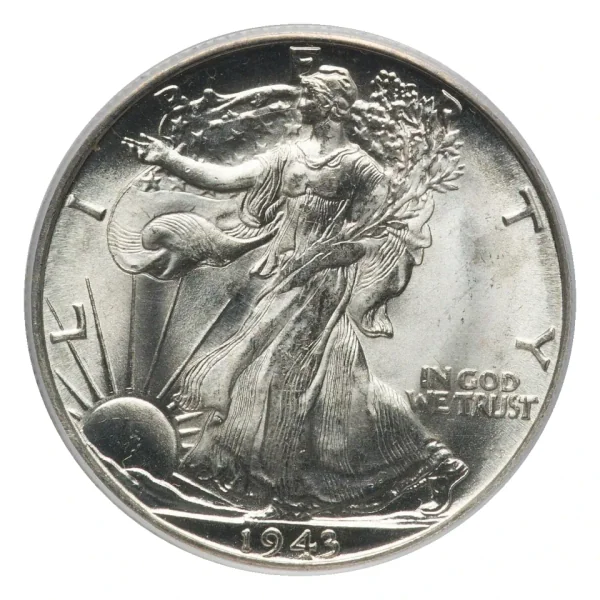
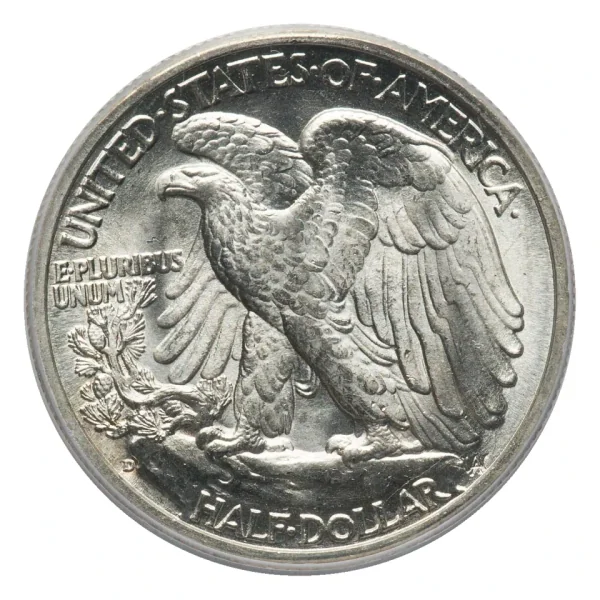
Coin photos
Basics & coin story
Philadelphia struck 53,190,000 Walking Liberty halves dated 1943, the series’ largest regular-strike mintage. Weinman’s Liberty-with-branches design and the eagle reverse distinguish it from later Franklin and Kennedy half dollars. This year produced circulation strikes; the preceding Proof program ended in 1942.
Availability in circulation grades is different from availability at the top of the grading scale. PCGS notes that a sharply defined 1943-S can be harder to find. Use the Walking Liberty series guide for examples of strike, wear and value differences.
| Feature | What to check |
|---|---|
| Metal | 90% silver, 10% copper |
| Nominal weight | 12.50 g |
| Fine silver | About 0.3617 troy oz |
| Mint mark | Blank, D or S at the lower left of the reverse rock |
| Designer | Adolph A. Weinman |
Identification
Find the mint beside the eagle’s rock
Turn to the eagle side and check the small area left of the rock. Use angled light on a worn coin: the D or S can fade into the nearby design. A clear blank area is expected on a Philadelphia example.
Check strike before assigning wear
On some 1943-S coins Liberty’s hand is weakly defined. Look for original luster and evidence of friction on multiple points before calling the coin worn or assigning a high grade.
Keep Missing Initials claims separate
PCGS lists an attributed 1943-S Missing Initials FS-901. Match the exact reverse to an attributed specimen. A weak or damaged area by itself is not evidence of that die variety.
Condition & value
Amounts are in U.S. dollars. Retail guide values are estimates for the stated grade, mint and designation. A dated sale is a record of one coin. Neither is a guaranteed purchase offer.
| Issue | Grade / condition | Value or reference | Basis | Important condition |
|---|---|---|---|---|
| 1943, 1943-D, 1943-S | G4 | $40 each | PCGS guide | Same circulated grade |
| 1943 or 1943-D | MS63 / MS65 | $120 / $180 | PCGS guide | Normal regular strikes |
| 1943-S | MS65 | $225 | PCGS guide | Strike and surfaces can affect desirability |
| 1943 Philadelphia | MS65 | $129 | Stack’s Bowers, Jun. 2026, lot 6887 | Actual reported sale for one coin |
| Any standard issue | Nominal fine silver | 0.3617 × silver price per troy oz | Metal calculation | Not a dealer offer |
Summary
Separate the silver-content benchmark from the price of an attributed coin. Read the mint before comparing grade and use the dated silver price per troy ounce for the nominal silver calculation.
Frequently asked questions
How much silver is in a 1943 half dollar?
About 0.3617 troy ounce at standard full weight. The coin is 90% silver and nominally weighs 12.50 g.
Is a 1943 half dollar with no mint mark rare?
No mint mark is standard for Philadelphia, the highest-mintage Walking Liberty issue. Grade and surface quality can still affect value.
Where is the D on a 1943-D half dollar?
On the reverse beside the lower-left side of the rock where the eagle stands.
Why does a 1943-S look weak at Liberty’s hand?
Weak strike is a known issue for the date and mint. Check luster and wear elsewhere before using a numerical grade.