

 App Store

COIN VALUE GUIDES · HALF DOLLARS
1942 Half Dollar Value:Walking Liberty Mint Marks, Silver and Proofs
Compare 1942 Walking Liberty half dollar values by mint, grade and strike. Find the reverse D or S and separate Proofs from normal 90% silver coins.
 HeriBase Editorial TeamUpdated
In this article
Quick answer
A regular 1942 Walking Liberty half dollar is 90% silver, with about 0.3617 troy ounce of fine silver. A worn example has a silver-market comparison as well as a collector price. In the PCGS guide checked November 24, 2026, ordinary Philadelphia, Denver and San Francisco coins were each listed at $40 in Good 4. Those are guide figures, not dealer bids.
At higher grades, the mint and strike matter more. The same guide lists Philadelphia and Denver at $180 in MS65, compared with $325 for 1942-S. A Philadelphia Proof and the cataloged FS-801 doubled die reverse belong in separate price categories.
Coin photos
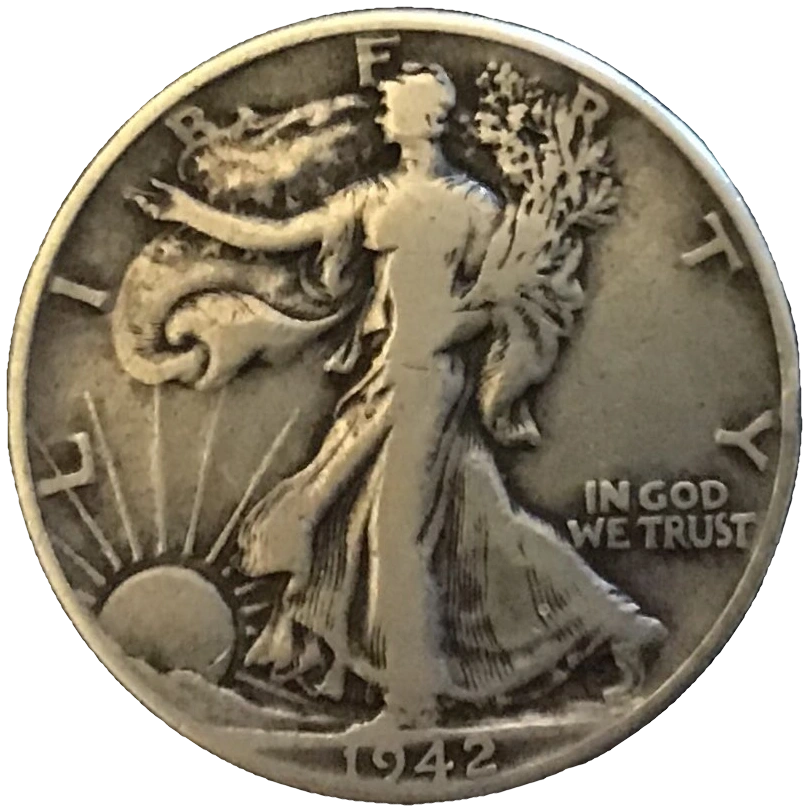
Coin photography by BrayLockBoy (CC BY-SA 4.0, the original). Cropped and resized.

Basics & coin story
The Walking Liberty half was introduced in 1916. Adolph A. Weinman placed Liberty walking toward the rising sun on the front and an eagle on a rocky perch on the back. The 1942 issues kept that design while the United States was issuing wartime coinage. They remained silver; the wartime composition change on the Jefferson nickel did not apply to this denomination.
Circulation strikes came from three mints. Philadelphia also made Proofs for collectors, the final year of the 1936–1942 Walking Liberty Proof run. Use the Walking Liberty half dollar series guide to compare other dates and grade bands.
| Feature | What to check |
|---|---|
| Denomination | 50 cents |
| Alloy | 90% silver, 10% copper |
| Nominal weight | 12.50 g |
| Fine silver | About 0.3617 troy oz |
| Mint mark | Reverse, beside the rock below the eagle; blank, D or S |
Identification
Read the reverse before selecting a mint
Turn the coin over and look to the left of the rock, above the lower rim. A blank space is normal for Philadelphia. D denotes Denver and S denotes San Francisco. Examine the field under angled light before deciding whether a faint letter is present.
Separate a bright regular strike from a Proof
A shiny surface can be from original luster, polishing or Proof manufacture. Look at the strike, edge and fields together. Use a reliable attribution for a Proof or FS-801 claim; an isolated doubled-looking letter is insufficient.
Condition & value
Amounts are in U.S. dollars. Retail guide values are estimates for the stated grade, mint and designation. A dated sale is a record of one coin. Neither is a guaranteed purchase offer.
| Issue | Grade / condition | Value or reference | Basis | Important condition |
|---|---|---|---|---|
| 1942 Philadelphia, Denver or San Francisco | G4 | $40 each | PCGS guide | Regular strikes of the same circulated grade |
| 1942 or 1942-D | MS65 | $180 each | PCGS guide | Problem-free circulation strikes |
| 1942-S | MS65 | $325 | PCGS guide | Compare strike sharpness and surfaces |
| 1942 Philadelphia | MS65 | $105 | Stack’s Bowers, Nov. 2024, lot 90209 | One reported sale; distinct from retail estimate |
| Any standard 1942 half | Nominal fine silver | 0.3617 × silver price per troy oz | Metal calculation | Wear and dealer spreads affect real proceeds |
Summary
Confirm the reverse mint mark and whether the piece is a regular strike, Proof or attributed variety. Calculate nominal silver with the dated silver price per troy ounce and use sold examples with the same grade and mint for the collector comparison.
Frequently asked questions
Is a 1942 half dollar real silver?
Standard 1942 Walking Liberty halves are 90% silver and contain about 0.3617 troy ounce of fine silver at nominal weight.
Where is the mint mark on a 1942 half dollar?
Look left of the rock on the reverse. D is Denver, S is San Francisco and a blank space is normal for Philadelphia.
Are 1942-S halves always worth more?
The difference depends on grade and strike. The cited PCGS guide is equal in G4 across mints but lists a higher 1942-S figure in MS65.
Is every bright 1942 half a Proof?
No. Use strike and surface diagnostics or documented attribution. Luster, polishing and Proof reflectivity are different.